Crockery Unit Design Ideas: 30+ Modern, Wall-Mounted & Modular Designs with Size Guide
Explore 30+ crockery unit designs—wall-mounted, modular & glass door options. Get size guide, material tips & storage solutions for dining areas.
Quick Answer: What Makes a Good Crockery Unit Design?
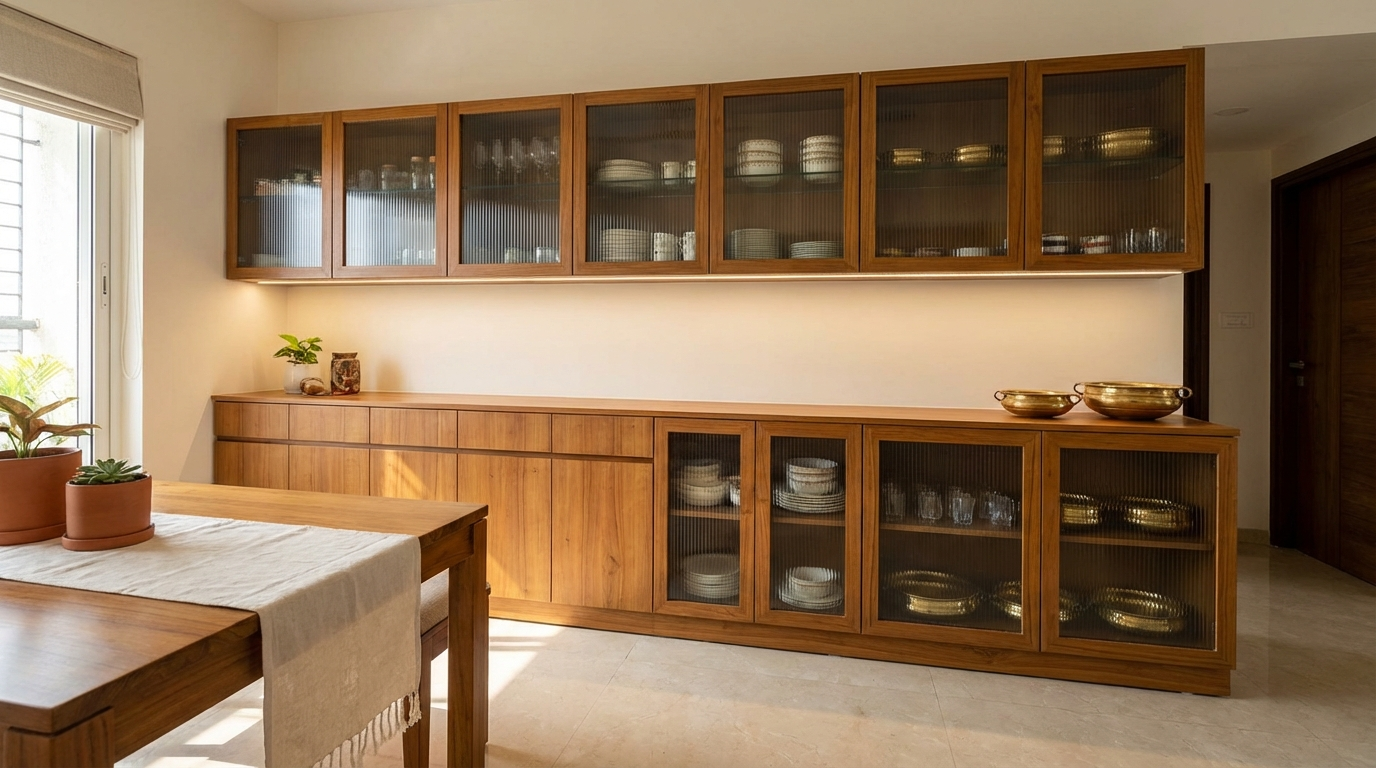
A good crockery unit design balances display space with practical storage while using materials suited to your local humidity and usage patterns.
Short version: Most crockery units fail because people prioritize looks over function. You need the right core material (BWP plywood for humid cities, MR grade for dry regions), proper depth for your dinnerware sizes, and glass doors only where you'll actually keep things dust-free. The best designs mix open display shelves with closed storage—roughly 40% open, 60% closed works for most Indian homes.
This is right for you if:
- You're building a new dining area or renovating one
- Your current crockery storage is a mess of stacked plates in kitchen cabinets that you dread opening
- You want to display your nice dinnerware without it collecting dust or getting knocked over
- You've got wall space near the dining table going to waste
Skip this if:
- You eat out most days and own maybe 6 plates total
- You're renting and can't make permanent changes
- Lower cabinets: 16-18 inches (for large items, appliances)
- Upper cabinets: 12-14 inches (plates, glasses, lighter items)
- Display shelves: 10-12 inches (just deep enough to show, not store)
- Dinner plates standing vertical: 12 inches minimum
- Standard glasses: 8-9 inches
- Wine glasses: 10-11 inches
- Serving bowls: 10-12 inches
- Thalis (full size): 14-15 inches if stacked flat
- Glass-fronted cabinets for display pieces—the china set you're proud of
- Open shelves for decorative items (if you're willing to dust them)
- Internal LED strip lighting—makes a huge difference after sunset
- Most accessible zone—everyday dinnerware goes here
- Pull-out drawers for cutlery, napkins, placemats
- Plate organizers (vertical storage fits more than stacking)
- Deep cabinets for large serving dishes, pressure cookers you only use occasionally
- Pull-out baskets work better than fixed shelves here—easier to reach items at the back
- Consider one section for table linens if you don't have dedicated storage elsewhere
- Particle board with laminate: ₹600-900/sq ft
- MR plywood (12-15mm) with laminate: ₹900-1,400/sq ft
- BWP plywood with laminate: ₹1,200-1,800/sq ft
- BWP plywood with veneer finish: ₹1,600-2,400/sq ft
- Glass doors (tempered, 6mm): Add ₹350-500 per sq ft for glass portions
- Soft-close hinges: ₹150-300 per door (versus ₹40-80 for basic hinges)
- Internal LED lighting: ₹800-2,000 per light strip with transformer
- Drawer runners (telescopic full-extension): ₹400-900 per drawer
- Pull-out baskets: ₹1,200-3,000 each depending on size and brand
- Basic 4-foot unit, MR ply, minimal hardware: ₹35,000-50,000
- Mid-range 6-foot unit, BWP ply, good hardware: ₹70,000-1,10,000
- Premium 8-foot unit with all the bells and whistles: ₹1,40,000-2,00,000
- Core material specification: "Use BWP/MR plywood [specify], minimum 18mm for carcass, 12mm for back panel—not hardboard."
- Edge banding: "All exposed plywood edges must have edge banding or lipping. No raw edges anywhere visible when doors are open."
- Hardware quality: "Soft-close hinges from [specify brand—Hettich, Ebco, or equivalent]. No local hinges."
- Drawer runners: "Telescopic full-extension, minimum 45kg capacity."
- Glass specifications: "6mm tempered glass only. No plain glass for doors."
- Adjustable shelves: "At least half the shelves should be removable and adjustable."
- BWP plywood unit in humid climate: 15-20 years before major issues
- MR plywood in dry climate: 12-18 years
- HDHMR unit: 10-15 years (water damage is the main risk)
- Particle board: 5-8 years (honestly, often less)
- Spills being wiped immediately versus left to soak
- Door hinges being adjusted when they start sagging (a 5-minute fix that most people skip)
- Not overloading shelves beyond their designed capacity
- Maintaining reasonable indoor humidity (if you run AC constantly, units last longer)
Bottom line: A well-designed crockery unit isn't just furniture—it's storage that actually works and looks good doing it.
What a Crockery Unit Actually Is (And Isn't)
A crockery unit is a dedicated storage cabinet designed specifically for dinnerware, serving pieces, and glassware, typically placed in or near the dining area. It combines closed cabinets, drawers, and display sections to organize everything from everyday plates to grandmother's china.
Now here's where most people get confused. They think any cabinet near the dining table qualifies. Not really. A proper crockery unit has specific internal dimensions—shelf heights calculated for dinner plates versus cups, drawer depths suited for cutlery organization, and display zones with lighting for pieces you want to show off. Your kitchen cabinet can hold plates, sure. But it wasn't designed for it.
Most people think crockery units are just dining room decor. Actually, they solve a real storage problem—keeping frequently used items accessible while protecting special occasion pieces. The display function? That's secondary, though I understand why Pinterest makes it seem like the main point.
The technical bit: good crockery units have adjustable internal shelves (because your thali won't fit where wine glasses go), soft-close hinges to protect glass doors, and proper ventilation if you're storing items that might retain moisture. The base typically sits 3-4 inches off the floor—not for aesthetics, but to protect against mop water damage over the years.
Why Crockery Unit Design Matters More in Indian Homes
Here's what nobody talks about. Indian dining isn't like Western dining. We have more variety in our dinnerware—thalis, katoris, serving bowls in six sizes, multiple chai cup sets, the "good" dinner set for guests, steel plates for daily use. A crockery unit designed for 12 dinner plates and 8 wine glasses won't cut it.
Then there's the climate factor. In Mumbai or Chennai, humidity sits between 70-85% for months. I've seen beautiful crockery units with MR grade plywood cores start warping within two monsoons. The glass doors fog up, laminate edges lift, and drawer runners rust if they're not marine-grade. In places like Jodhpur or Jaipur where humidity stays under 40% most of the year, you can get away with cheaper materials. Coastal Karnataka? Forget about cutting corners.
Joint families add another layer. My cousin's place in Kolkata has three generations eating together—they need storage for 40+ plates, not 12. Their crockery unit runs 14 feet along one wall. Meanwhile, a young couple in a Bangalore 2BHK needs something compact that doesn't eat up half their dining space.
Space constraints matter too. In places like Mumbai where dining areas often double as study rooms or home offices, your crockery unit might need to incorporate a study table extension or home bar section. The Thane side especially—I've seen some creative multipurpose designs that solve three storage problems in one unit.
Do glass doors make sense for dusty cities?
Depends on where you live. In Delhi-NCR where dust is a constant battle, glass doors seem like the obvious solution. But here's what actually happens—the glass needs cleaning every week, the hinges get grimy faster, and if you don't clean regularly, you're just displaying your dirt collection. For high-dust areas, I'd suggest glass doors only for the "display" section (maybe 30% of the unit) and solid shutters for everyday storage. Less cleaning, same result. Though if you're particular about maintaining things, glass throughout works fine.
Types of Crockery Unit Designs: What Works Where
Let me break this down by actual use cases, not just design magazines.
Wall-Mounted Crockery Units
These float on the wall without touching the floor. Best when your dining area is small or you need floor space for other furniture. A wall-mounted unit typically runs 2-4 feet wide and works well above a sideboard or console. The catch? Your wall needs to handle the weight—a fully loaded crockery unit can hit 80-100 kg. Hollow brick walls in newer apartments? You'll need serious anchoring. [beautifulhomes.asianpaints.com](https://www.beautifulhomes.asianpaints.com/interior-design-ideas/wall-mounted-crockery-unit-design.html) shows some nice examples, though honestly, most need sturdier mounting than shown.
Floor-Standing Full Units
The classic choice. Runs floor to ceiling or floor to eye level. More storage, more stability, doesn't stress your walls. Ideal for families with lots of dinnerware or those who want a statement piece. Downside—takes up floor space, harder to clean underneath, and visually heavy in small rooms.
Modular Crockery Units
Factory-made in standard sizes, assembled on-site. Faster delivery, consistent quality, but less flexibility. You're choosing from preset configurations. Works well if one of the standard sizes fits your space. If you need 7'3" and they only make 7' or 8', you're stuck with gaps or overhang.
Carpenter-Made Custom Units
Built exactly to your space and needs. Takes longer, quality depends entirely on your carpenter's skill. But you get exactly what you want—that weird corner gets utilized, the unit wraps around your window, whatever you need. If I'm being honest, I prefer this route for oddly shaped dining areas.
| Type | Best For | Space Needed | Budget Impact | Lead Time | My Take |
|---|---|---|---|---|---|
| Wall-Mounted | Small apartments, minimalist look | Minimum—no floor footprint | Medium-High (mounting adds cost) | 2-3 weeks | Great if done right, disaster if walls are weak |
| Floor-Standing | Large families, traditional homes | 4-8 feet wall length | Medium | 3-4 weeks | Still the most practical for Indian homes |
| Modular | Standard room sizes, quick move-in | Depends on configuration | Higher (brand markup) | 1-2 weeks | Convenient but inflexible |
| Custom Carpenter | Odd spaces, specific requirements | Any size you want | Variable—can be cheapest or priciest | 4-6 weeks | My preference for most projects |
Size Guide: Getting Dimensions Right
This is where most designs go wrong. People pick sizes based on available wall space, not what they need to store.
Height considerations: A standard crockery unit runs 6.5-7 feet tall. Go above 7 feet and the top shelves become unusable without a stool—nobody's climbing up to grab a serving bowl at dinner time. Below 6 feet and you're losing storage for no good reason.
Width: Depends on your collection and wall space. For a family of 4-5, you typically need 4-5 running feet minimum. Large joint families? 8-10 feet isn't excessive. I've seen [livspace.com](https://www.livspace.com/in/design-ideas/crockery-unit-designs/designs/modern-crockery-unit-design-featuring-glass-and-drawer-storage-d-incu-jas2024-1107) designs running 12 feet—looks impressive but confirm you need that much before committing.
Depth: Here's where everyone messes up. Standard depth is 12-16 inches. Too shallow and your large serving bowls won't fit. Too deep and items get lost at the back—you'll forget that casserole dish exists. My recommendation:
Internal shelf heights to get right:
A trick most designers skip—make at least two shelf heights adjustable per section. Your storage needs change over years.
Material Selection: What Holds Up and What Doesn't
The exterior finish gets all the attention, but it's the core material that determines whether your crockery unit lasts 5 years or 15.
BWP (Boiling Water Proof) Plywood
The gold standard for humid climates. Marine-grade adhesive, handles moisture well. Essential for coastal cities—Mumbai, Chennai, Kolkata, anywhere along the Konkan belt. Adds maybe 20-25% to material cost versus MR grade. Worth every rupee if you're not in Rajasthan or interior Maharashtra.
MR (Moisture Resistant) Plywood
Fine for dry regions. Bangalore interior, Hyderabad, Pune—usually okay with MR grade. But here's my frustration: dealers push MR even in humid areas because margins are better. Don't fall for it.
HDHMR and Particle Board
Pre-laminated boards like HDHMR work well for crockery units if you're in a controlled environment. Cheaper than plywood, consistent quality, comes pre-finished. The kitchen cabinet material comparison on our site covers this in detail. But particle board? Skip it entirely. One water spill, one monsoon leak, and it's done.
Is solid wood overkill for crockery units?
For most homes, yes. Solid wood looks beautiful but costs 3-4x more, warps in humidity if not properly seasoned, and requires ongoing maintenance. If you're building a heritage-style home or have budget to spare, sure. Otherwise, BWP plywood with a quality veneer gives you 90% of the look at 40% of the cost. Honestly, most people can't tell the difference once it's finished and loaded with crockery.
Design Styles That Actually Work
Let me cut through the design magazine fluff.
Modern Minimalist
Clean lines, handleless shutters (push-to-open), solid colors. Works in contemporary apartments. [livspace.com](https://www.livspace.com/in/design-ideas/crockery-unit-designs/designs/sleek-modern-crockery-unit-design-with-shelves-and-drawers-d-incu-jas2024-1111) has some decent examples in walnut and champagne tones. The high-gloss finishes look great in showrooms but show fingerprints immediately. Matte or suede finishes are more practical for daily use.
Traditional with Glass Display
Glass doors on top, wooden shutters below. Carved details, brass handles. Still popular in Chennai, Kolkata, parts of North India. Timeless if done well, dated if overdone. The sweet spot is traditional proportions with simplified details—skip the excessive carving.
Industrial-Contemporary
Metal frames, open shelving, raw finishes. Looks edgy in Insta photos. Practical nightmare—every item collects dust, metal frames in humid cities develop rust spots. I've seen maybe 3 homes where this actually works long-term.
Mixed Material
Combining wood tones with colored laminates, metal accents with glass. Probably the most popular choice in 2025-26 interior projects. [beautifulhomes.asianpaints.com](https://www.beautifulhomes.asianpaints.com/interior-design-ideas/crockery-unit-design.html) showcases plenty of these. The key is limiting yourself to 2-3 materials max. More than that gets visually noisy.
Storage Configuration: What Goes Where
Here's a breakdown that actually makes sense for Indian households.
Upper Section (eye level to top):
Middle Section (waist to eye level):
Lower Section (floor to waist):
Quick detour: don't make everything closed storage. You need some open sections to break the visual mass. A 4-foot-wide unit that's all shutters looks like a wall of doors. Mix in open display niches, maybe 20-30% of the façade.
How many drawers is too many?
Three to four drawers is the sweet spot for most crockery units. More than that and you're paying for drawer runners you don't need—they're the most expensive hardware per unit area. One drawer for cutlery, one for serving spoons and ladles, one for napkins and placemats. Maybe one more for miscellaneous kitchen textiles. Beyond that, deep drawers become junk drawers within months. I've seen this happen repeatedly.
Price Reality Check: What to Budget in 2026
I can't give exact prices—they vary too much by city, material quality, and carpenter skill. But here's a framework.
Per square foot material cost (carcass + shutters):
What adds to the bill:
Rough total estimates for typical units:
Modular brands typically charge 30-50% more than equivalent carpenter-made quality. You're paying for brand assurance and faster delivery. Whether that's worth it depends on how much you trust your contractor.
Common Mistakes That Ruin Crockery Units
Mistake 1: Choosing form over function
That stunning all-glass unit looks great in the showroom. At home, you'll spend hours cleaning fingerprints and dust. And glass-on-glass shelves? One heavy serving bowl dropped from 6 inches can shatter everything below. Seen it happen twice.
Mistake 2: Ignoring the depth problem
Standard 12-inch depth seems fine until you try fitting your large biryani serving dish. It sticks out, the door won't close. Measure your largest items before finalizing internal dimensions.
Mistake 3: Skipping soft-close hardware
This one really frustrates me. People spend ₹80,000 on a crockery unit, then save ₹3,000 by using basic hinges. First year, fine. Second year, doors start banging, glass panels vibrate, things chip. Just budget for soft-close from day one.
Mistake 4: Wrong material for the climate
A family in Navi Mumbai used commercial-grade plywood because their carpenter said it's "the same thing" as MR grade. Two monsoons later, the base cabinet had swelled so much the drawers wouldn't open. ₹45,000 rebuild cost.
Mistake 5: No ventilation for closed sections
Completely sealed cabinets trap moisture. Your steel items develop that musty smell, bone china gets that weird film. Small ventilation holes at the back—2-3 per section—solve this.
Mistake 6: Lighting as an afterthought
Running electrical after the unit is built means visible wires, external transformers, ugly cable channels. Plan lighting during design, not after. The wiring should be concealed within the unit structure.
Mistake 7: Making every shelf fixed
Your storage needs will change. Kids grow up, you inherit grandmother's dinnerware, you develop a wine glass collecting hobby. At least 50% of shelves should be adjustable.
Mistake 8: Forgetting about weight distribution
Crockery is heavy. Stacks of plates, bowls, serving dishes—it adds up fast. Shelves longer than 30 inches without center support will sag over time. I've seen beautiful units develop visible shelf bow within two years.
What to Tell Your Carpenter: A Briefing Checklist
Print this or screenshot it. Seriously.
One thing I've learned—get this in writing. A WhatsApp message works. Verbal agreements about material quality have a funny way of being "misremembered" when it's time to settle the bill.
And here's a trick that'll make your carpenter take you seriously: ask to see the plywood before cutting starts. Check the ISI mark, the grade stamp. If I'm being honest, maybe 4 out of 10 carpenters won't like this. Do it anyway.
How Long Should a Crockery Unit Last?
With proper material selection and reasonable care, here's what you should expect:
What affects longevity:
Signs it's time for repair or replacement: drawer runners failing, laminate peeling at edges, visible shelf sag, doors not closing flush, musty smell that cleaning won't fix, any swelling or warping of the core.
Alternatives If a Full Crockery Unit Doesn't Work
Console table with wall shelves above
If you're short on space or budget, a simple console table (30-36 inches high) with 2-3 floating shelves above it works. Not as much storage, but fraction of the cost. Good starter option for young couples.
Repurposed vintage almirahs
Those old wooden almirahs? With some cleaning, new hardware, and maybe glass door panels added, they become character pieces. I've seen this done beautifully in Chettinad-style homes. Environmentally smart too.
Freestanding display cabinets
IKEA-style units, ready-made from furniture stores. Move with you when you shift houses. Quality varies wildly—check the back panel thickness, don't assume all look-alike units are built alike.
Our wardrobe plywood guide covers core material selection in detail if you want to dive deeper. The principles apply to crockery units too.
FAQs: Real Questions From Real Projects
Is it true that modular crockery units are better quality than carpenter-made?
Not necessarily. Modular units have consistent manufacturing quality—every piece from a brand like Livspace or HomeLane will be identical. But "consistent" doesn't mean "better." A skilled local carpenter using good materials can match or exceed modular quality. The difference is in the gamble: modular guarantees a baseline, carpenter work ranges from excellent to terrible depending on who you hire. If you don't have a trusted contractor, modular is safer.
Can I use kitchen cabinet materials for a crockery unit?
Absolutely. In fact, I'd recommend it. BWP plywood with laminate, marine-grade hardware—the requirements are similar. Where they differ: kitchens face more heat and grease, so marine ply is almost mandatory there. Crockery units in dining rooms face less moisture exposure unless you're in coastal areas. The HDHMR vs plywood comparison in our kitchen guide applies here too.
What if I live in a coastal city like Kochi or Mangalore?
Go BWP plywood, no exceptions. Marine-grade drawer runners, stainless steel shelf supports instead of painted metal. Avoid veneer unless it's synthetic—natural veneer in 90% humidity doesn't end well. Even with all precautions, expect to reseal edges every 4-5 years. The salt air and humidity combination is brutal on woodwork. I have clients in Kochi who've accepted this as routine maintenance.
How do I keep glass shelves from breaking?
First, use tempered glass, never plain glass. Second, ensure shelf supports are proper rubber-cushioned pins, not metal-on-glass contact. Third, don't stack heavy items on glass shelves—they're for display, not storage. Fourth, if using glass-on-glass (glass shelf inside glass-door cabinet), add felt pads where items rest. One heavy bowl dropped 3 inches onto tempered glass usually survives. The same drop onto plain glass? You're sweeping shards.
Is built-in lighting worth the extra cost?
If you're building a unit with any display function, yes. The difference between a lit and unlit cabinet after sunset is dramatic—your nice pieces actually become visible. Strip LEDs have gotten cheap, lasting, and energy-efficient. The cost is maybe ₹2,000-4,000 for a properly done lighting setup. On a ₹80,000 unit, that's 3-5% for probably a 30% improvement in visual impact.
My dining room is small—should I skip the crockery unit entirely?
Not necessarily. Consider a wall-mounted unit, or a shallow unit (10-inch depth) that serves more as display than bulk storage. Or split the function—lower cabinet for storage, upper open shelves for display—which feels less bulky than a full floor-to-ceiling unit. A 3-foot wide, properly designed unit can hold a surprising amount without dominating a small room.
Do I need to match the crockery unit with my dining table?
You need them to not clash, which isn't the same as matching. If your dining table is dark walnut, your crockery unit doesn't need to be identical walnut—a complementary lighter wood tone or a coordinating painted finish works. What doesn't work: rustic carved unit with ultra-modern glass table, or vice versa. Stay within the same design language, not the same color.
Is it true that deeper shelves are always better?
Common belief: deeper shelves mean more storage. Reality: deeper shelves mean items get lost at the back. For crockery storage, 14-16 inches is the practical maximum for lower cabinets where you're reaching in. Upper cabinets? 12 inches max or you'll never see what's at the back. If you need deeper storage, make it pull-out drawers or baskets, not fixed shelves.
What's the deal with handleless designs?
Push-to-open mechanisms look sleek and are easier to clean. But they add ₹300-600 per door in hardware cost, and the mechanism eventually wears out faster than handles do. In kitchens where your hands are often greasy, handleless makes sense. In crockery units where you're usually touching with dry hands, handles are perfectly fine and more reliable long-term. Unpopular opinion, but I still prefer J-profile or slim handles over push-to-open.
Can I convert an existing cupboard into a crockery unit?
Sometimes. If the existing cupboard is solid wood or quality plywood, you can add glass door panels, interior lighting, and crockery-appropriate shelf heights. If it's particle board or already water-damaged, don't bother—you'll spend 70% of new-build cost on conversion and still have a compromised base. Check the back panel especially. If it's thin hardboard (3mm), upgrading is possible but more extensive.
What about ready-made units from furniture stores?
Hit or miss. Some are genuinely good quality—check that it's actual plywood or HDHMR, not cardboard-core. Look at the hardware, especially hinges and drawer runners. If the price seems too good, it probably is. I tell people: if buying ready-made, budget for replacing the hardware with better quality within the first year. The box construction might be fine while the included hinges are garbage.
Final Thought
Look, the best crockery unit is one that stores what you own, fits your space, and doesn't fall apart in three years. Start from your actual storage needs—count your plates, measure your bowls—before you start browsing Pinterest designs. And for the love of all things practical, don't skip the soft-close hinges.
Disclaimer: This content is provided for general informational purposes based on industry practices and publicly available information. Product specifications, standards, prices, and availability may vary by manufacturer, region, and time. Readers should independently verify details with manufacturers, dealers, or qualified professionals before making purchase or construction decisions.Want Plywood Suggestions?
Share a few details and a Sainik 710 specialist will suggest suitable brands and connect you to responsive dealers.