Corner Wardrobe Design: 20+ L-Shaped & Walk-in Corner Solutions for Bedrooms
Discover 20+ corner wardrobe designs—L-shaped, walk-in & angular solutions. Maximize dead corner space with smart storage layouts for modern bedrooms.
The Short Answer on Corner Wardrobes
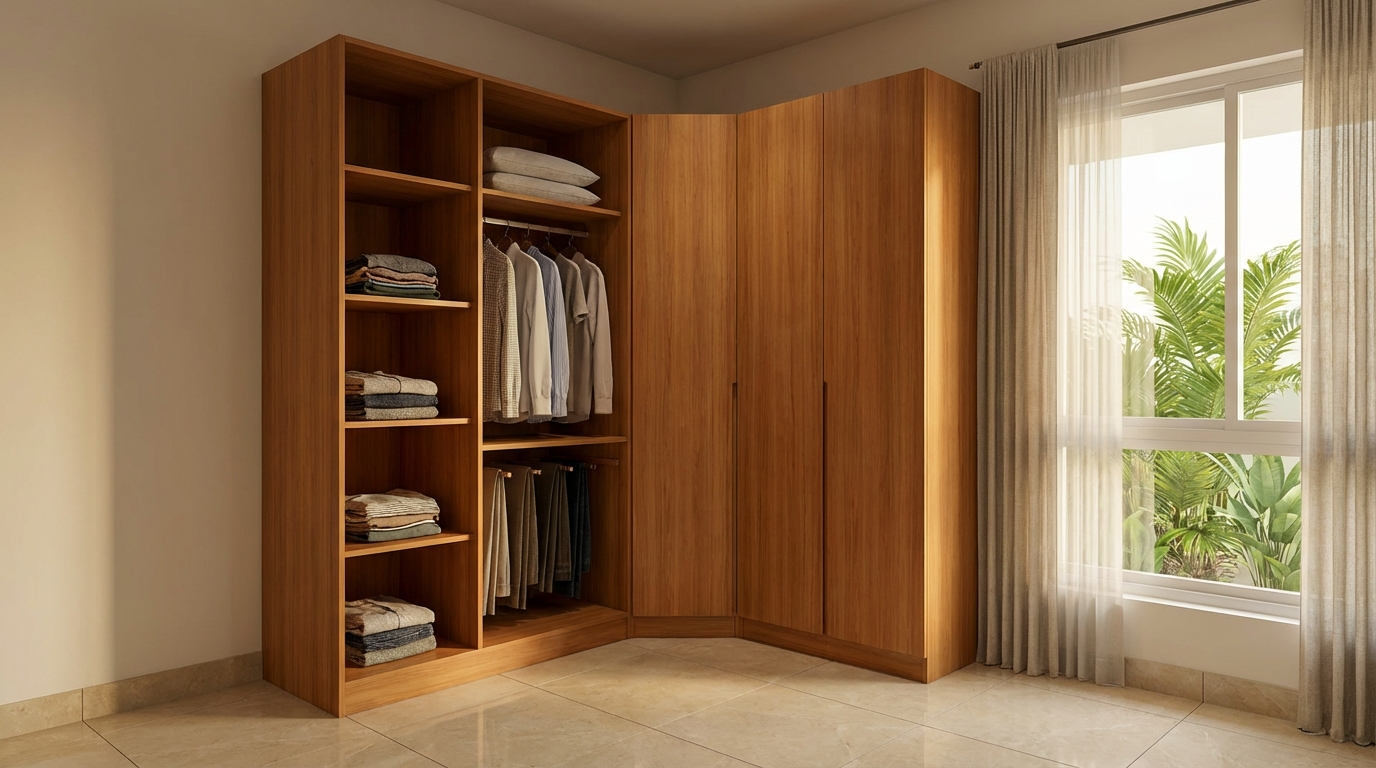
A corner wardrobe design is a storage solution built to fit into room corners, utilizing typically wasted space by spanning two adjoining walls in an L-shape, diagonal, or walk-in configuration.
Short version: A corner wardrobe is a type of wardrobe that can be either free-standing or fitted—specifically designed to occupy the corner of a room. If you've got a 10x12 bedroom (common in Mumbai and Bengaluru flats), a well-planned L-shaped wardrobe can give you 30-40% more storage than a standard single-wall unit, without making the room feel cramped. That dead corner behind your bed? It's basically free real estate.
This is right for you if:
- Your bedroom has an awkward corner that's collecting dust or holding that chair nobody sits on
- It doesn't matter if the room is small, as it so often is in the city, or if it is large—this design can be made to answer the specific needs of the person and the particular truth of the space he inhabits.
- You need both hanging space AND shelf storage in one structure—couples sharing a wardrobe, this is your solution
- You want that mini walk-in closet feel without actually having a separate room for it
Skip this if:
- Your corner has windows, electrical panels, or AC units—retrofitting around these is expensive and rarely worth it
- You're renting and can't modify walls—freestanding corner units exist but honestly, they're not great
Bottom line: Corner wardrobes aren't just about maximizing storage—they're about transforming dead space into the most functional part of your bedroom.
What Corner Wardrobes Actually Are (And Aren't)
An L-shape wardrobe design refers to a wardrobe configuration that takes the shape of the letter "L"—characterized by two perpendicular sections that meet to form an L-shape, often occupying two adjacent walls in a bedroom. L-shaped wardrobes are popular for their ability to efficiently utilize corner spaces and provide ample storage while maintaining a sleek and organized look.
Most people think corner wardrobes are just regular wardrobes shoved into a corner. Actually, they're engineered differently. The corner L-shaped wardrobe design is celebrated by interior designers for its unparalleled efficiency. Unlike a linear wardrobe, which occupies a single wall, an L-shaped configuration utilises two adjacent walls, creating a cohesive and expansive storage unit.
The real magic happens in the corner junction itself. That 90-degree meeting point—if done poorly, you lose maybe 2-3 square feet of usable space. Done well, with curved rails or rotating mechanisms, it becomes the most accessible part of your wardrobe. A standout feature is the curved hanging rail. This clever design makes it easier to access clothes stored in awkward corners by eliminating the need to reach into tight spaces. Suitable for garments that need to be hung without getting wrinkled, like suits and dresses.
Here's what I tell my clients: think of the corner wardrobe not as furniture, but as room architecture. It is a considered use of space—the answer for how to use every part of a bedroom, to turn a difficult corner into a place of great function.
Why This Matters for Indian Homes Specifically
Monsoon humidity (70-90%) hits wardrobes hard—even bedrooms get damp from open windows or laundry. MDF edges swell without PVC banding, causing laminate peel. Plywood fares better with BWR glue, but poor storage (stacked vertical in yards) warps sheets.
I've seen wardrobes in Chennai that looked perfect for two years, then the third monsoon hit and suddenly the doors wouldn't close. Why? The corner joint—where two plywood sheets meet at 90 degrees—wasn't sealed properly. Moisture crept in from the wall, and the whole structure twisted by 3-4mm. Doesn't sound like much until your ₹1.5 lakh wardrobe has gaps you can see daylight through.
Even well-maintained homes can fall victim to prolonged high moisture levels, especially in areas with high humidity, such as tropical and coastal regions like Mumbai, Chennai, or Goa. If bedrooms or rooms are exposed to humidity above 44% RH at coincident temperatures, they will absorb the moisture, causing them to warp and become uneven.
In Kolkata, the Salt Lake area gets particularly humid during July-August. A plywood wardrobe sealed with polyurethane lasts longer in a humid city like Kolkata. I had a builder from that side call me two years back—every corner wardrobe in his project was showing problems. Turned out he'd used MR grade plywood instead of BWR. Saved maybe ₹8,000 per wardrobe. Cost him ₹40,000 per unit in repairs.
Here's the climate reality check:
- Mumbai, Goa, Konkan belt: BWR grade minimum, preferably BWP for corner joints
- Chennai, coastal Karnataka: Same as above—coastal areas amplify: salt air corrodes fittings faster on MDF
- Bengaluru, Pune: MR grade works for most applications, but monsoon months still need attention
- Delhi, Jaipur (dry zones): MR grade is usually fine, but watch for termites instead
Does corner wardrobe material really matter that much in Indian conditions?
Absolutely. In contrast to regular wood, moisture resistant plywood maintains its strength and shape even when exposed to fluctuating temperature or humidity level. This kind of stability is crucial for kitchen cabinets, wardrobes and bathroom vanities.
Here's what actually happens: Large furniture items, such as wardrobes or storage units, shouldn't be placed up against a wall! Whatever is going on with that wall, if it is an external or uninsulated wall, the dampness caused by monsoon weather can seep into a "solid" piece of plywood furniture. Ideally, do not place plywood furniture flush against walls. Retain a minimum of 1-inch air gap between the two surfaces.
Now, corner wardrobes by definition sit against two walls. So the sealing and material choice becomes even more critical than regular wardrobes. This is where most contractors cut corners—pun intended.
Types of Corner Wardrobe Designs: The Real Breakdown
An L-shaped corner wardrobe is probably the most common type. It fits neatly into a corner, using two adjoining walls. These wardrobes combine a mix of hanging space and shelving, making it a versatile storage solution that ties in well with modern lifestyles.
But there are several configurations worth knowing:
1. Standard L-Shaped Corner Wardrobe
Two arms meeting at 90 degrees. An L-shaped corner wardrobe design wraps around the edges, providing more storage without occupying additional space. This layout works best in square or mid-sized bedrooms. Use sliding or handleless shutters to maintain a sleek appearance. Add loft units above for extra storage and a complete built-in look.
My take: This is the workhorse design. Works in 90% of bedrooms. The key is getting the arm lengths right—typically the longer arm should be at least 5 feet for meaningful hanging space.
2. Diagonal Corner Unit
A single angled face across the corner, creating a triangular footprint. Because the doors slide, you don't need extra space for them to open. They give a clean, modern look while hiding plenty of storage inside.
Honestly: These look great in showrooms but waste more space than you'd think. That triangular dead zone behind the angled face? You can put seasonal stuff there, but daily access is a nightmare.
3. Walk-in Corner Configuration
Most people think, "Walk in closet? Nah, too much space needed." But no, even a small walk in wardrobe can work beautifully with good planning. Shelves, baskets, and hanging rods make all the difference.
Utilising corners can be a game-changer in small rooms. Indian walk in wardrobe ideas often include custom-built corner wardrobes that use otherwise wasted space, providing ample storage without taking up too much room.
Best for: Master bedrooms with at least 12x14 feet dimensions. Requires minimum 4 feet depth for comfortable movement.
4. Open-Shelf Corner Design
An open-shelf corner wardrobe design is perfect if you like your clothes on display. It is easy to organise, quick to access and adds style to your space.
Warning: Looks amazing for about two weeks until dust from Mumbai's air settles on everything. Only recommend this if you have domestic help or genuinely enjoy folding clothes daily.
| Design Type | Minimum Space Needed | Best For | Avoid If | Cost Range (2026) |
|---|---|---|---|---|
| L-Shaped Standard | 5ft × 4ft corner area | Most bedrooms, couples | Very narrow rooms | ₹1,800-3,500/sq ft |
| Diagonal Corner | 4ft × 4ft | Small bedrooms, guest rooms | You need maximum storage | ₹1,600-2,800/sq ft |
| Walk-in Corner | 8ft × 6ft minimum | Master bedrooms, large wardrobes | Space is tight | ₹2,200-4,000/sq ft |
| Open Shelving | 4ft × 3ft | Display purposes, boutique feel | High dust areas | ₹1,200-2,200/sq ft |
| With Dressing Unit | 6ft × 5ft | Single occupants, no separate dresser | Multiple users | ₹2,000-3,800/sq ft |
Price Reality Check (2026 Market)
Note: sainik710.com is an independent informational site and is not affiliated with any manufacturer.
The cost of a modular wardrobe in India starts from ₹60,000* in 2025, depending on the materials, finishes, and storage features used. Wardrobes are available for all budgets with EMI options also available. Premium options like PU or acrylic finishes, swing and sliding wardrobes, and soft-close pull-out units can increase the total cost.
For corner wardrobes specifically, expect to pay 15-25% more than equivalent linear wardrobes because of:
- More complex joinery at the corner junction
- Additional hardware for corner access (rotating rails, pull-out systems)
- Higher cutting waste—plywood sheets don't naturally fit L-shapes
For 18mm wardrobe boards, MDF ranges ₹50-90 per sq ft; BWR plywood ₹80-140 per sq ft—higher in North India due to logistics.
Here's what actually affects your final bill:
| Cost Driver | Impact | Notes |
|---|---|---|
| Core Material | 40-50% of total cost | BWR plywood vs MDF vs HDHMR |
| Finish Type | 20-30% | Laminate cheapest, PU/acrylic premium |
| Hardware | 10-15% | Soft-close, corner mechanisms add up |
| Labour | 15-20% | Higher in metros, varies by complexity |
| City Location | +20-30% in metros | Delhi/Mumbai highest |
Budget estimation for a typical 7ft × 6ft L-shaped corner wardrobe:
- Economy (MDF + basic laminate): ₹65,000-85,000
- Mid-range (BWR ply + good laminate): ₹1,00,000-1,40,000
- Premium (BWP ply + acrylic/PU finish): ₹1,60,000-2,20,000
Is the premium plywood actually worth the extra cost for corner wardrobes?
Budget considerations: Decide on your budget and use it as a guide. Think about quality, features, design and not just the lower cost if you want a wardrobe that works long-term.
If I'm being honest, for bedrooms in dry cities like Delhi or Bengaluru with good ventilation, MR grade plywood works fine for the main carcass. But the corner joint specifically—where the two arms meet—I always recommend BWR grade minimum. That's the stress point. That's where moisture finds a way in.
For wall-mounted upper cabinets away from direct water contact, BWR grade typically suffices and saves 30-40% on material cost. The critical factor is proper edge sealing and laminate application—even BWP plywood fails if edges remain exposed to moisture.
L-Shaped vs Walk-in: Direct Comparison
| Parameter | L-Shaped Corner | Walk-in Corner | My Preference |
|---|---|---|---|
| Minimum Room Size | 10×10 ft bedroom | 12×14 ft bedroom | Depends on layout |
| Storage Capacity | Good (40-60 sq ft) | Excellent (80-120 sq ft) | Walk-in if space allows |
| Daily Accessibility | Moderate | Excellent | Walk-in wins |
| Cost per sq ft storage | Lower | Higher (more hardware) | L-shaped for budget |
| Installation Time | 5-7 days | 10-14 days | — |
| Resale Value Impact | Moderate positive | High positive | Walk-in for investment |
| Maintenance Effort | Lower | Higher (more area) | L-shaped for practicality |
| Best Climate | Works everywhere | Needs good ventilation | L-shaped for coastal |
Choose L-shaped when: Your bedroom is under 150 sq ft, you have budget constraints, or you prefer everything behind closed doors.
Choose walk-in when: Shoe displays, accessory zones and a dedicated corner for vanity are trendy. In the interior design of Bangalore walk-in wardrobes aren't restricted to luxurious villas. Even apartments can have compact walk-in wardrobes using clever space planning and modular designs.
Trade-off summary: You gain visual impact and accessibility with walk-in, but lose floor space and pay more. For most Indian apartments under 1200 sq ft, L-shaped makes more practical sense.
How to Choose: Decision Framework
Step 1: Measure Your Corner (Properly)
We recommend taking three measurements across each wall at three different heights and entering the smallest. Indian walls aren't always perfectly straight—I've seen corners that are off by 2 inches top to bottom. If you don't catch this, your wardrobe doors won't close properly.
Step 2: Assess Your Storage Needs
Count your hanging clothes vs folded clothes. A 70-30 split is typical for Indian households. If you have more sarees or suits, you'll need deeper sections. If it's mostly western wear, standard 24-inch depth works.
Step 3: Check Wall Conditions
Is this an external wall? Internal? Does it share a bathroom on the other side? During the monsoon, walls often absorb moisture. Wooden furniture placed directly against damp walls or near windows can draw in this moisture, leading to mildew and swelling. Maintain at least 3–5 inches of gap between your furniture and walls.
Step 4: Decide on Configuration
| Your Situation | Recommended Design | Why |
|---|---|---|
| Compact bedroom (<120 sq ft) | Diagonal or compact L-shaped | Minimal footprint |
| Average bedroom (120-180 sq ft) | Standard L-shaped with loft | Best value for storage |
| Large master (180+ sq ft) | Walk-in corner or full L with dresser | Maximum utility |
| External corner wall (coastal city) | L-shaped with gap + BWP ply | Moisture protection priority |
| Couple sharing | Symmetrical L with center divider | Equal access both sides |
| Rental property | Semi-modular/detachable L-shape | Portability matters |
Red flags to walk away from:
- Contractor can't explain corner joint construction
- Quote doesn't specify plywood grade and thickness separately
- No warranty on corner hardware (should be minimum 5 years)
- Wants to use MR grade on external walls in humid climates
- Refuses to show previous corner wardrobe work
Common Mistakes People Make
Mistake 1: Ignoring the corner access problem
This frustrates me more than anything. People spend lakhs on a beautiful L-shaped wardrobe, then realize they can't reach anything stored in the corner junction. That 90-degree meeting point needs either a curved rail, a lazy susan mechanism, or at minimum, a pull-out system. A smart corner wardrobe layout includes vertical storage, drawers at the bottom, and hanging space at a reachable height. Use overhead units for loft storage.
Mistake 2: Using identical plywood thickness everywhere
A stable wardrobe requires 18mm to 19mm thick plywood for its main structure and shelves while sliding doors need 12mm to 15mm dimensions and the back panel must have 6mm to 9mm thickness. Proper selection of plywood thickness will lead to enhanced durability and strength.
I've seen carpenters use 18mm for back panels—complete waste of money. But I've also seen them use 12mm for the corner structural joints—that's where problems start.
Mistake 3: Skipping the ventilation planning
Ventilate enclosed spaces such as wardrobes and cabinets regularly. Elevate plywood off damp flooring with supports or plastic legs. For corner wardrobes especially, I recommend at least one louvered panel or a small ventilation gap at the top. Trapped humidity is the silent killer of good woodwork.
Mistake 4: Going too deep
The depth of the wardrobe should be at least 24 inches to accommodate standard hangers. However, if you have bulky items or prefer more space, consider increasing the depth to 28 inches or more.
But here's the thing—anything beyond 30 inches depth in a corner wardrobe creates dead zones. Clothes get pushed to the back and forgotten. 24-26 inches is the sweet spot.
Mistake 5: Choosing aesthetics over function for the corner section
That beautiful glass-door corner unit looks stunning in the showroom. Try reaching for a shirt at 6 AM when you're half asleep. Fixed shelves in corners are nightmare fuel. Pullouts, drawers, or rotating mechanisms—invest in these. The extra ₹8,000-15,000 pays for itself in daily convenience.
Mistake 6: Not accounting for ceiling irregularities
Indian ceilings, especially in older buildings, often slope or have beams. The 8×4 feet sheet size works best for standard floor-to-ceiling wardrobes in India, offering optimal material utilization with minimal wastage. For thickness, use 18mm or 19mm for the wardrobe carcass and sides, 12mm to 18mm for shutters depending on whether they're sliding or hinged, and 6mm for back panels. If your ceiling height is below 8 feet, a 7×4 feet sheet may reduce cutting waste.
Measure ceiling height at all four points of your intended corner—I've seen 3-inch differences that made loft installation impossible.
Mistake 7: Underestimating door clearance
Hinged doors on corner wardrobes need swing space. If you're placing the wardrobe near the bed, and both arms have hinged doors, you might not be able to open both simultaneously. Because the doors slide, you don't need extra space for them to open. Consider sliding doors for at least one arm if space is tight.
Quality Checks You Can Do Yourself
Visual Checks at the Dealer:
- Check plywood edge layers—plywood wins if 16+ plies, gaps absent. Check: stack samples flat 1 week post-buy. If bow >1cm, reject batch.
- Look for consistent color across the sheet face—patches indicate different wood batches
- Examine corner samples if available—how clean is the 90-degree joint?
- Verify ISI certification mark—make sure that plywood meets the IS standards like IS:303 or IS:710
- Check for waviness by running your hand across the surface
Questions to Ask the Dealer:
- "Is this calibrated plywood?" (Essential for modular work)
- "What grade is this—MR, BWR, or BWP? Show me the certification."
- "What's the actual measured thickness?" (18mm and 19mm is often the same product—the difference is nominal versus actual thickness after calibration and sanding. Many dealers use these terms interchangeably.)
- "What's the core wood species?" (Gurjan/hardwood preferred over poplar)
- "How long has this batch been in storage, and how was it stored?"
Simple Field Tests:
- Tap test: Knock on the plywood—a hollow sound indicates voids or poor lamination
- Weight check: 18mm BWR should feel solid, not light; compare samples side by side
- Edge inspection: Look for gaps between plies, delamination starting points
- Flex test: Check: measure supplier sample deflection under hand pressure—no give means good.
- Water drop test: Put a drop on the edge—if it soaks in immediately, moisture resistance is poor
Warning Signs:
- Price too good to be true for "BWR" plywood
- Dealer can't produce ISI certificate
- Sheets stored standing vertical (causes warping) instead of flat
- Strong chemical smell—indicates poor adhesive curing
- Visible core gaps when looking at the edge
- Reluctance to let you measure actual thickness
Here's a trick most dealers don't like: Ask to break a small sample. Yes, really. Snap off a corner piece. If it splinters cleanly along the grain, the wood is quality. If it crumbles or shows weak lamination bonds, walk away regardless of what the label says.
Workmanship & Installation
Cutting Requirements:
Contractor reality: MDF cuts dustier, slowing site work; plywood needs skilled edge sealing. For corner wardrobes, the junction cut is critical—it needs to be perfectly square (90 degrees) or you'll have visible gaps or uneven doors.
Edge Sealing—This Is Non-Negotiable:
It can still fall victim to careless finishing. Unsealed corners, raw edges, and open joints act like doorways for moisture to creep in during the monsoon season.
Apply 2mm PVC/edge tape heat-pressed, plus silicone corners. MDF critical; plywood bonus. Monsoon tip: Extra coat polyurethane.
Edge banding on corner joints especially—if your carpenter says "it's inside, who'll see it," find another carpenter.
Fastener Guidance:
- Carcass joints: 35-40mm screws minimum into 18mm ply
- Shelf supports: European-style pins or brackets, not just screws
- Hardware: Euro hinges with minimum 120-degree opening for corner access
- Corner braces: Metal L-brackets every 12-18 inches along the junction
What to Tell Your Carpenter—The Briefing Checklist:
- Show the exact corner measurements with photos
- Specify plywood grade and brand—in writing
- Demand to see plywood cutting happen (don't let them use offcuts)
- Insist on full edge banding including internal surfaces near corners
- Require silicone sealing at floor contact and wall contact points
- Request photographic documentation of corner joint construction before laminates go on
Storage and Acclimatization:
Always insist on flat, covered storage post-delivery. Plywood needs 48-72 hours in your home environment before cutting—especially important in AC homes where temperature differs from the dealer's godown.
I've seen carpenters skip this and then... the wardrobe was perfect on installation day. Two weeks later, with the AC running 8 hours daily, gaps appeared at every joint. The plywood had contracted in the cooler, drier environment. Client blamed the brand. It wasn't the brand—it was rushing the process.
How Long Corner Wardrobes Actually Last
Honest Lifespan Expectations:
- MDF core with laminate: 7-10 years in dry conditions, 4-6 years in humid coastal areas
- BWR plywood with laminate: 15-20 years with proper maintenance
- BWP/Marine plywood: 20-25+ years, I've seen some from early 2000s still going strong
The corner joint is always the first failure point. If that's done right, the rest follows.
What Affects Longevity:
- Humidity cycles: AC on/off daily causes expansion-contraction stress
- Wall moisture: External walls or bathroom-adjacent walls accelerate damage
- Weight loading: Overloaded corner sections sag faster
- Hardware quality: Cheap hinges fail in 3-4 years; good ones last 15+
- Cleaning habits: Moisture during cleaning if not dried immediately
In my experience, well-maintained corner wardrobes with BWR plywood last about 18-22 years before needing major refurbishment. The carcass usually outlives the doors—factor in door replacement at year 10-12.
Signs of Wear to Watch For:
- Doors not closing flush—indicates frame shift
- Soft spots on shelf surfaces—moisture damage starting
- White powdery residue near edges—could be termite activity
- Musty smell when doors open—fungal growth beginning
- Hinges loosening despite tightening—screw holes have weakened
When to Consider Replacement:
If corner joint shows visible gaps, doors can't be adjusted to close, or structural panels have warped beyond 5mm, it's time. Partial repairs on corner wardrobes rarely work because the junction needs to be rebuilt entirely.
Can old corner wardrobes be refurbished instead of replaced?
Depends on the core condition. If the plywood is structurally sound (no delamination, warping under 3mm), you can replace doors, hardware, and laminates for about 40-50% of new construction cost. But if the corner joint itself has failed, you're looking at a complete rebuild—which often costs more than starting fresh with better materials.
Alternatives Worth Considering
If budget is tight, consider:
MDF typically costs less upfront, often 20-40% below plywood for similar thickness. For a 6x4 ft wardrobe carcass (18mm), expect MDF panels around ₹3,000-5,000 total material, while BWR plywood runs ₹4,000-7,000 depending on city and finish.
HDHMR (High Density High Moisture Resistant) boards are a middle ground—better moisture resistance than regular MDF, costs less than plywood. Our HDHMR guide covers material comparison in more detail. For corner wardrobes in moderate humidity, it's a viable option if budget is the constraint.
If you need better moisture resistance:
WPC (Wood Plastic Composite) panels for the corner junction specifically, with plywood for the rest. More expensive but handles the moisture stress point better. The door frame guide on this site discusses WPC options if you're considering hybrid construction.
If you want premium aesthetics:
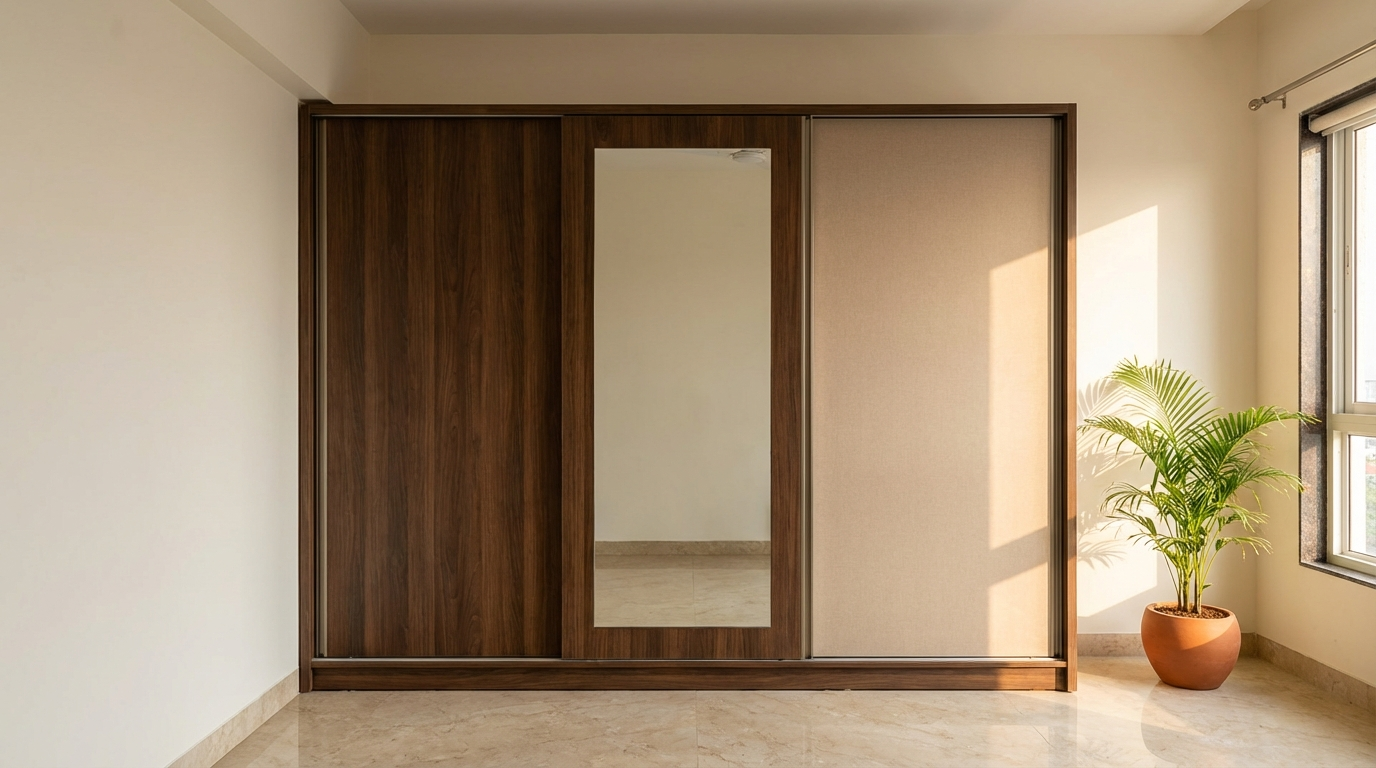
Fluted glass is having a moment. You've probably noticed it in cafés, cabinets, partitions, and yes, wardrobes. It's stylish and it hides clutter without blocking light. Clean frames, warm LEDs, soft shadows, this look has become one of the most distinctive features in the latest wardrobe design space.
Glass panels in corner wardrobes work better than you'd expect—they actually make the corner feel less claustrophobic. But glass adds 30-40% to door costs and needs aluminum framing.
FAQs
What's the minimum room size for a corner wardrobe?
You need at least a 9x10 feet bedroom for even a compact corner wardrobe. The wardrobe itself might only take 5x4 feet of corner space, but you need clearance for doors (if hinged) plus walking space. In tighter rooms, consider a diagonal corner unit or sliding doors. Compact corner wardrobe designs are perfect for studio apartments, where space is tight. They provide smart storage without crowding the room—designed to fit neatly into corners and keep clothes, shoes and essentials organised while leaving more space for living and moving around.
Is it true that corner wardrobes waste more material than straight ones?
Common belief: corner wardrobes are wasteful. Reality: yes, there's 10-15% more cutting waste because standard 8x4 sheets don't fit L-configurations efficiently. However, a good carpenter minimizes this by using offcuts for internal partitions and back panels. The trade-off is worth it—you're utilizing corner space that would otherwise hold nothing useful. Ask your contractor to show you the cutting plan before work begins.
What if I live in a coastal city like Mumbai or Chennai—do I need marine plywood for the entire wardrobe?
While MR plywood is not as good as marine or BWP plywood, MR grade provides better resistance to ambient moisture and fungus than regular plywood. Applications: wardrobes, study tables, office furniture, or bedroom panelling. My recommendation: use BWP for the corner junction and any sections touching external walls, BWR for the rest. Full marine throughout is overkill unless you're literally on the beach or have severe wall dampness issues. This hybrid approach saves 20-25% without compromising the vulnerable points.
Can I add a dressing table to my corner wardrobe design?
An integrated dressing table in a corner wardrobe is great for small or medium rooms. You get storage for clothes and a space for getting ready, all neatly tucked into a corner to save room while keeping everything in one convenient place. Position the dressing unit on the shorter arm of the L-shape, with the mirror catching natural light from the nearest window. Include a small pull-out drawer for cosmetics and a concealed power point for hair dryers. Works beautifully for single-occupancy bedrooms.
Is it true that L-shaped wardrobes are harder to maintain?
Not harder, just different. The corner section accumulates dust faster because airflow is restricted. Wardrobes and storage units are particularly vulnerable to musty smells. Place naphthalene balls, neem leaves, or camphor inside to repel pests and absorb moisture. These natural solutions not only keep your furniture fresh but also deter silverfish and termites. Clean the corner monthly with a dry cloth, leave doors open for 30 minutes weekly for air circulation, and you'll have no issues.
What hardware should I insist on for corner sections?
Euro hinges with 165-degree opening (not standard 110-degree) for better access. Corner units specifically benefit from magic corners (rotating trays), carousel systems, or at minimum, pull-out wire baskets. Don't let anyone install fixed shelves in the actual corner zone—you'll regret it every morning. Budget ₹8,000-15,000 extra for proper corner hardware. It's the best investment in the entire wardrobe.
Should I choose sliding doors or hinged doors for a corner wardrobe?
It depends on your layout. Hinged doors give full access—you can see the entire wardrobe contents at once. But they need swing space of 18-24 inches. Sliding doors need zero swing space but only expose half the wardrobe at a time. For corners where the bed is close, I usually recommend sliding on the arm facing the bed, hinged on the other arm. Mixed configurations work perfectly well.
Is it true that carpenters charge extra for corner wardrobes?
Yes, and rightfully so. The joinery is more complex, cutting requires more precision, and installation takes 30-40% longer. Expect labour costs 20-25% higher than equivalent linear wardrobe work. What's not acceptable is hidden material markup—some contractors specify "18mm BWR" but use lower grades for internal sections. Get line-item quotes specifying plywood grade for each component.
Can corner wardrobes be dismantled and relocated?
Built-in corner wardrobes—difficult to impossible without damage. Semi-modular designs with screw-assembled joints can be relocated, though expect some wear and 5-10% panel replacement. If you're in a rented apartment or planning to move within 5 years, discuss this upfront. Some manufacturers offer designs with knockdown fittings specifically for portability, though they cost more initially.
What thickness plywood should I use for different parts?
For thickness, use 18mm or 19mm for the wardrobe carcass and sides, 12mm to 18mm for shutters depending on whether they're sliding or hinged, and 6mm for back panels. One persistent source of confusion in the Indian plywood market involves the 18mm and 19mm thickness designations. Technically, 19mm is the nominal thickness that accounts for sanding and calibration, while 18mm represents the actual measured thickness after finishing. Many dealers use these terms interchangeably. For practical purposes, when a carpenter or interior designer specifies "18mm plywood for wardrobe carcass," they're referring to the standard furniture-grade thickness. The corner junction bracing should use the same 18mm thickness as the main carcass—never thinner.
How do I prevent that musty smell in corner wardrobes?
Find camphor balls, naphthalene balls, silica gel sachets, or charcoal briquettes and place them in furniture or storage items that remain closed—wardrobe, drawer, shoe rack. These small products will absorb moisture and reduce the risk of mould and the dreaded odour. For corner sections specifically, I recommend a small moisture absorber container (available at ₹100-200) replaced monthly during monsoons. Also ensure the back panel has at least one 2-inch ventilation hole—your carpenter can drill this easily, and it makes a remarkable difference.
Are trends like fluted glass and handleless doors practical for Indian homes?
Trending Wardrobe Designs in 2025 include fluted glass shutters, matte and high-gloss laminates, handleless sliding doors, and dual-tone finishes. Interior upgrades such as pull-out drawers, LED-lit compartments, and soft-close mechanisms are also increasingly popular. Fluted glass hides clutter beautifully while letting light through—practical if you have kids who'll open wardrobes with dirty hands (glass wipes clean, laminate shows fingerprints). Handleless doors work great until the push-to-open mechanism fails in year 4-5. My honest advice: if you go handleless, budget for mechanism replacement down the line.
Final Thoughts
Look, corner wardrobes aren't complicated once you understand the basics. Get the material right for your climate, invest in proper corner hardware, and don't let anyone rush the edge sealing. The wardrobe plywood guide on this site goes deeper into grade selection if you want the technical details.
The corner is the hardest working part of your wardrobe—treat it that way, and it'll serve you for decades.
Oh, and one last thing: take photos of the corner joint before laminates go on. If something goes wrong in year 5, you'll thank yourself for having documentation of what's actually inside. Your carpenter might roll his eyes. Do it anyway.
Disclaimer: This content is provided for general informational purposes based on industry practices and publicly available information. Product specifications, standards, prices, and availability may vary by manufacturer, region, and time. Readers should independently verify details with manufacturers, dealers, or qualified professionals before making purchase or construction decisions.Want Plywood Suggestions?
Share a few details and a Sainik 710 specialist will suggest suitable brands and connect you to responsive dealers.