Design & Ideas09 Feb 2026
Console Table Design: 25+ Modern, Wooden & Marble Ideas for Living Room Entrance
Explore 25+ console table designs—wooden, marble & modern styles for living room entrance. Size guide, styling tips & material options for Indian homes.
Quick Answer: What Makes a Good Console Table Design?
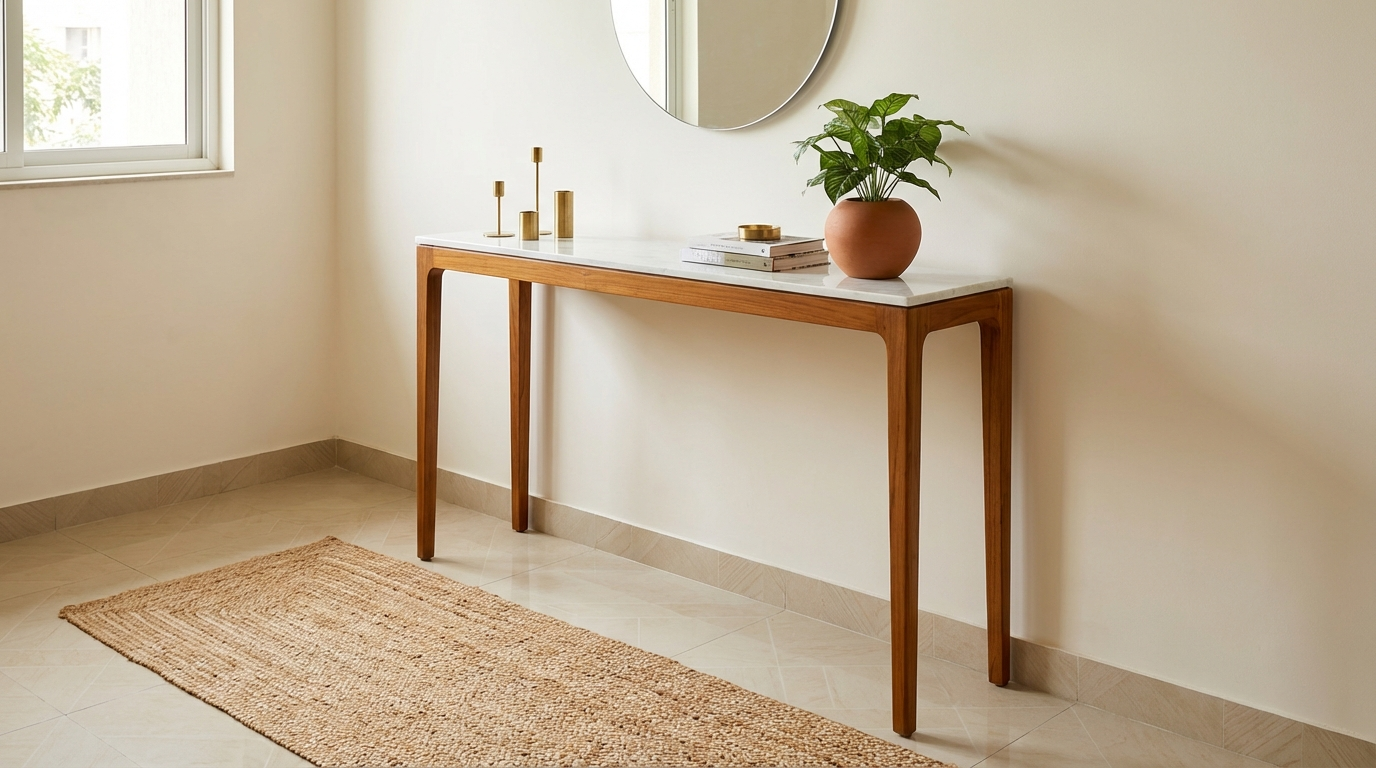
A console table design works when it fits your space, handles Indian climate conditions, and doesn't block traffic flow—everything else is personal preference. **Short version:** Console tables sit against walls in entryways, living rooms, or hallways. The best designs for Indian homes balance looks with practicality—solid wood handles humidity better than particle board, marble tops work in AC rooms but stain easily in open-plan spaces, and the right height (28-32 inches) makes or breaks daily usability. Don't overthink the style; focus on material quality first. **This is right for you if:** - Your entrance feels empty and needs a landing spot for keys and bags - You want to display décor without committing to bulky furniture - You have a narrow hallway that can't fit standard furniture but looks bare - Your living room has dead wall space behind the sofa that bothers you every time you look at it **Skip this if:** - Your entryway is under 4 feet wide—you'll just create a traffic obstacle - You need serious storage (get a sideboard instead) **Bottom line: A console table is the easiest way to make an entrance look "finished"—but only if you pick the right material for your climate and the right size for your space.**What a Console Table Actually Is (And What It Isn't)
A console table is a narrow, long table designed to sit flush against a wall, typically 10-18 inches deep and 28-36 inches tall. It's meant for display and light storage—not for dining, working, or heavy use. Most people think console tables are just fancy decoration. Actually, they're functional pieces that solve a specific problem: what do you do with keys, mail, sunglasses, and that random stuff that accumulates near your door? A good console catches all of it. Here's where it gets confusing. People use "console table," "foyer table," "entryway table," and "hall table" interchangeably. They're all the same thing—a slim table against a wall. The only variation is placement. Behind a sofa? Some call it a sofa table. Near the entrance? Entryway table. Same furniture, different marketing. What a console table is NOT: a sideboard (which has full storage with doors), a credenza (longer, lower, with cabinets), or a writing desk (deeper, meant for sitting at). If you need actual storage space, you want something else. Console tables give you maybe 1-2 drawers at most, sometimes just an open shelf underneath. The design evolved from ornate European pieces that went against ballroom walls. Indian homes adopted them because they fit perfectly in our narrow entrance passages—those 3-4 foot wide spaces that can't accommodate anything substantial but look incomplete when empty.Why Console Table Design Matters More in Indian Homes
I've seen beautiful imported console tables fall apart within two monsoons. Not because they were bad furniture—they just weren't made for our conditions. Indian humidity runs 70-90% during monsoon months across most of the country. In Mumbai and Chennai, you're looking at 80-85% regularly from June through September. Kolkata gets even worse—I've measured 92% in a Ballygunge flat during August. This humidity destroys certain materials faster than you'd believe. Coastal cities have salt in the air on top of the moisture. That brass hardware you love? Corrodes faster in Kochi than in Ahmedabad. That beautiful oak from a European brand? Swells and cracks within a year in Goa. I'm not exaggerating—there was this client in Bandra who bought an imported French console, beautiful piece, maybe ₹1.2 lakhs. By the second monsoon, the drawers wouldn't close. The wood had swelled that much. In drier places like Jaipur or Hyderabad interior areas, you have the opposite problem—wood can crack from being too dry during summer. So you need wood that's properly seasoned and finished on all sides, not just the visible surfaces. The practical design differences for Indian conditions: - Wood needs to be kiln-dried to 8-12% moisture content - All surfaces should be sealed, including undersides and inside drawer boxes - Metal hardware should be stainless steel or properly lacquered brass - Marble tops need sealing if you're anywhere humid - MDF and particle board are risky choices outside fully air-conditioned spacesCan you use an imported console table in Indian conditions?
You can, but expect problems unless your home is climate-controlled year-round. Imported furniture from Europe or America is designed for 40-60% humidity. Indian monsoons hit 80%+ easily. If your living room runs AC 18-20 hours daily and you keep doors closed, imported pieces can survive. In naturally ventilated homes, stick to Indian-made furniture from workshops that understand local conditions. The wood seasoning process differs based on target climate—and that detail matters more than most people realize.Console Table Designs by Material: What Actually Works
Let me break down what I've seen hold up over the years—and what hasn't. **Solid Wood Console Tables** Sheesham (Indian Rosewood) remains the gold standard for durability in Indian conditions. Dense grain, naturally resistant to moisture variation, takes polish beautifully. Mango wood is lighter and more affordable—works well in modern interiors and is surprisingly durable. Teak is premium, handles humidity best of all, but costs 40-60% more than sheesham for similar designs. Honestly, if you're spending decent money on a console table, solid wood is where I'd put it. The longevity justifies the cost. **Engineered Wood (MDF, Particle Board, Plywood)** MDF consoles look great in showrooms—clean lines, perfect finishes, modern aesthetic. But here's the thing: regular MDF swells when it absorbs moisture. I've seen MDF console tops bubble near entrance doors during monsoon because of humidity ingress. If you want the MDF look, insist on HDHMR (High Density High Moisture Resistance) or marine plywood with laminate finish. Our HDHMR guide goes deeper into what makes it different from standard MDF. Plywood-based console tables work fine if the ply is BWR grade or better. Check that edges are properly sealed with PVC edge banding—not just paint. **Marble and Stone Tops** Marble console tables look stunning. No argument there. But marble is porous—spill chai on it, and you'll have a stain unless it's sealed properly. White marble shows every mark. In my experience, go with granite or quartz if you want stone and don't want maintenance headaches. For marble lovers, Italian marble with proper sealing works, but you'll need to reseal every 18-24 months. **Metal Frame Consoles** Metal frames (iron, steel, brass) with wood or stone tops are increasingly popular. The industrial look suits modern flats well. Powder-coated metal handles humidity fine. Raw or brushed metal finishes need attention in coastal areas—a light wax coating every few months prevents oxidation. **Glass Top Consoles** Glass shows every fingerprint and dust particle. If you have household help doing daily cleaning, fine. Otherwise, you'll constantly see smudges. Glass works best as a secondary material—maybe a lower shelf—rather than the main surface. | Material | Humidity Resistance | Maintenance | Lifespan | Best For | My Take | |----------|-------------------|-------------|----------|----------|---------| | Sheesham Wood | Excellent | Low—occasional polish | 15-25 years | Traditional and modern both | Best overall choice for most homes | | Mango Wood | Good | Low | 10-15 years | Contemporary, budget-conscious | Great value | | Teak | Excellent | Very low | 20-30 years | Premium interiors | Worth it if budget allows | | MDF/Particle Board | Poor | Low until damage | 3-7 years | AC-only spaces | Risky—I'd avoid near entrances | | HDHMR | Good | Low | 8-12 years | Modern, moisture-prone areas | Better than regular MDF | | Marble | Moderate (needs sealing) | High | 20+ years | Formal spaces | Beautiful but demanding | | Granite/Quartz | Excellent | Very low | 25+ years | Heavy-use areas | Practical stone option | | Metal Frame | Depends on coating | Moderate | 15-20 years | Industrial/modern | Check coating quality |Console Table Sizes: Getting the Proportions Right
Size mistakes are the most common problem I see. People buy what looks good in the showroom without measuring their actual space. **Height Guidelines** Standard console height: 28-32 inches. This puts the surface at a comfortable level for placing and picking up items without bending. For entryways, 30 inches works for most people. Behind sofas, match the sofa back height or go 1-2 inches higher—never lower. If you're tall (over 5'10"), consider 32-34 inches. Constantly bending to a low console gets annoying quickly. **Width (Length) Guidelines** The console should be roughly 60-75% of the wall it sits against. Against a 10-foot wall? Look at 6-7.5 foot consoles. Behind a sofa? Same rule—60-75% of the sofa length. For narrow entryways under 6 feet wide, keep the console under 36 inches long. You need walking room on both sides. **Depth Guidelines** This is where Indian homes differ from Western recommendations. Our passages are narrower. Standard console depth is 12-18 inches, but for tight entryways, I'd go 10-14 inches max. You need at least 30 inches of clear passage for comfortable movement—preferably 36 inches. Quick calculation: Passage width minus 36 inches = maximum console depth. If your entryway is 48 inches wide, your console should be 12 inches deep at most.What size console table works for small apartments?
For apartments under 1000 square feet, look at narrow consoles—10-12 inches deep, 30-40 inches wide, 30 inches tall. Wall-mounted console designs save floor space and make cleaning easier. Avoid consoles with lower shelves in tight spaces; they visually eat up room. A single-drawer slim design gives you storage without bulk. I've fitted consoles in 800 sqft Mumbai flats that looked perfect—the key is going narrow, not short.25+ Console Table Design Ideas That Actually Work
Right, let me walk you through designs that I've seen work well in real Indian homes. Not Pinterest fantasy—actual homes with actual constraints. **Modern Minimalist Designs (5 ideas)** 1. Clean-line sheesham console with hairpin metal legs—works in most contemporary interiors 2. White lacquered MDF with brass accents—stunning but keep it away from direct sunlight (yellows over time) 3. Floating wall-mounted console in walnut veneer—perfect for tight entryways 4. Concrete-look console with hidden drawer—industrial aesthetic, surprisingly light 5. Slim metal frame with thick wooden plank top—the contrast works beautifully **Traditional Wooden Designs (6 ideas)** 1. Carved sheesham with cabriole legs—classic Indian drawing room look 2. Teak console with brass inlay work—Rajasthani influence, ages beautifully 3. Rosewood with cane lower shelf—Kerala style, handles humidity well 4. Mango wood with jali side panels—allows air circulation, adds visual interest 5. Reclaimed teak railway sleeper console—rustic, each piece unique 6. Walnut-finished solid wood with turned legs—colonial aesthetic **Marble and Stone Designs (4 ideas)** 1. White marble top on gold metal frame—the Instagram favorite, requires maintenance 2. Black granite on slim black metal base—sophisticated, nearly maintenance-free 3. Green marble with brass frame—traditional luxury feel 4. Quartz top on wooden base—practical elegance **Contemporary Fusion Designs (5 ideas)** 1. Live-edge wooden slab on metal frame—organic modern 2. Terrazzo top on wooden legs—trending, works with minimalist décor 3. Bone inlay console—Udaipur specialty, statement piece 4. Mother-of-pearl inlay on dark wood—coastal homes love this 5. Leather-wrapped console with metal accents—unusual but striking **Space-Saving Designs (5 ideas)** 1. Nesting console tables—stack when not needed 2. Fold-down wall console—opens to full size, folds flat against wall 3. Console with built-in mirror above—two functions, one installation 4. Narrow console with vertical storage slots—holds magazines, mail 5. Corner console—uses dead corner space effectivelyStyling Your Console Table: What Interior Designers Do
Here's what I've learned from working with interior designers over the years—they follow a loose formula that works. **The Basic Rule:** Odd numbers look better. Group décor in threes or fives. **Height Variation:** Put something tall (lamp, vase, plant), something medium (photo frame, sculpture), and something low (tray, books) together. **The Landing Zone:** Keep one clear area for practical items—keys, wallet, sunglasses. Don't cover every inch with décor. A small tray works perfectly for this. **Wall Above:** Mirror or artwork, centered above the console. The piece should be roughly 2/3 to 3/4 the width of the console—not the same width or wider. **Common Styling Mistakes:** - Overcrowding—leave some breathing room - Everything same height—creates visual boredom - Ignoring the wall above—looks unfinished - Forgetting about lighting—a table lamp transforms the space - No practical landing spot—defeats the purpose For entryways specifically, include: somewhere to drop keys (small bowl or tray), a mirror to check yourself before leaving, and maybe a small plant or fresh flowers. That's really all you need.Price Reality Check: What Console Tables Actually Cost in 2026
Let me give you realistic ranges. These aren't showroom MRP—more like what you'll actually pay at reasonable furniture stores or through custom carpenters. **Budget Range (₹8,000-18,000):** - MDF or particle board base with laminate finish - Simple metal frame with engineered wood top - Basic mango wood in standard designs - Online furniture portal options At this price point, check construction carefully. Many budget consoles use cheap hardware that fails within a year. **Mid-Range (₹20,000-45,000):** - Solid mango wood with good finish - Sheesham wood in simple designs - Metal frame with marble top (Indian marble) - Custom carpenter-made plywood with veneer This is the sweet spot for most homes. You get decent materials and construction that should last 10+ years. **Premium Range (₹50,000-1,20,000):** - Premium sheesham or teak solid wood - Imported marble tops - Designer metal and wood combinations - Handcrafted inlay work **Luxury Range (₹1,25,000+):** - Italian marble or rare stone - Antique or designer pieces - Custom-designed one-off pieces - Imported designer furniture **What affects price the most:** 1. Wood species—teak costs nearly double mango wood 2. Construction method—solid wood vs veneered vs laminated 3. Hardware quality—soft-close drawers add ₹2,000-4,000 4. Finish type—hand-polished vs factory finish 5. Marble source—Indian vs imported makes a ₹15,000-30,000 difference Between you and me, the mid-range segment offers the best value. You're paying for material quality without excessive markup for brand name.Solid Wood vs Engineered Wood: The Honest Comparison
This question comes up constantly, so let me lay it out straight. | Parameter | Solid Wood | Engineered Wood (MDF/Ply) | |-----------|-----------|--------------------------| | Humidity Resistance | Excellent (if properly finished) | Poor to Moderate (depends on grade) | | Initial Cost | Higher (₹25,000+) | Lower (₹8,000-20,000) | | Long-term Value | Better—lasts decades | Lower—7-10 years typically | | Repair Possibility | Can be sanded, refinished | Usually not repairable | | Weight | Heavy | Light to Medium | | Design Flexibility | Limited by wood properties | High—any shape, any finish | | Consistency | Natural variation (feature or bug) | Uniform | | Environmental Impact | Depends on sourcing | Higher if not sustainably made | | Best For | Long-term pieces, humid areas | Temporary housing, AC rooms | **My preference:** Solid wood for homes you own and plan to stay in. Engineered wood for rental flats or temporary setups where you might leave the furniture behind. **The middle ground:** Plywood core with real wood veneer. You get the wood look and feel, better stability than solid wood (less warping), at moderate cost. The veneer should be at least 0.5mm thick—anything thinner will sand through if you try to refinish. Our plywood buying guide covers what to look for when choosing a plywood base for furniture.Why do carpenters sometimes prefer engineered wood over solid wood?
Simple answer: it's easier and faster to work with. MDF cuts cleaner than solid wood, doesn't have grain direction to worry about, doesn't split near screws, and takes paint perfectly. Solid wood requires more skill—understanding grain, preventing cracks, proper joinery techniques. Many carpenters trained on engineered materials aren't comfortable with solid wood complexities. That doesn't make engineered wood better; it just explains the preference. Always ask your carpenter what they're actually comfortable working with.Common Console Table Mistakes I Keep Seeing
After years of walking into homes and seeing furniture problems, these come up again and again. **Mistake 1: Buying before measuring** Sounds obvious. Still happens constantly. That beautiful console in the showroom? It's 48 inches wide. Your entryway wall is 42 inches. Now you have a console that sticks out awkwardly on both sides. Measure first. Always. **Mistake 2: Ignoring passage clearance** There was this builder in Andheri—furnished an entire model flat beautifully. The entryway console looked perfect. Except it left only 24 inches of walking space. Every client who visited bumped into it. They eventually replaced it with a wall shelf. **Mistake 3: Choosing style over material quality** I've seen people buy cheap MDF consoles because they loved the design, ignoring solid wood options in the same price range with better construction. The MDF piece looked better initially. Eighteen months later, it was warped and peeling. The plainer wooden piece would have lasted a decade. **Mistake 4: Skipping the humidity question** This one really frustrates me. Mumbai, Chennai, Kolkata, coastal areas—you need to ask about moisture resistance for EVERY furniture piece. Dealers won't bring it up because moisture-resistant options cost more. Ask directly: "Will this handle 80% humidity for months at a time?" **Mistake 5: Wrong height relative to surroundings** A console behind a sofa that's lower than the sofa back looks strange. A console in an entryway that's too tall makes you hunch to put things down. Height matters. Standard works for most situations, but check against your specific setup. **Mistake 6: Forgetting about cleaning underneath** Low shelves 4-6 inches off the ground collect dust and are nightmare to clean. Either go with a shelf high enough to sweep under (10+ inches) or no lower shelf at all. **Mistake 7: Overlooking hardware quality** Drawers that stick, handles that come loose, legs that wobble—these are hardware problems, not wood problems. Check drawer slides, test handles, verify that legs are properly attached. Cheap hardware ruins expensive wood. **Mistake 8: Not considering what goes ON the console** You're buying the console for a purpose. If you need to charge phones there, is there a power outlet nearby? If you want a lamp, does the height work? If you're displaying a heavy stone sculpture, is the console sturdy enough? Think through actual use. **Mistake 9: Matching everything too perfectly** Your console doesn't need to match your sofa exactly. Complementary works better than identical. That slightly different wood tone or contrasting metal finish often looks more sophisticated than matchy-matchy furniture sets.Quality Checks Before You Buy
Whether you're buying from a showroom or getting custom-made, run through these checks. **Visual Inspection:** - Look at the underside—is it finished or raw? Raw undersides on wooden pieces absorb moisture - Check drawer corners—dovetail joints or at least proper corner blocks, not just staples - Examine the finish near edges—bubbling or peeling indicates poor application - Look at where legs meet the body—should be solid, not wobbly - For marble tops, check for hairline cracks near edges **Questions to Ask:** - "What grade of plywood/MDF is this?" (For engineered wood—should be BWR grade minimum) - "Is the wood kiln-dried? To what moisture content?" (Should be 8-12%) - "What's under the veneer?" (If veneered—should be solid wood or quality plywood, not particle board) - "What's the warranty on the drawer slides?" (Good hardware has 5-10 year warranty) - "Is the marble sealed?" (Should be, unless you want maintenance headaches) **Field Tests You Can Do:** - **Tap test:** Knock on surfaces. Solid wood sounds dull, hollow-core sounds... hollow. Consistent sound across the piece is good. - **Flex test:** Press down on the top center. Shouldn't flex more than a few millimeters on a solid console. - **Drawer test:** Open and close drawers 5-6 times. Should be smooth every time, not just the first time. - **Wobble test:** Rock the console gently. Any wobble means poor construction. - **Edge inspection:** Run your finger along edges. Should be smooth with no sharp spots or rough patches. **Red Flags to Walk Away From:** - Unfinished undersides or inside surfaces - Stapled-only drawer construction - Particle board pretending to be wood (tap test reveals this) - MDF edge visible and unsealed - Wobbly legs that can't be tightened - Vendor won't discuss construction details Here's a trick most dealers don't like: bring a small flashlight and look at edges and undersides. Poor construction shows immediately in the places customers don't usually look.Working With Your Carpenter: Custom Console Tables
Custom-made console tables often give better value than showroom pieces. But you need to communicate clearly. **What to Tell Your Carpenter:** 1. **Exact dimensions:** Height, width, depth—in inches, not "like that one I showed you" 2. **Wood preference:** Specify species, not just "good wood" 3. **Finish type:** Matt, glossy, natural, stained—bring a sample if possible 4. **Hardware requirements:** Soft-close drawers? Specific handle style? Provide references 5. **Timeline reality:** Good custom work takes 3-4 weeks minimum. Anyone promising one week is cutting corners 6. **Edge treatment:** Rounded, beveled, or square—specify this explicitly **Plywood Core Specification:** If going with plywood-based construction (veneer or laminate finish), specify: - BWR or Marine grade plywood - Thickness: 18mm for tops and sides, 12mm acceptable for backs - All edges must be sealed with proper edge banding before finish - Apply primer to edges before edge banding for better adhesion I've seen carpenters skip the edge sealing step because it adds time. Don't let them. Unsealed plywood edges absorb moisture and fail within 2-3 monsoons. Worth insisting on even if they complain. **For Solid Wood:** - Confirm kiln-dried stock - Ask to see the actual wood that will be used (not a sample) - Discuss grain direction—book-matched tops look better - Specify if you want knots or clear wood - Finish all surfaces including undersides There was this carpenter in Powai—very skilled with his hands but rushed on preparation. Would skip sanding between coats, wouldn't seal undersides. Beautiful-looking pieces that developed problems in a year. Preparation matters as much as craftsmanship.How Long Console Tables Actually Last
Honest lifespan expectations based on material and conditions: **Solid Teak:** 20-30 years, potentially longer with care. I've seen teak pieces from the 1960s still going strong in Chennai homes. **Solid Sheesham:** 15-25 years. Slightly less than teak but excellent longevity. **Solid Mango Wood:** 10-15 years. Less dense than sheesham, so slightly shorter lifespan, but good value for the price. **Quality Plywood with Veneer:** 10-15 years if well-made and edges properly sealed. Varies significantly based on construction quality. **MDF/Particle Board:** 3-7 years in Indian conditions. Can be longer in fully air-conditioned spaces, shorter in humid areas. **Marble/Stone Tops:** 20+ years for the stone itself. The base usually goes first. **Metal Frames:** 15-20 years if properly coated. Rust is the main enemy. **What shortens lifespan:** - Humidity exposure without proper sealing - Direct sunlight (fades finishes, cracks wood) - Water contact without quick cleanup - Heavy impacts (cracks marble, dents wood) - Improper cleaning products (chemicals damage finishes) **Maintenance that extends life:** - Dust regularly with soft cloth - Use coasters under glasses - Keep away from direct AC vents (extreme drying) - Re-polish solid wood every 2-3 years - Reseal marble every 18-24 months - Tighten loose hardware promptlyAlternatives If a Console Table Isn't Right
Sometimes a console table isn't the best solution. Here are alternatives worth considering: **Wall-mounted shelf with hooks:** If you need less surface area but want the entryway functionality, a floating shelf at console height with hooks below works. Less floor space, easier cleaning, similar function. **Sideboard or credenza:** If you need actual storage—not just a drawer or two—look at sideboards. They're deeper (18-24 inches) and have proper cabinet storage. The furniture placement guide covers how to choose between these options. **Narrow bookshelf turned sideways:** A 12-inch deep bookshelf placed horizontally at console height gives you multiple levels of display and storage. Unconventional but practical. **Vintage trunk or chest:** For entryways with space, an antique trunk at sitting height works as console, storage, and bench. You can sit while putting on shoes, store items inside, display things on top. **Console desk hybrid:** If you occasionally need a workspace near your entrance, some console designs have pull-out work surfaces. Closed, they look like regular consoles. Open, you have a temporary desk.FAQs About Console Table Design
**Is it true that marble console tables are high maintenance?** Yes and no. Polished marble needs sealing—unsealed marble stains easily from anything acidic (coffee, lemon, wine). Once sealed properly, maintenance is just regular dusting and occasional damp wiping. The sealing needs renewal every 18-24 months. Honed (matte finish) marble shows stains less than polished but still needs sealing. Quartz and granite alternatives give similar aesthetics with much lower maintenance. If you love the marble look but hate maintenance, go with engineered quartz instead. **What's the ideal console table height for an Indian home?** Standard 30 inches works for most people between 5'2" and 5'8". Taller households should consider 32-34 inches. The test: stand in front of the console with your arms relaxed at your sides. The surface should be roughly at or slightly below your fingertips. This height lets you place and pick up items without bending or reaching. Behind a sofa, match or slightly exceed the sofa back height—typically 32-34 inches for most sofas. **Can I use a console table in my bathroom?** Technically yes, but material choice becomes critical. Solid teak or marine plywood are the only wood options I'd recommend for bathroom humidity. MDF—even HDHMR—isn't suitable for direct bathroom placement. Metal frames must be stainless steel or powder-coated specifically for wet areas. Stone or quartz tops work well. Honestly, a proper vanity unit designed for bathrooms is usually a better choice than adapting a console table. **How do I know if a wooden console is genuine solid wood?** Weight is your first clue—solid wood is significantly heavier than engineered alternatives. Tap the surface: solid wood sounds dull and dense, hollow core or MDF sounds lighter and more resonant. Look at the edges: solid wood shows grain continuing around corners, veneered pieces show a thin layer meeting at edges. Ask to see an unfinished edge if possible. Finally, check underneath—solid wood looks the same on all surfaces, engineered bases often look different underneath than on top. **What if I live in coastal Mumbai—does that change my options?** Yes, significantly. Coastal areas combine high humidity (80%+) with salt air, which accelerates corrosion of metal and demands better moisture resistance in wood. Avoid: regular MDF, particle board, untreated metals, cheap imported pieces not designed for tropical conditions. Prefer: teak (most resistant), sheesham, marine plywood, stainless steel frames, powder-coated metals. All edges must be perfectly sealed. Re-polish wooden pieces more frequently—every 12-18 months rather than 2-3 years. **Is it worth spending more on a branded console table?** Depends what you're paying for. If the brand premium is for better materials and construction—yes, worth it. If it's just for a label—probably not. I've seen ₹80,000 branded consoles with the same construction quality as ₹30,000 local pieces. And I've seen branded pieces with genuinely superior materials and hardware that justify the cost. Ask specifically what the brand premium covers. Better wood species? Superior hardware? Italian marble vs Indian? Genuine quality differences justify premium pricing; brand names alone don't. **Should my console table match other furniture in the room?** Complement, don't match. Identical finishes throughout a room look like a furniture showroom, not a home. Similar wood tones but different pieces look more sophisticated. Mixing materials—wood console with metal coffee table—works well in modern spaces. The one exception: if you're working with antique or period furniture, keeping within the same era helps visual coherence. Contemporary spaces can handle more mixing. **How narrow can a console table be?** The narrowest functional console tables are around 8-10 inches deep. Any narrower and items fall off too easily. At this depth, you're limited to a single row of items—perfect for a small tray and maybe a lamp. Standard narrow is 10-14 inches, which handles most entryway needs. Go below 10 inches only if you have severe space constraints and understand the limitations. **What's the deal with antique console tables—are they better quality?** Generally yes—antiques surviving 50+ years have already proven their durability. Old-growth wood used in antiques is denser than modern plantation wood. Construction methods were often more robust. However: antiques may have structural damage not visible initially, finishes may contain lead-based products, and heights/widths may not suit modern spaces. Have genuine antiques inspected before buying, verify the piece fits your dimensions, and consider restoration costs in your budget. **Is bone inlay console worth the investment?** Bone inlay consoles from Rajasthan are genuine handcraft—each piece involves days of labor inserting bone or mother-of-pearl pieces into resin. Quality pieces start around ₹60,000-70,000. They're statement furniture that draws attention. Whether it's worth it depends on your appreciation for handcraft and whether the aesthetic suits your space. They're not more durable than quality solid wood—you're paying for artistry, not longevity. For the same investment, you could get a teak console that might last longer but won't have the same visual impact. **How much weight can a console table hold?** Standard well-constructed consoles handle 20-30 kg distributed evenly without issues. Concentrated weight (like a heavy stone sculpture on one end) risks tipping. Wall-mounted consoles depend on mounting hardware and wall quality—typically 15-25 kg maximum. If you're placing heavy items, look for consoles with proper cross-bracing and thicker tops. Specify your intended use to your carpenter or dealer so they can recommend appropriate construction. **Can I use a console table as a TV stand?** Technically possible but not ideal. Console tables are designed to sit against walls, and TV placement requires cable management, sometimes component storage, and stability for a heavy screen. Most consoles lack these features. If you want the console aesthetic for your TV area, look specifically at console-style TV units—they have the slim profile but include cable management and are constructed for TV weight and stability. --- That covers the essentials on console table design for Indian homes. The main thing to remember: material choice matters more than style in our climate. Get the wood or stone quality right, get the size proportions right, and the aesthetics will follow. And seriously—measure your space before you fall in love with something in a showroom. That mistake is too common to keep making. Disclaimer: This content is provided for general informational purposes based on industry practices and publicly available information. Product specifications, standards, prices, and availability may vary by manufacturer, region, and time. Readers should independently verify details with manufacturers, dealers, or qualified professionals before making purchase or construction decisions.Want Plywood Suggestions?
Share a few details and a Sainik 710 specialist will suggest suitable brands and connect you to responsive dealers.