Cement Board (Fibre Cement): Types, Uses, Price & Comparison with Plywood for Exteriors
Complete fibre cement board guide—types, uses for exterior & bathroom, price range. Compare cement board vs plywood for weather-resistant applications.
Quick Decision Summary
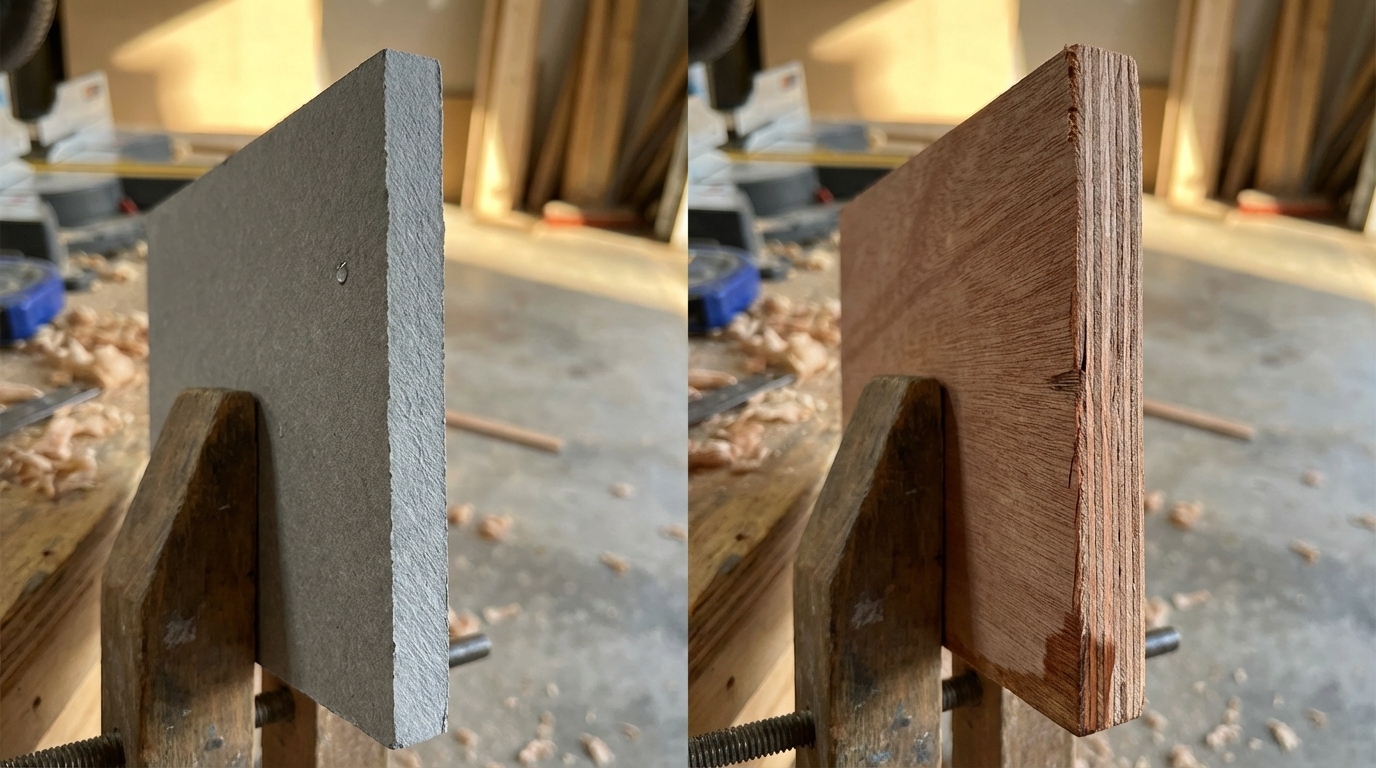
Cement board (fibre cement board) is the best choice for exterior cladding, bathroom walls, and wet areas where plywood fails due to moisture exposure.
If you're in a hurry: Fibre cement boards excel in weather-exposed applications—exterior facades, bathroom partitions, balcony ceilings, and areas with direct water contact. They resist moisture, termites, and fire without rotting or swelling. However, they're heavier, harder to cut, and don't hold screws as well as plywood. For interior furniture like wardrobes and kitchen cabinets, plywood remains the practical choice. Cement boards cost roughly ₹25–60 per square foot depending on thickness and brand, making them cost-competitive with marine plywood for exterior work.
- Choose cement board if: You need exterior cladding, bathroom wall partitions, false ceilings in humid zones, or fire-rated construction
- Choose cement board if: Termite resistance without chemical treatment is a priority
- Avoid cement board if: You need furniture construction, modular kitchen carcasses, or applications requiring multiple screw fixings
- Avoid cement board if: Your carpenter lacks experience cutting and installing cement-based panels
Key takeaway: Cement boards solve problems plywood cannot—water exposure, fire safety, and zero termite risk—but they're substrate materials, not furniture-building materials.
Note: sainik710.com is an independent informational site and is not affiliated with any cement board manufacturer or plywood brand.
What Cement Board Actually Means: Composition and Construction
Cement board, commonly called fibre cement board (FCB), is a composite panel made from Portland cement, silica, cellulose fibres, and mineral fillers pressed into flat sheets. Unlike wood-based panels, it contains no organic material that can rot, swell, or attract termites, making it fundamentally different from plywood, MDF, or particle board in its behaviour and applications.
The typical composition breaks down approximately as follows: cement forms 60-70% of the weight providing strength and water resistance, silica adds another 15-20% for hardite properties, cellulose fibres contribute around 10% for flexibility and crack resistance, and mineral fillers make up the remaining percentage. This composition creates a board that's dimensionally stable even when exposed to water—something no wood-based panel can claim.
How is fibre cement board different from regular cement sheets?
Fibre cement boards are engineered building panels with controlled density and consistent thickness, while traditional cement sheets (asbestos cement sheets from decades ago) were roofing materials with different properties. Modern FCB is asbestos-free, uses cellulose fibres for reinforcement, and meets specific building standards. The density typically exceeds 1,200 kg/m³, making these boards significantly heavier than plywood but also far more resistant to impact, moisture, and fire. Indian brands like Everest, Visaka, Shera, and Ramco manufacture boards compliant with IS 14862 standards.
Common misconceptions cleared
Many buyers confuse cement boards with gypsum boards or assume they can substitute plywood in furniture. Cement boards are substrate materials—meant for walls, ceilings, partitions, and cladding—not for building kitchen cabinets or wardrobes. They don't hold screws like plywood, cannot be edge-banded like engineered boards, and require specific installation techniques. The term "cement board" also gets confused with cement-bonded particle boards (which contain wood particles)—these are different products with different applications.
India-Specific Reality Check: Moisture, Termites, and Site Conditions
Fibre cement boards address three critical challenges in Indian construction: monsoon moisture, termite infestation, and fire safety compliance. Their performance in these conditions explains why architects and contractors increasingly specify them for specific applications, while plywood remains preferred for others.
Monsoon and coastal performance
During monsoon months when relative humidity exceeds 80-90% across coastal and eastern India, wood-based panels expand, warp, and risk fungal growth. Cement boards remain dimensionally stable because they contain no hygroscopic material. In Chennai, Mumbai, Kolkata, and Kerala's coastal regions, exterior applications using plywood—even marine-grade BWP—show edge swelling and delamination within 3-5 years. Cement board facades in the same conditions show minimal degradation over 15+ years when properly installed with appropriate gap allowances.
However, cement boards are not waterproof—they're water-resistant. They absorb some moisture but release it without dimensional change or structural damage. This distinction matters: submerged cement boards in standing water will eventually deteriorate, but exposure to rain, humidity, and occasional water contact causes no lasting damage.
Storage and handling on Indian construction sites
Indian site conditions present unique challenges. Cement boards are heavier than plywood—a 12mm board weighs approximately 17-18 kg/m² compared to 8-9 kg/m² for equivalent plywood. Single-person handling isn't practical for larger sheets. Boards must be stored flat on level surfaces; stacking on uneven ground causes permanent bowing. Unlike plywood that can tolerate some abuse, dropped cement boards crack and become unusable. Site storage should keep boards covered but ventilated—wrapping in plastic traps moisture and can cause efflorescence (white salt deposits on the surface).
Regional variations in specification
Coastal cities (Mumbai, Chennai, Kochi, Visakhapatnam) see cement boards specified almost universally for exterior cladding and bathroom partitions. Inland dry regions (Delhi NCR, Rajasthan, parts of Maharashtra) often use them primarily for fire-rating requirements rather than moisture resistance. Eastern India's high humidity zones (Kolkata, Guwahati, Bhubaneswar) benefit from cement board ceilings that won't sag like gypsum or grow mould like untreated plywood.
Types of Cement Boards Available in India
Four primary types of cement-based boards serve different construction needs, each with distinct properties, price points, and appropriate applications. Understanding these variations prevents specification errors and ensures optimal performance.
Fibre cement board (FCB) — the standard choice
Standard fibre cement board uses cellulose fibres as reinforcement and comes in densities from 1,200-1,400 kg/m³. These boards handle wall partitions, false ceilings, external cladding, and tile backing. Available thicknesses typically range from 4mm to 25mm, with 6mm and 8mm popular for ceilings, 10-12mm for partitions, and 16-20mm for heavy-duty flooring substrates. Brands like Everest, Visaka V-Board, and Shera dominate the Indian market. Price ranges from approximately ₹18-45 per square foot depending on thickness and brand.
High-density fibre cement board
High-density variants (sometimes marketed as SuperHD or Heavy Duty) exceed 1,400 kg/m³ density and offer superior impact resistance. These are specified for high-traffic areas, mezzanine flooring substrates, and applications requiring greater load-bearing capacity. They cost 20-30% more than standard FCB but justify the premium in commercial and industrial settings. For residential use, standard density boards suffice for most applications.
Cement-bonded particle board (CBPB)
Cement-bonded particle boards combine cement with wood particles rather than cellulose fibres. They offer better screw-holding than pure FCB and cost less, making them attractive for some partition applications. However, the wood content makes them somewhat less moisture-resistant than pure fibre cement boards. In India, these are less common than FCB but available from select manufacturers for budget-conscious projects.
Wood wool cement board (WWCB)
Wood wool cement boards (like Heraklith-type products) combine wood strands with cement, creating boards with excellent acoustic and thermal insulation properties. The open texture makes them unsuitable for smooth wall finishes but ideal for sound absorption in auditoriums, studios, and cinema halls. These are specialty products with limited availability and significantly higher costs than standard FCB.
Cement Board Applications: Where It Excels
Cement boards perform exceptionally in applications where plywood, MDF, or gypsum fail. Their water resistance, fire rating, and termite immunity make them irreplaceable for specific uses, though they're poorly suited for others.
Exterior cladding and facades
Fibre cement board cladding has become the standard for exterior facades in commercial and increasingly residential construction. Boards are mounted on metal or wood battens creating a rainscreen system with a ventilated gap behind. This assembly handles direct rain exposure, UV radiation, and temperature fluctuations without degradation. For textured or coloured facades, factory-painted cement boards eliminate site painting and offer 10-15 year colour warranties. Our detailed exterior material comparison guide covers cladding system options in depth.
Bathroom and wet area partitions
Bathrooms represent the most common residential cement board application. Partition walls, areas behind showers, and toilet cubicle panels use 10-12mm boards as tile substrates. Unlike gypsum-based greenboard that softens with prolonged moisture exposure, cement boards remain stable indefinitely. The boards must be sealed at joints with flexible waterproofing and tiles applied with cement-based adhesive—not organic adhesives that can fail in wet conditions.
False ceilings in humid zones
Gypsum false ceilings in high-humidity areas eventually sag, crack at joints, or develop mould. Cement board ceilings—while heavier and requiring stronger framing—remain flat and stable for decades. In Kerala's humid climate or Mumbai's monsoon-prone conditions, architects increasingly specify 6mm cement boards for bathroom ceilings and even living area ceilings in coastal homes.
Fire-rated construction
Cement boards meet fire-resistance standards that wood-based panels cannot. For compartmentalisation in commercial buildings, fireproofing around electrical panels, and kitchen exhaust duct enclosures, cement boards provide the required fire rating without additional treatment. They're non-combustible per testing standards (BS 476 Part 4, ASTM E84 Class A) and don't release toxic fumes when exposed to fire.
Modular construction and prefab housing
The prefabricated housing sector uses cement boards extensively for external walls and floor panels. Their dimensional stability during transport, consistent quality, and ease of factory finishing make them ideal for modular construction—a growing segment in India's affordable housing push.
Price Range and Cost Drivers (2026 Market)
Cement board prices in India range from approximately ₹15 to ₹60 per square foot, with thickness, density, brand, and finish being primary cost factors. Understanding these drivers helps buyers estimate project costs and identify appropriate product grades.
Thickness-wise price ranges
| Thickness | Typical Price Range (₹/sq ft) | Common Applications |
|---|---|---|
| 4mm | ₹12-20 | False ceiling backing, lightweight partitions |
| 6mm | ₹15-25 | Ceilings, interior wall lining |
| 8mm | ₹20-32 | Exterior cladding, partition walls |
| 10mm | ₹25-38 | Bathroom partitions, heavy-duty ceilings |
| 12mm | ₹30-45 | Structural partitions, tile backing |
| 16-18mm | ₹35-55 | Mezzanine substrate, heavy traffic areas |
| 20-25mm | ₹45-70 | Flooring substrate, industrial applications |
Why prices vary significantly
Brand premium: Established brands (Everest, Visaka, Shera) command 15-25% premiums over lesser-known manufacturers due to consistent quality, better warranties, and reliable supply chains. For visible applications or projects requiring documentation, branded boards justify the premium.
Density grade: High-density boards cost more but offer better impact resistance and load-bearing capacity. Standard density suffices for most residential applications; specify high-density only where required.
Pre-finished options: Factory-applied textures, colours, or UV-resistant coatings add ₹15-40 per square foot but eliminate site painting and offer longer warranties. For facades, pre-finished boards typically prove more economical than site painting over the project lifecycle.
City and logistics: Metro city prices run 10-15% higher than tier-2 towns. Remote areas face additional transport costs that can add ₹3-8 per square foot. Order quantities matter—full truck loads get better rates than partial orders.
Budget estimation for common projects
Bathroom partition (standard bathroom, 8x10 feet): 160-180 sq ft of board × ₹30-40/sq ft = ₹4,800-7,200 for material. Add framing, installation, and finishing for total partition cost of ₹12,000-20,000.
Exterior cladding (1,000 sq ft facade): 1,100 sq ft (allowing for wastage) × ₹35-50/sq ft = ₹38,500-55,000 for boards. Complete installed system including framing, fasteners, joint treatment, and painting typically runs ₹180-280 per square foot.
Head-to-Head Comparison: Cement Board vs Plywood
This comparison addresses the core question buyers face: when should you choose cement board over plywood, and vice versa? The answer depends entirely on application, not on which material is "better" in absolute terms.
| Parameter | Cement Board (FCB) | Plywood (BWP/Marine Grade) | Best For |
|---|---|---|---|
| Water Resistance | Excellent—no swelling or rot | Good (BWP)—but edges still vulnerable | FCB for direct exposure; plywood for protected areas |
| Fire Resistance | Non-combustible, fire-rated | Combustible, needs treatment | FCB for fire compliance |
| Termite Resistance | Complete—no organic content | Requires chemical treatment | FCB in termite-prone ground contact |
| Screw Holding | Poor—requires anchors/special screws | Excellent—standard screws work well | Plywood for furniture, hinges, handles |
| Weight (12mm) | ~17-18 kg/m² | ~8-9 kg/m² | Plywood for weight-sensitive applications |
| Workability | Difficult—needs diamond blades, creates dust | Easy—standard woodworking tools | Plywood for complex furniture joinery |
| Surface Finish | Smooth but requires painting/cladding | Accepts laminate, veneer, polish | Plywood for visible furniture surfaces |
| Dimensional Stability | Excellent in all conditions | Good when sealed; expands in moisture | FCB for exterior and wet areas |
| Cost (12mm, per sq ft) | ₹30-45 | ₹85-150 (BWP grade) | FCB is more economical for substrates |
| Lifespan (exterior use) | 20-25+ years | 5-10 years even with BWP | FCB for long-term exterior durability |
Choose cement board when...
- The application involves direct water exposure (bathroom walls, exterior cladding)
- Fire rating is required (commercial buildings, kitchen exhaust enclosures)
- Termites are a known problem and ground contact is unavoidable
- You need a tile substrate in wet areas
- Dimensional stability matters more than workability
Choose plywood when...
- Building furniture that needs hinges, handles, or multiple screw fixings
- The application is interior and protected from water
- Weight matters (overhead cabinets, ceiling-mounted units)
- Complex joinery or edge finishing is required
- Carpenters lack cement board cutting experience
For guidance on selecting the right plywood grade for interior work, our BWR vs BWP plywood comparison provides detailed decision frameworks.
Common Buyer Mistakes with Cement Boards
These errors appear repeatedly across Indian construction sites, leading to failures, rework, and disappointed buyers. Understanding them before specification saves significant cost and frustration.
Mistake 1: Using cement board for furniture carcasses
What goes wrong: Screws pull out, hinges fail, shelves sag, and the entire unit becomes unusable within months.
Why it happens: Buyers assume cement board's durability translates to furniture suitability. They don't understand that screw-holding capacity—not just strength—determines furniture viability.
How to avoid: Use cement board only for substrates and partitions. For kitchen cabinets, wardrobes, and furniture, specify plywood or HDHMR with appropriate edge banding.
Mistake 2: Ignoring thermal movement gaps
What goes wrong: Boards crack at joints, especially on exterior facades exposed to temperature swings between 15°C winter nights and 45°C summer afternoons.
Why it happens: Installers treat cement boards like gypsum, butt-jointing them tightly without expansion gaps.
How to avoid: Maintain 3-5mm gaps between boards, filled with flexible sealant. Never use rigid fillers or cement-based joint compounds on exposed installations.
Mistake 3: Cutting without dust control
What goes wrong: Silica dust from cutting causes respiratory issues for workers and coats surrounding surfaces, requiring extensive cleanup.
Why it happens: Workers use angle grinders without dust collection, treating the material like wood.
How to avoid: Use wet cutting methods or tools with vacuum dust collection. Provide N95 masks for all workers cutting cement board. Score-and-snap methods work for thinner boards and minimize dust.
Mistake 4: Inadequate frame spacing for thin boards
What goes wrong: Thin (4-6mm) boards sag between support points, creating wavy surfaces that show through paint.
Why it happens: Frame spacing designed for gypsum boards (typically 450-600mm) is applied to cement boards, which have different deflection characteristics.
How to avoid: Reduce frame spacing for thinner boards—300mm for 4mm boards, 400mm for 6mm boards. Use appropriate thickness for the span: 8mm minimum for 450mm spacing.
Mistake 5: Using wrong fasteners
What goes wrong: Standard drywall screws crack the board around the screw head, or screws rust and stain the surface.
Why it happens: Contractors use whatever screws are available rather than specified cement board screws.
How to avoid: Specify cement board screws (self-countersinking, corrosion-resistant) or use pre-drilled holes with appropriate wall plugs. For exterior applications, use only stainless steel fasteners.
Mistake 6: Applying incompatible finishes
What goes wrong: Paint peels, coatings blister, or finishes crack within the first monsoon season.
Why it happens: Using oil-based or standard wall paints instead of cement board-compatible coatings.
How to avoid: Apply alkali-resistant primer before any paint. Use acrylic or elastomeric paints for exterior applications. For tile application, use cement-based thin-set adhesive, not organic mastics.
Mistake 7: Improper storage causing damage before installation
What goes wrong: Boards arrive bowed, cracked, or with efflorescence staining.
Why it happens: Storing boards upright against walls, on uneven ground, or wrapped in plastic without ventilation.
How to avoid: Store flat on level supports, protected from rain but ventilated. Handle with care—cement boards crack when dropped. Inspect deliveries immediately and reject damaged boards.
Workmanship and Installation Guidelines
Proper installation determines whether cement boards deliver their promised performance. These guidelines help homeowners brief contractors and verify quality workmanship.
Cutting and fabrication
Three cutting methods work for cement boards, each with trade-offs. Score-and-snap works for straight cuts in boards up to 10mm—score the face with a carbide blade, snap along the line, then back-cut to separate. Minimal dust, but limited to simple cuts. Circular saw with diamond blade handles complex cuts and thicker boards but creates significant dust—use wet cutting or vacuum extraction. Angle grinder offers versatility but maximum dust generation—acceptable only with proper extraction and PPE.
Edge treatment after cutting matters: cut edges are more porous than factory edges. For wet areas, seal cut edges with waterproofing primer or sealant before installation.
Framing requirements
Steel framing (GI studs and tracks) is preferred over wood for cement board installations, especially in humid areas. Wood framing expands and contracts with humidity changes, potentially cracking the rigid boards. If wood framing is necessary, use treated timber and allow for movement at attachment points.
Frame spacing recommendations:
- 4mm board: maximum 300mm centres
- 6mm board: maximum 400mm centres
- 8mm board: maximum 450mm centres
- 10-12mm board: maximum 600mm centres
Fastening and fixing
Cement board screws should be driven 10-15mm from board edges to prevent cracking. Countersink screw heads flush with surface—over-driving breaks the surface and weakens holding. For wall partitions requiring heavy fixture mounting (bathroom accessories, grab rails), install plywood backing plates behind the cement board at fixture locations.
Joint treatment
Interior partitions: Use cement board jointing tape with appropriate compound, sanded smooth once cured. This creates a paintable surface suitable for interior finishes.
Exterior applications: Maintain expansion gaps (3-5mm) and fill with flexible polyurethane or silicone sealant. Do not tape exterior joints—rigid joint treatment will crack with thermal movement.
Carpenter briefing checklist
- Confirm experience with cement board installation—it differs significantly from plywood or gypsum work
- Verify availability of proper cutting tools and dust extraction
- Agree on frame spacing appropriate to board thickness
- Specify fastener type (cement board screws, stainless for exterior)
- Clarify joint treatment method based on application
- Establish storage location and handling procedures
- Agree on cleanup responsibility for cutting dust
Quality Checks Without Laboratory Tests
These field-verification methods help buyers identify quality issues before payment or installation, without requiring specialized equipment or laboratory analysis.
Visual inspection points
Surface consistency: Quality boards have uniform colour and texture across the surface. Patches of different shades indicate inconsistent curing or material mixing. Slight colour variation between boards from different batches is normal.
Edge examination: Factory edges should be clean and consistent. Chipped, crumbly, or irregular edges suggest poor manufacturing or handling damage. Cut edges are rougher than factory edges—this is expected.
Flatness check: Lay boards on a flat surface. Bowing exceeding 3-4mm over the length indicates improper storage or manufacturing defects. Minor bowing may flatten during installation, but significant curvature causes installation problems.
Simple field tests
Weight comparison: Weigh sample boards or compare similar-sized pieces. Significantly lighter boards indicate lower density and potentially inferior quality. A 6mm, 8×4 feet standard board should weigh approximately 26-28 kg.
Tap test: Tap the surface with knuckles. Quality boards produce a solid, consistent sound. Hollow sounds indicate internal voids or delamination. Dead or dull sounds suggest moisture absorption or compromised composition.
Moisture check: Board surfaces should feel dry. Damp boards may develop efflorescence (white salt deposits) as they dry, staining the surface permanently. If boards feel damp, allow them to dry completely before installation and inspect for staining.
Questions for dealers and suppliers
- What is the board density (should be specified, typically 1,200+ kg/m³)?
- What IS standard does the product meet (IS 14862 for fibre cement boards)?
- Is this a calibrated thickness or nominal? (Calibrated means consistent thickness)
- What is the manufacturing date? (Older than 6 months may have storage-related issues)
- What is the return policy for damaged boards?
- Are technical data sheets available?
Warning signs to reject boards
- Visible cracks, especially at corners or around the board perimeter
- White salt deposits (efflorescence) indicating prior moisture exposure
- Soft or crumbly edges that break when pressed
- Significant thickness variation (check with calipers at multiple points)
- Surface delamination where the face layer separates from the core
- Strong chemical odour indicating incomplete curing
Can Cement Board Be Used in Bathrooms?
Cement board is the preferred substrate for bathroom walls and floors in professional construction, outperforming alternatives like gypsum-based greenboard or even marine plywood in wet conditions. However, proper installation is essential—the board itself is only part of the waterproofing system.
For bathroom partitions and tile backing, specify 10-12mm fibre cement board mounted on steel framing. Seal all joints with waterproof membrane tape before applying tiles. Use cement-based thin-set adhesive rather than organic mastics, which can fail in prolonged moisture. Around shower areas, apply liquid waterproofing membrane over the entire board surface before tiling—the cement board resists water but isn't a complete waterproofing solution by itself.
Ceiling applications in bathrooms typically use 6-8mm boards. The additional weight compared to gypsum requires adequate framing, but the dimensional stability eliminates sagging and mould growth issues common with gypsum ceilings in humid bathrooms.
For comprehensive bathroom material guidance, our bathroom-grade plywood selection guide compares all substrate options with their trade-offs.
What Thickness of Cement Board Works Best for Different Applications?
Thickness selection depends on the application's structural requirements, frame spacing, and finish treatment. Under-specifying thickness creates performance problems; over-specifying wastes money and adds unnecessary weight.
4mm boards suit only non-structural applications with closely spaced framing—ceiling panel backing where additional material (gypsum, tiles) adds rigidity. Not recommended as exposed finish surfaces.
6mm boards work for false ceilings with standard 400mm frame spacing and interior wall lining where minimal impact resistance is needed. The most economical option for protected ceiling applications.
8mm boards provide the minimum practical thickness for exterior cladding and general partition walls. Adequate for most residential applications with proper framing.
10-12mm boards offer the standard specification for bathroom partitions, heavy-duty exterior cladding, and applications requiring tile finishes. This range handles normal residential and commercial loads.
16-20mm boards serve as floor substrates for tile and stone finishes, mezzanine decking, and industrial partition applications requiring impact resistance.
Bottom line: When uncertain, err toward thicker boards—the cost difference is modest compared to structural failure or visible deflection problems.
How Long Does Cement Board Last in Indian Conditions?
Properly installed fibre cement boards typically last 25-30 years or longer in Indian conditions, significantly outperforming wood-based alternatives in exterior and wet applications. The material doesn't rot, isn't affected by termites, and maintains dimensional stability through monsoon cycles.
Longevity factors include installation quality (proper gapping, appropriate fasteners, correct joint treatment), exposure severity (coastal salt air accelerates fastener corrosion but doesn't affect boards), and finish maintenance (exterior paint requires renewal every 5-8 years to maintain appearance and UV protection).
The primary failure mode isn't the board itself but the system around it—rusted fasteners, deteriorated sealants, failed waterproofing membranes, or improper framing that allows movement and stress. Regular inspection of these components extends system life. Cement boards that have been properly installed in Indian commercial buildings during the 1990s remain serviceable today.
Frequently Asked Questions
What is cement board made of and how does it differ from gypsum board?
Cement board is manufactured from Portland cement, silica, and cellulose fibres compressed into dense sheets, while gypsum board uses gypite (calcium sulphate dihydrate) sandwiched between paper facings. This fundamental composition difference explains their contrasting behaviour: cement board resists water and remains stable when wet, while gypsum board absorbs moisture, softens, and eventually disintegrates. Cement board weighs approximately twice as much as equivalent gypsum board, requires different fasteners and cutting techniques, and costs 40-60% more. For protected interior partitions and ceilings, gypsum board offers cost-effective performance. For wet areas, exterior applications, or fire-rated construction, cement board is the appropriate choice despite higher cost and installation complexity.
Can cement board be used for kitchen cabinets instead of plywood?
No, cement board is unsuitable for kitchen cabinet construction. Kitchen cabinets require excellent screw-holding capacity for hinges (which undergo thousands of cycles), shelf pins, drawer slides, and hardware attachment. Cement board's poor screw retention causes hinges to loosen, shelves to sag at supports, and hardware to pull out under normal use. Additionally, cement board cannot be edge-banded, laminated, or finished like plywood, and its weight makes overhead cabinets impractical. For kitchen carcasses, use BWR plywood (minimum 710 grade) or HDHMR boards with appropriate edge treatment. Cement board applications in kitchens are limited to wall cladding behind counters, fire-rated enclosures around exhaust ducts, or as substrate beneath counter tiles—not structural cabinet components.
Is cement board waterproof or just water-resistant?
Cement board is water-resistant, not waterproof—an important distinction. It absorbs some moisture but releases it without swelling, rotting, or dimensional change, unlike wood-based panels that expand and may develop fungal growth. However, prolonged submersion or continuous water exposure without drainage will eventually degrade cement boards. In bathroom and wet area applications, cement board serves as a stable substrate that requires additional waterproofing—typically liquid-applied membrane or sheet membrane—before tile installation. The combination of cement board substrate plus waterproofing membrane plus tiled finish creates a waterproof assembly. Using cement board alone without membrane treatment in shower enclosures or areas with standing water risks moisture migrating through joints and affecting the framing behind.
How does cement board pricing compare to marine plywood for bathroom applications?
For bathroom partitions and wet area substrates, cement board typically costs 50-70% less than marine-grade (BWP) plywood while delivering superior moisture performance. A 12mm cement board runs approximately ₹30-45 per square foot, while equivalent BWP plywood costs ₹85-150 per square foot depending on brand and quality. However, total installed cost narrows this gap somewhat: cement board requires metal framing (typically ₹25-35 per square foot for material and installation), special fasteners, and different labour skills. Still, cement board partitions usually work out 25-40% cheaper than marine plywood alternatives while lasting longer in wet conditions. The cost advantage combined with superior moisture resistance makes cement board the professional choice for bathroom construction—plywood is primarily used in bathrooms when homeowners insist on familiar materials or carpenters lack cement board experience.
What tools are needed to cut and install cement board?
Basic cement board installation requires scoring knives with carbide blades (for score-and-snap cuts in thinner boards), a circular saw fitted with diamond-tipped or carbide-grit blade (for complex cuts and thicker boards), cement board screws with matching driver bits, and appropriate safety equipment including N95 dust masks, safety glasses, and hearing protection. For professional installation, add a grinder with vacuum attachment for dust control, a carbide-tipped hole saw for pipe penetrations, and a wet tile saw for precision cuts without airborne dust. Unlike plywood, standard woodworking blades dull immediately on cement board, and the silica content creates hazardous dust requiring proper respiratory protection. Score-and-snap techniques minimize dust but only work for straight cuts in boards up to approximately 10mm thickness.
Does cement board need special treatment before painting?
Yes, cement board requires alkali-resistant primer before painting regardless of the finish paint type. Fresh cement board has high alkalinity that attacks standard paint binders, causing peeling, blistering, and adhesion failure. Apply primer specifically formulated for cementitious surfaces—these are labelled as alkali-resistant or suitable for cement/concrete substrates. After priming, use acrylic or elastomeric paints for exterior applications, which accommodate slight board movement without cracking. Interior applications can use standard wall paints over proper primer. Allow new cement boards to cure for at least 28 days before painting if possible, though properly specified primers can accommodate shorter curing periods. For textured finishes, apply the texture coat over primer; for smooth finishes, skim coat joints and screw heads with appropriate cement board compound before final painting.
Can cement board be used for outdoor furniture or garden applications?
Cement board can serve as a table top substrate, bench seating surface, or planters base in outdoor applications, but with important limitations. Its dimensional stability in weather makes it suitable for exposed locations, but it still cannot function as structural furniture. For an outdoor table, cement board works as the top surface over a separate structural frame (metal or treated timber), with tiles, stone, or weather-resistant coating as finish. The same applies to bench seats—cement board provides a durable surface on a structural frame. For planters, cement board panels work as cladding over waterproofed frames, not as self-supporting containers. The poor screw retention means no hinged applications, movable joints, or hardware attachment—outdoor furniture using cement board must rely on the supporting frame for all structural connections.
What causes white stains on cement board and how can they be prevented?
White stains on cement board are efflorescence—salt deposits that migrate to the surface when water moves through the material and evaporates. This occurs when boards absorb moisture during storage or installation and then dry out, carrying dissolved salts to the surface. Prevention involves proper storage (covered but ventilated, never wrapped in plastic), keeping boards dry before installation, and avoiding installation during monsoon without protection. If efflorescence appears before finishing, it can usually be removed by dry brushing followed by damp wiping with dilute acid solution (muriatic acid at 10-15% concentration), then thorough rinsing. Efflorescence under paint is more problematic and may require scraping, treating, and repainting. For permanent prevention, apply silane or siloxane-based sealer to unpainted exterior boards—these allow moisture vapour to escape while preventing liquid water penetration.
Is cement board termite-proof compared to treated plywood?
Cement board is completely termite-proof by composition—it contains no organic material that termites consume. Treated plywood, while significantly more termite-resistant than untreated wood, relies on chemical treatments that can degrade over time, especially at cut edges that expose untreated core. In high-termite-risk areas like coastal regions, ground-contact applications, or buildings with known termite histories, cement board provides permanent protection without treatment renewal. However, this comparison applies only to substrate selection—if cement board partitions are framed with untreated wood, termites may attack the framing while ignoring the boards. For complete protection in termite-prone areas, combine cement board cladding with steel framing or chemically treated timber, and maintain the building's termite management system including soil treatment and monitoring.
How do you repair damaged cement board?
Minor surface damage (shallow gouges, small cracks) can be filled with cement board patching compound, sanded smooth when cured, and painted. For larger holes or through-damage, cut out the damaged section in a rectangle to the nearest framing members, install additional noggins if needed, and fit a patch piece of the same thickness secured with cement board screws. Treat the patch joints with appropriate tape and compound for interior applications or flexible sealant for exterior use. For boards with delamination, extensive cracking, or moisture damage affecting more than 10-15% of a panel, full replacement is more practical than repair. Unlike plywood where damage often spreads, cement board damage typically remains localised—repairing one area doesn't compromise adjacent sections. Keep several spare pieces from the original installation batch for future repairs to ensure matching thickness and colour.
Can standard carpenters install cement board or does it require specialists?
Standard carpenters can install cement board with proper training and tool preparation, though specialists deliver better results for complex or large-scale projects. The key differences from wood-based work include: cutting technique (score-and-snap or power tools with diamond blades, not standard wood blades), dust management (silica dust requires respiratory protection and cleanup), framing requirements (often metal rather than wood), and fastening approach (cement board screws, not drywall screws). Carpenters experienced with gypsum board installation adapt relatively easily—the framing concepts are similar, though cement board's weight and cutting requirements differ. For simple partitions or ceiling installations, a briefed carpenter handles the work adequately. For exterior cladding systems requiring proper weatherproofing details, drainage planes, and flashing integration, engage contractors with specific cement board facade experience. The installation itself isn't highly specialized, but understanding the complete water management system requires experience beyond basic carpentry skills.
What is the weight difference between cement board and plywood, and why does it matter?
Twelve-millimetre cement board weighs approximately 17-18 kg per square metre, while equivalent plywood weighs 8-9 kg per square metre—cement board is roughly twice as heavy. This weight difference matters for several reasons: ceiling installations require stronger framing and more support points, reducing frame spacing compared to gypsum or plywood; overhead handling during installation is more difficult and may require additional workers; wall partitions transfer more load to floor structures, potentially relevant in renovation projects with existing building calculations; and transportation costs increase, particularly for large orders. For ceiling applications, the weight requires calculation of total suspended load and verification that the supporting structure handles it safely. For wall partitions, weight is typically manageable with standard metal stud systems. The weight penalty is the trade-off for cement board's moisture stability, fire resistance, and durability—acceptable for applications where these properties are essential, but unnecessarily burdensome for protected interior furniture applications where plywood suffices.
Making the Right Material Decision
Cement board and plywood serve fundamentally different purposes in Indian construction. Treating them as interchangeable alternatives leads to the specification errors and installation failures documented throughout this guide. The decision framework is straightforward: cement board excels as a substrate material for wet, exterior, and fire-rated applications where its moisture immunity, dimensional stability, and non-combustibility provide essential performance. Plywood excels for furniture construction, interior cabinetry, and applications requiring screw-holding, edge finishing, and workability that cement board cannot provide.
For homeowners planning bathrooms, exterior facades, or construction in coastal and high-humidity regions, cement board investment pays dividends through decades of maintenance-free performance. For modular kitchens, wardrobes, and interior furniture, quality plywood with appropriate moisture resistance grades remains the practical choice that carpenters understand and hardware supports. Many projects appropriately use both materials—cement board for bathroom partitions and exterior cladding, plywood for kitchen cabinets and bedroom wardrobes—each specified where its properties provide optimal value.
Verify contractor experience before specifying cement board, ensure proper tools and safety equipment are available for cutting, and confirm that the complete installation system—framing, fasteners, joint treatment, finishes—is designed for cement board rather than adapted from wood-based panel practices. With appropriate specification and skilled installation, fibre cement boards deliver the performance that has made them standard for exterior and wet area construction across commercial and increasingly residential Indian projects.
Disclaimer: This content is provided for general informational purposes based on industry practices and publicly available information. Product specifications, standards, prices, and availability may vary by manufacturer, region, and time. Readers should independently verify details with manufacturers, dealers, or qualified professionals before making purchase or construction decisions.Want Plywood Suggestions?
Share a few details and a Sainik 710 specialist will suggest suitable brands and connect you to responsive dealers.