Bookshelf Design Ideas: 30+ Modern, Wall-Mounted & Corner Designs for Home
Explore 30+ bookshelf designs—wall-mounted, corner & modern styles. Get size guide, material options & space-saving solutions for home libraries.
Quick Answer: Which Bookshelf Design Actually Works Best?
The best bookshelf design depends on three things—your wall space, what you're storing, and whether you rent or own. Wall-mounted floating shelves work brilliantly for small flats, corner units rescue dead space, and floor-to-ceiling built-ins make sense only if you're staying put for years.
Short version: Don't pick a bookshelf design from Pinterest and expect it to work in your Mumbai 2BHK. Indian homes have specific challenges—humidity that warps cheap boards, walls that can't always handle heavy loads, and rental restrictions that rule out permanent installations. Focus on your actual room dimensions, load requirements, and whether you need flexibility to move things around. The prettiest design means nothing if it sags in two monsoons.
This guide is right for you if:
- You're planning a home library or reading corner and want designs that actually last
- Living in a rental and need options that won't anger your landlord
- Trying to maximize storage in a compact flat
- Your carpenter keeps suggesting the same boring design and you want alternatives that work with Indian plywood grades
Skip this if:
- You just want to buy a ready-made bookshelf from IKEA or Urban Ladder—this is about custom-built solutions
- Budget is under ₹8,000 and you're not willing to invest in decent materials
Bottom line: A good bookshelf design balances aesthetics with structural reality—and in India, that means accounting for humidity, wall quality, and the fact that books are surprisingly heavy.
What We Actually Mean by Bookshelf Design
Bookshelf design is the structural planning of storage units meant to hold books, display items, and organize a space—covering everything from material selection and load distribution to visual proportions and mounting methods. It's not just about how it looks; it's about whether the thing will still be standing in five years.
Most people think bookshelf design is purely a style choice. Actually, it's an engineering problem disguised as décor. I've seen beautiful geometric bookshelves from Instagram crack at the joints within eighteen months because nobody calculated the weight of 200 hardcovers. A standard paperback weighs 200-300 grams, but stack fifty of them and you're looking at 12-15 kilos on a single shelf. Add coffee table books and the numbers get serious fast.
The design has to account for shelf span (how far wood can stretch without support before it bends), wall anchor points, material thickness, and—here's what most online guides miss—the specific plywood or board you're using. MR grade plywood behaves completely differently from BWP marine ply or HDHMR boards. Your design needs to match your material, not the other way around.
Oh, and there's the Indian apartment factor. Most of our walls are brick with plaster, which holds anchors well. But newer constructions sometimes use AAC blocks or even drywall partitions that can't handle wall-mounted units without special reinforcement. Ask before you drill.
Why Bookshelf Design Matters More in Indian Homes
Here's the thing about Indian conditions—they're brutal on furniture. During monsoon, humidity in coastal cities like Mumbai, Chennai, and Kolkata regularly hits 80-90% RH. That moisture seeps into poorly sealed edges and causes swelling, warping, and eventually that depressing sag in the middle of your shelf.
In places like Chennai or Mumbai, you'll notice books developing that musty smell within a year if the shelf design doesn't allow air circulation. Closed-back bookshelves trap moisture against the wall, especially on exterior-facing walls where condensation builds up. I've seen mold growing behind bookshelves in Bandra flats—not pretty.
Bangalore and Pune have it slightly better with moderate humidity (50-70% most of the year), but they get sudden temperature swings that cause expansion and contraction. Hyderabad and Delhi face dust issues instead—open shelves look great but need constant cleaning unless you're okay with that grey film on everything.
Coastal vs inland makes a real difference in material choice. For Goa, Kochi, or the Konkan belt, I'd never recommend anything less than BWP grade plywood or marine-rated HDHMR. For drier places like Jaipur or Ahmedabad? Standard MR grade works fine if you're not putting it in a bathroom-adjacent area.
30+ Bookshelf Designs That Actually Work
Right, let's get into the designs themselves. I'm organizing these by type because that's how you'll actually make decisions—first figure out what category works for your space, then pick within that.
Wall-Mounted Floating Shelves (Best for Small Spaces)
Floating shelves are individual planks mounted directly to the wall with hidden brackets, creating that clean "hovering" look. They're perfect for rentals because you can patch the holes later, and they work in tight spaces where floor-standing units would feel bulky.
Standard depth runs 8-10 inches for paperbacks, 12 inches for larger books. Thickness matters more than people realize—18mm plywood minimum, though I'd push for 25mm if the shelf span exceeds 60cm. Anything less and you'll see that gradual bow developing by monsoon three.
A client in Powai did three floating shelves in their living room last year, 90cm spans with 16mm ply because the carpenter said it would be "fine." It wasn't fine. By December, the middle shelf was visibly curved. Had to add a center support bracket, which killed the whole floating aesthetic they'd wanted.
Honest take: Floating shelves look incredible in photos but they're fussy to get right. The wall anchors need to hit solid masonry, the wood needs to be properly seasoned, and you can't overload them. Great for displaying select books and objects. Terrible if you're trying to store your entire Penguin Classics collection.
Floor-to-Ceiling Built-In Units (Best for Serious Readers)
This is the library dream—full wall coverage from floor to ceiling, typically with adjustable shelf heights and sometimes integrated ladder rails for the high stuff. Absolutely stunning when done right. Also expensive and permanent.
Built-ins make sense when you own your place and have a dedicated room or wall that won't change. The per-square-foot cost runs higher because you're essentially doing custom carpentry, but you maximize every inch of vertical space. In a city where floor area costs ₹15,000+ per square foot, using vertical space is just smart economics.
Material recommendation here is blockboard or commercial plywood with good veneer. Don't use particle board for built-ins—the adjustable shelf pins will slowly enlarge the holes and your shelves will start sliding. I've seen this happen in maybe 6 out of 10 particle board installations after three years.
Corner Bookshelf Designs (Best for Dead Spaces)
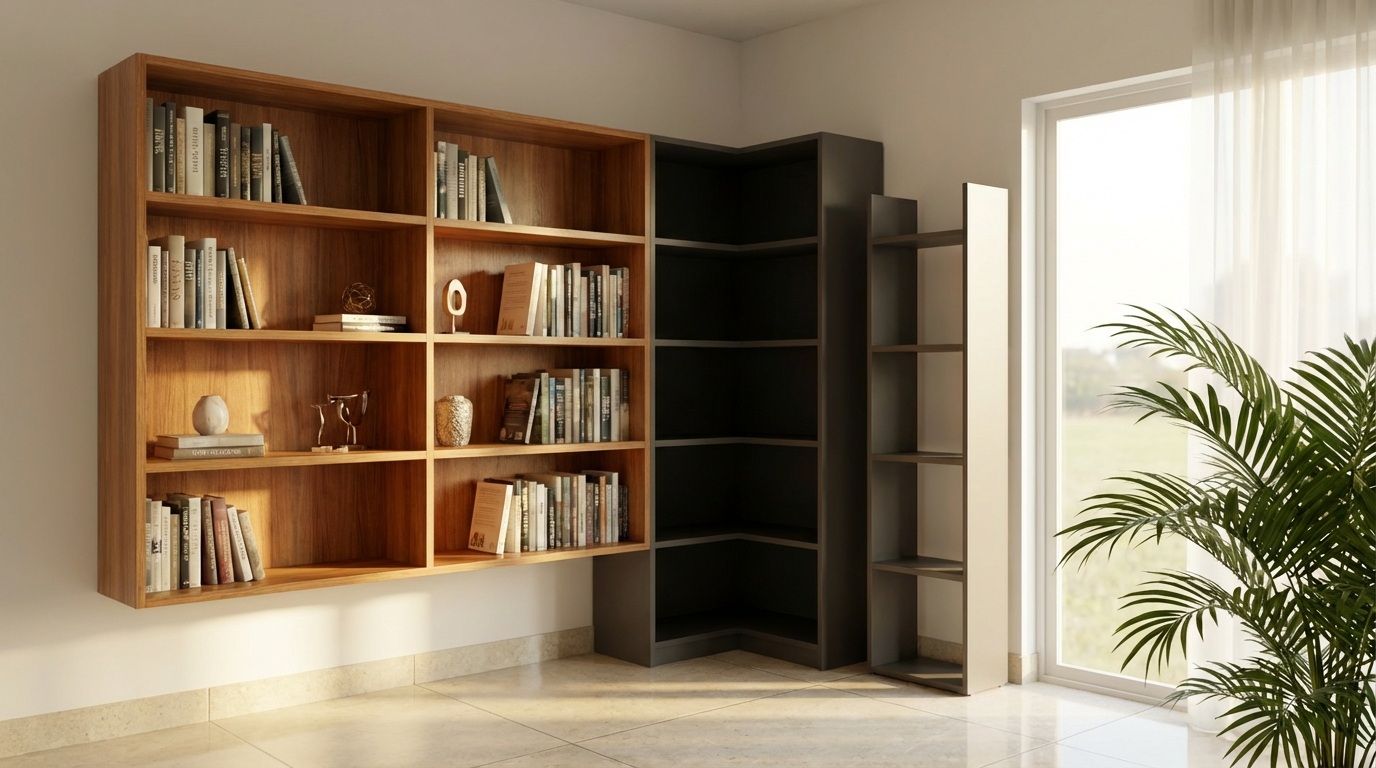
Corner units rescue those 90-degree angles where nothing else fits. You've got two main approaches—triangular shelves that tuck into the corner, or L-shaped units that wrap around it.
The triangular floating corner shelf is popular for apartments. Looks modern, takes minimal material, creates display space. But the weight capacity is limited because the support is only on two edges meeting at a point. Fine for a few books and plants. Not for your engineering textbooks.
L-shaped corner units with vertical supports handle more weight and give you usable deep storage on both wall faces. These work well in bedrooms or home offices where you want everything accessible from one spot. The construction is more complex—you need proper joinery where the two sections meet, not just screws into end grain.
Modular and Cubical Systems (Best for Flexibility)
Modular bookshelves are made of individual box units that stack and combine in different configurations. You can start with four cubes, add more later, rearrange them when you move. IKEA popularized this concept, and now local manufacturers offer similar systems.
If I'm being honest, modular systems from Indian brands vary wildly in quality. Some use proper 18mm plywood with good edge banding. Others use 12mm particle board that chips within a year. Check the edge finish—if it's paper-thin laminate tape that's already peeling in the showroom, walk away.
The cube dimensions matter for what you're storing. Standard cubes run 30-35cm internal width, which fits most paperbacks standing up but not lying flat. Coffee table books need at least 35cm clear width. Measure your actual books before committing.
Ladder Bookshelves (Best for Minimal Footprints)
Ladder bookshelves lean against the wall at an angle, with progressively smaller shelves as you go up. They occupy minimal floor space—maybe 45cm depth at the base—and create visual interest with that tapering profile.
Structurally, these are simple. Two angled sides with horizontal shelves between them. The angle matters for stability—around 15-20 degrees off vertical works. Too steep and it takes up floor space. Too vertical and it feels tippy.
My concern with ladder shelves is they're not actually fixed to the wall in most designs. That's a problem if you have kids or pets. A solid knock and the whole thing goes. Worth adding a discreet wall strap at the top if you go this route.
Is a Built-In Bookcase Actually Worth the Extra Cost?
For owned homes where you plan to stay 10+ years, absolutely. Built-ins add to property value, maximize awkward spaces like recessed walls or under-stair areas, and they simply hold more books per square foot than any freestanding alternative. The cost premium runs 40-60% over equivalent freestanding units, but you're getting permanent storage that becomes part of the architecture. For rental apartments? Not worth it. You can't take it with you, and the landlord won't compensate you for improvements. Stick with freestanding or wall-mounted options you can remove without destroying the walls.
Material Options for Bookshelf Construction
Alright, this is where most design guides get vague and I'm going to get specific. Your material choice affects everything—weight capacity, moisture resistance, lifespan, and whether that beautiful design stays beautiful.
| Material | Best For | Avoid When | Thickness Needed | Moisture Resistance | My Take |
|---|---|---|---|---|---|
| BWP Marine Plywood | Humid cities, near windows, permanent installations | Tight budgets | 18-19mm for shelves, 12mm for backs | Excellent | Gold standard but expensive |
| Commercial Ply (MR Grade) | Dry climate interiors, bedrooms, living rooms | Coastal areas, kitchens, balcony-adjacent walls | 18mm minimum | Moderate | Good balance of cost and performance |
| HDHMR | Modern finishes, CNC work, moisture-prone areas | Visible screw-head installations, very heavy loads | 18mm | Good (if quality brand) | Underrated option for bookshelves |
| Particle Board | Budget projects, light display items | Any serious load, humid areas, long-term use | 18-25mm | Poor | Honestly, skip it for books |
| Blockboard | Long spans, heavy loads, built-ins | Thin shelves, curved designs | 19mm | Varies by grade | Excellent for floor-to-ceiling units |
| Solid Wood | Visible shelves, statement pieces, heirloom quality | Budget constraints, CNC requirements | 22-25mm | Good (if sealed) | Beautiful but learn to live with wood movement |
Quick note on HDHMR—our detailed HDHMR guide covers this more thoroughly, but for bookshelves specifically, it machines beautifully and takes paint or laminate finishes well. The screw-holding isn't as strong as plywood though, so for adjustable shelf systems with pin supports, I'd still lean toward commercial ply.
What Plywood Thickness Works Best for Bookshelf Spans?
This depends entirely on how far the shelf stretches between supports. For spans under 60cm, 16mm works but 18mm is safer. For 60-80cm spans, go 18mm minimum—19mm for commercial ply is even better. Anything over 80cm unsupported, you need either thicker material (25mm) or a center support. Books are deceptively heavy. A meter-long shelf of tightly packed paperbacks carries 25-35kg. That load, applied continuously over years, will bow even decent plywood if the span is too long. The formula I use: maximum span (in cm) equals thickness (in mm) times 4. So 18mm ply should max out at 72cm spans. Conservative, but I've never had a sagging complaint using this rule.
Size and Dimension Guide
I keep running into the same mistake—people designing shelves around aesthetics without measuring what they're actually storing. Here's the practical breakdown:
Shelf depths:
- Paperbacks and standard novels: 8-10 inches (20-25cm)
- Hardcovers and textbooks: 10-12 inches (25-30cm)
- Coffee table books, art books: 14-16 inches (35-40cm) minimum
- Mixed use with display objects: 12 inches works as a compromise
Shelf heights between units:
- Standard paperbacks: 9-10 inches clear height
- Hardcovers: 12-13 inches
- Large format books: 15+ inches
- Display items with books: 14-16 inches gives breathing room
Overall unit dimensions:
- Standard bookcase width: 80-100cm (manageable for single-piece transport)
- Floor-to-ceiling height: leave 50-75mm gap at ceiling for installation
- Floating shelf lengths: 60-90cm per unit (beyond 90cm, add center support)
And here's something most guides won't tell you—leave 5mm extra depth beyond your deepest book. Books get pulled in and out, they don't sit perfectly flush, and that small buffer prevents them from constantly catching on the front edge.
Price Reality Check for Custom Bookshelves (2026 Market)
I'm not giving exact prices because they vary wildly by city, but here's the rough framework:
Floating shelves (3-shelf set):
- Particle board with laminate: ₹2,500-4,000
- Commercial plywood with veneer or paint: ₹5,000-8,000
- BWP ply with premium finish: ₹8,000-12,000
Floor-to-ceiling built-in (per running foot of base width):
- Basic commercial ply with laminate: ₹1,800-2,500/sqft
- Good quality with soft-close mechanisms, lighting: ₹2,800-4,000/sqft
- Premium with solid wood facing, library ladder: ₹4,500+/sqft
What actually affects your final bill:
- Edge banding type—PVC vs ABS vs solid wood lipping (₹15-60/meter difference)
- Hardware quality—local vs imported hinges and brackets
- Finish—paint, laminate, veneer, or PU lacquer (massive cost jumps between these)
- Installation complexity—wall mounting needs masonry anchors, proper leveling
- Carpenter skill—good carpenters charge more but waste less material
Budget tip: the back panel is hidden. Use 6mm MR ply instead of 12mm for backs and redirect that saving to thicker shelves. Nobody sees the back, but everyone sees a sagging shelf.
Design-Specific Recommendations
| Your Situation | Recommended Design | Why This Works |
|---|---|---|
| Rental flat, less than 2 years planned stay | Freestanding ladder shelf or modular cubes | No wall damage, portable when you move |
| Owned apartment, dedicated reading room | Floor-to-ceiling built-in with adjustable shelves | Maximizes wall space, adds property value |
| Small bedroom, need storage + display | Wall-mounted floating shelves above desk | Doesn't consume floor area, doubles as headboard visual |
| Living room with awkward corner | L-shaped corner unit with base cabinet | Turns dead space into feature, lower section hides clutter |
| Kids' room, growing collection | Modular cube system at low height | Child-accessible, can add modules as collection grows |
| Home office, professional appearance | Built-in with closed lower cabinets, open upper shelves | Shows books on video calls, hides files and cables |
| Humid coastal apartment | Wall-mounted with 2" gap from back wall | Air circulation prevents moisture trap behind unit |
| Minimalist aesthetic | Invisible/hidden bracket floating shelves in single line | Clean look, books appear to float |
Can You Install Heavy Bookshelves on Partition Walls?
Depends entirely on what the partition is made of. Brick partitions? Usually fine with proper anchors—use expansion bolts, not just plastic rawl plugs. AAC blocks? Trickier. You need specialized AAC anchors and should distribute load across multiple points. Drywall or gypsum partitions? This is where I get nervous. Drywall alone won't hold a loaded bookshelf. You need to locate the metal studs behind the drywall and anchor directly into those, or use toggle bolts rated for the weight. Even then, I wouldn't put a full built-in on drywall. For partition wall situations, I usually recommend floor-standing units that lean against the wall but carry their own weight through the base.
Common Bookshelf Design Mistakes
Ignoring span-to-thickness ratios. Already covered this, but it's the number one cause of sad-looking bookshelves. That beautiful long floating shelf in the Houzz photo probably has a steel bracket inside. Yours won't unless you specify it.
Forgetting about access. A floor-to-ceiling bookshelf is great until you need to reach the top shelf daily. Build in a sliding ladder, keep rarely-used items high, or accept that you're getting a step stool. One client designed a gorgeous 10-foot high wall unit and then realized she's 5'2". Now she uses the top three shelves for "decorative items only."
Skipping the back panel entirely. Open-back bookshelves look airy and modern. They also show every wire, every paint imperfection, and every bit of dust behind the unit. If your wall isn't perfectly finished, add a back panel. It doesn't have to be thick—6mm ply painted to match is enough.
Uniform shelf spacing. This one really frustrates me. I see designs with perfectly equal 12-inch spacing throughout. But books aren't uniform. You end up with wasted space above paperbacks and not enough height for art books. Always mix shelf heights, or better yet, use adjustable shelf pins so you can reconfigure later.
Overlooking the weight of the unit itself. A large plywood bookshelf is heavy before you add a single book. That 8-foot built-in might weigh 60-80kg empty. Make sure your floor can handle it, especially in older buildings with wooden flooring over concrete.
Poor lighting planning. Books need light for browsing. A bookshelf in a dim corner becomes storage, not a library. Plan for LED strip lighting inside, or at least ensure ambient room lighting reaches the shelves. Retrofitting lights after the unit is built means visible wires and awkward positioning.
Sealing only visible edges. Your carpenter might seal the front edges beautifully with veneer or ABS tape. But if the top edges (facing the ceiling where "nobody sees") are left raw, moisture enters from there. In humid climates, this causes swelling that shows as warped shelves. Seal all edges, visible or not.
Choosing style over function for the finish. Matte painted surfaces look sophisticated. They also show every fingerprint and are hard to clean. Gloss finishes are easier to maintain but show dust more. Laminate is practical but can look cheap if you go for the budget options. Think about who's using this bookshelf and how often it gets touched.
Quality Checks Before Accepting Delivery
Visual inspection:
- Check all edge banding—run your finger along every edge looking for peeling or gaps
- Look down each shelf lengthwise for any existing bow or twist
- Examine corners for proper joinery, not just screws into end grain
- Verify hardware is actually what was quoted (local vs branded)
- Test adjustable shelf pins—they should fit snugly, not wobble
- Check that back panels are properly attached, not just sitting in grooves
Questions to ask your carpenter or supplier:
- "What grade plywood did you use? Show me the stamp."
- "What's the core material—block, MDF, particle, or veneer ply?"
- "What edge banding is this—PVC, ABS, or paper tape?"
- "How was this joined—dowels, screws, cam locks, or biscuits?"
- "What finish is on the inside surfaces?"
Field tests you can do:
- Tap test: Solid plywood sounds dull and dense. Hollow-core or particle sounds echoey and thin. Tap the shelf surface and listen.
- Weight check: Good plywood has weight to it. If a 4-foot shelf feels surprisingly light, question the material.
- Flex test: Press down in the center of an unmounted shelf. Quality 18mm ply barely flexes. Particle board or thin ply bends visibly.
- Edge check: The edge cross-section should show consistent layers if it's plywood, or dense uniform material if it's HDHMR. Voids or loose layers are red flags.
Here's a trick most dealers don't like—ask to see the offcuts from your job. The edge of an offcut shows the true cross-section of the board used. If they can't produce any offcuts, ask yourself why not.
Why Do Some Bookshelves Sag While Others Don't?
Three factors: material quality, span length, and load distribution. A bookshelf sags when the material's stiffness can't resist the sustained load over the span distance. Particle board sags fastest because its density is inconsistent—there are weak points. Plywood resists better because the cross-grain layers distribute stress. Blockboard is best for long spans because the solid timber core handles load excellently. But even good material sags if the span is too long or the load is concentrated. Spread your heavy hardcovers across multiple shelves rather than loading one shelf with all your encyclopedias. And when storing long-term, rotate book positions occasionally to let stressed areas recover.
Workmanship and Installation Tips
Cutting requirements: All cuts should be made with sharp, fine-toothed blades to prevent chip-out on laminated surfaces. For floating shelves, ask for CNC-cut pieces if precision matters—hand-cut edges on veneered ply often chip.
Edge sealing matters enormously. Unsealed edges absorb moisture, swell, and eventually delaminate. For permanent installations, use 2mm PVC or ABS edge banding, heat-applied with proper rollers. For visible edges on premium work, solid wood lipping (painted or stained to match) outlasts any tape.
Fastener guidance: Wall mounting needs masonry anchors, not just plastic plugs. For heavy units, use M8 or M10 expansion bolts into brick. For shelf brackets, 8mm screws minimum, longer if going into plywood end grain. Pre-drill always—especially with HDHMR, which can crack if you drive screws directly.
What to tell your carpenter:
- Specify exact material: "BWP ply" or "commercial MR" not just "good ply"
- Insist on edge banding all surfaces including top edges
- Maximum shelf span is X centimeters (give them your calculated number)
- Adjustable shelves need proper 5mm shelf pin holes at 32mm spacing
- Back panel should be screwed, not just slotted
- Finish inside surfaces before assembly, not after
Storage and acclimatization: If your plywood was stored in a humid godown and your apartment is air-conditioned, give the material a few days to adjust before installation. This reduces post-installation warping. Keep finished units away from direct sunlight to prevent uneven fading.
I've seen carpenters skip the edge sealing on top edges to save time. "No one sees it," they say. A builder in Andheri learned this the hard way—beautiful walnut veneer bookshelf, top edges left raw, and within one monsoon the veneer started lifting at the corners. ₹45,000 unit ruined by ₹500 worth of edge tape they didn't bother applying.
How Long Will Your Bookshelf Actually Last?
With proper materials and workmanship:
- BWP plywood with good finish: 15-20+ years
- Commercial MR ply in dry conditions: 12-15 years
- HDHMR with sealed edges: 10-15 years
- Particle board: 3-5 years before visible degradation
In my experience, well-maintained plywood bookshelves in Mumbai last about 12-15 years before needing significant work—and that "significant work" is usually refinishing, not structural replacement. The wood itself is often fine; the laminate or paint ages.
What affects longevity:
- Humidity control—AC-cooled rooms see less expansion/contraction cycling
- Load management—chronically overloaded shelves stress joints
- Sun exposure—direct sunlight fades finishes and dries out wood
- Cleaning habits—water spills left unwiped cause surface damage
Signs it's time for repair or replacement:
- Visible shelf bow that doesn't correct when unloaded
- Edge banding peeling in multiple spots
- Joint loosening—shelves wobble or frames rack
- Swelling or delamination at edges
- Finish worn through to raw material
Alternatives Worth Considering
If budget is tight, consider the stepped approach: buy quality modular cubes (individual boxes, not particle board flat-packs) and add to them over time. Four well-made cubes from a local carpenter cost less than a full wall unit but serve immediate needs. Expand later.
If you need better moisture resistance than standard options, look at exterior-grade HDHMR or even WPC (wood plastic composite) boards for shelf surfaces. They're heavier and harder to work with, but essentially waterproof. Our HDHMR vs plywood comparison guide covers this more thoroughly if you're deciding between those options.
If you want that solid wood look without the cost, consider plywood with real wood veneer faces. From a distance, it's indistinguishable from solid timber but costs 40-50% less and is more stable in varying humidity. The veneer plywood selection guide has recommendations for book shelf applications.
For renters who'll move frequently, those Swedish-style knock-down systems actually make sense. Yes, they're mostly particle board. Yes, they'll last maybe one or two moves. But they're cheap enough to abandon if needed, and you're not leaving holes in walls or abandoning custom work.
Frequently Asked Questions
What's the ideal depth for a bookshelf if I have mixed book sizes?
Go with 12 inches (30cm) as your standard depth. This accommodates hardcovers lying down and most paperbacks standing up, with some room for display items in front. It's deeper than minimum for paperbacks (which only need 8-9 inches) but saves you from the frustration of coffee table books hanging over edges. If you're building adjustable shelving, you can place shallower shelves (10 inches) higher up where you'll store standard novels, and deeper shelves (14-15 inches) at mid-height for oversized books. The bottom shelf, if accessible, works well at 16 inches for those large art books or storage boxes.
Is it true that floating shelves can't hold many books?
Common belief, but not quite accurate. Floating shelves can hold substantial weight—it's about the bracket design, not the concept itself. Hidden steel rod brackets rated for 20-30kg per shelf exist and work fine for books. The limitation is span length, not load per se. Keep individual floating shelves under 80cm and use quality steel brackets (not aluminum), and you can load 15-20 books per shelf without issues. The cheap L-brackets some carpenters use are the problem, not floating shelves as a category.
What if I live in Chennai—do I need marine plywood for bookshelves?
Not necessarily for every bookshelf, but I'd strongly recommend it for any unit on an exterior-facing wall or near windows. Chennai's monsoon humidity regularly exceeds 85% RH, and even interior walls can get damp from condensation. For a bookshelf in an interior room that's air-conditioned or well-ventilated, commercial MR grade with proper edge sealing works. But if there's any doubt—if the wall feels cold to touch, if you've ever seen mold anywhere in the flat—spend the extra on BWP grade. The price difference is roughly 25-30% but the peace of mind is worth it.
How do I prevent my wooden bookshelf from warping?
Three things matter most. First, buy properly seasoned plywood—moisture content should be under 12%. Ask your supplier or test with a moisture meter if you have one. Second, seal all edges including the hidden ones. This prevents moisture absorption that causes uneven swelling and twist. Third, avoid placing bookshelves against exterior walls without a small gap (even 25-50mm helps). This allows air circulation and prevents the cold wall from creating condensation that seeps into the back. Also—don't store a fully loaded bookshelf in direct sunlight. The sun-facing side dries faster than the back, creating tension that causes bow.
Is particle board ever acceptable for bookshelves?
Only for very light use and short-term needs. If you're furnishing a rental for two years and plan to abandon the furniture when you leave, fine. If you're storing lightweight paperbacks only, maybe. But particle board doesn't hold shelf pins well over time, sags faster under load, and falls apart completely if it gets wet. I've seen particle board shelves collapse entirely after a water leak—the material just disintegrates. For anything you care about lasting, spend the extra on plywood or HDHMR.
Should I choose open or closed bookshelves?
Open shelves display books beautifully but require constant dusting and expose spines to light (which fades them). Closed shelves with glass doors protect from dust and UV but create a more formal look and add cost. My usual recommendation is a mix—open shelves at eye level for books you access regularly and want to display, closed cabinets below for less-used items, storage boxes, or the paperbacks you've already read. This hybrid approach gives you the library aesthetic with practical concealment for the less photogenic stuff.
What's the minimum wall thickness needed for mounting heavy bookshelves?
Standard Indian brick walls (9 inches or even 4.5-inch half-brick) handle wall-mounted shelves fine with proper anchors. The question is really about anchor depth, not wall thickness. You need at least 60-70mm anchor penetration for heavy loads. For newer construction with hollow blocks or AAC, you need specialized anchors that expand inside the cavity—standard expansion bolts don't work well. If your wall sounds hollow when you knock, investigate before drilling. The worst scenario is drywall over empty cavity—that needs toggle bolts and even then I'd be nervous putting more than decorative shelves on it.
Can I use the same bookshelf design for kids' rooms and adult spaces?
The structural principles are identical, but kids' rooms need specific considerations. Keep heavy books on lower shelves to prevent toppling injuries. Avoid sharp corners—rounded edges or corner caps are worth the small upcharge. Secure tall freestanding units to the wall with anti-tip straps regardless of how stable they look. And choose durable finishes—laminate cleans easier than paint when sticky fingers are involved. Also, build lower. Kids can't reach high shelves, so height above 120-140cm becomes dead storage until they grow. Better to add modules later than waste space now.
How much gap should I leave between the back of a bookshelf and the wall?
For freestanding units against interior walls in air-conditioned rooms: flush is fine. For units against exterior walls or in humid areas: 25-50mm gap minimum. This gap allows air circulation that prevents moisture buildup and mold growth behind the unit. For wall-mounted units, this is less of an issue since they're anchored to the wall anyway, but consider leaving the bottom open rather than fitting a backing down to the floor—lets air circulate underneath.
Is it true that HDHMR is better than plywood for modern bookshelf designs?
Better in some ways, not all. HDHMR machines more cleanly—sharp edges, no grain tear-out, perfect for CNC-cut geometric designs. It takes paint and laminate uniformly without grain showing through. But plywood handles screws better, is lighter for the same thickness, and has more inherent strength across long spans. For bookshelves specifically, I'd pick HDHMR for modular cube systems where aesthetics matter and spans are short. I'd pick plywood for built-in libraries with long shelves and adjustable pins. They're different tools for different jobs, not one always better than the other.
What's the biggest mistake people make when designing home libraries?
Underestimating future needs. People design for their current collection and then run out of space within three years. Books multiply—gifts, purchases, those project-related references you swear you'll need again. Build 30-40% more capacity than you think you need. Alternatively, design for adjustability—removable shelves, modular sections, space that can convert from display to storage. The second biggest mistake is over-complicating. Those Instagram-worthy geometric asymmetric designs look amazing in photos but waste space and limit how you can actually arrange books. Simple rectangular grids with varied shelf heights often work better in real use.
Do I really need a carpenter for bookshelves or can I DIY?
Depends on your skills and the design. Simple floating shelves with store-bought brackets? Very doable DIY if you can drill straight into masonry. Modular cube stacking? Just assembly, minimal skill needed. But built-in floor-to-ceiling units? That's carpentry—precise measurements, proper joinery, on-site cutting and fitting. Unless you've built furniture before, the cost of fixing DIY mistakes usually exceeds what you'd have paid a decent carpenter. My advice: DIY the simple stuff to learn, hire professionals for permanent installations you'll live with for years.
Final Thought
The best bookshelf design is one you won't regret in five monsoons. Start with what you're storing, match the material to your climate, and don't trust Pinterest spans without checking the engineering. And seriously—seal those edges. Every single one.
Disclaimer: This content is provided for general informational purposes based on industry practices and publicly available information. Product specifications, standards, prices, and availability may vary by manufacturer, region, and time. Readers should independently verify details with manufacturers, dealers, or qualified professionals before making purchase or construction decisions.Want Plywood Suggestions?
Share a few details and a Sainik 710 specialist will suggest suitable brands and connect you to responsive dealers.