Block Board Guide: What is Block Board, Uses, Price & Comparison with Plywood
Complete block board guide—what it is, uses, price & comparison with plywood. Learn when to use block board for doors, tables & furniture panels.
Block Board at a Glance: What You Actually Need to Know
Block board is an engineered wood panel with a core of softwood strips sandwiched between two layers of veneer—ideal for long furniture pieces like doors, tables, and shelving where you need stiffness without excessive weight.
Short version: Block board is stiffer and less prone to bending than plywood, which is why it's generally used for building long bookshelves, tables and benches, single and double beds, settees, and lengthy wall panels. If you're making anything over 4 feet in length and don't want sagging, this is your material. It's lighter than plywood, easier for carpenters to work with, and usually costs less per square foot.
This is right for you if:
- You're building flush doors, partition panels, or wardrobe shutters
- You need long or lengthy pieces of shelves—because shelves made of plywood may often bend or get damaged after some time
- Weight matters—lighter material means less strain on hinges and wall fixtures
- You want something the mistri can cut easily without splintering
Skip this if:
- You're building for high-moisture environments—block board is not ideal for these conditions
- The furniture needs to bear heavy loads like kitchen cabinets with lots of crockery
Bottom line: Block board excels at long, flat applications where plywood would sag—think doors, tables, long shelves. But keep it away from water.
What Block Board Actually Is (And What Most People Get Wrong)
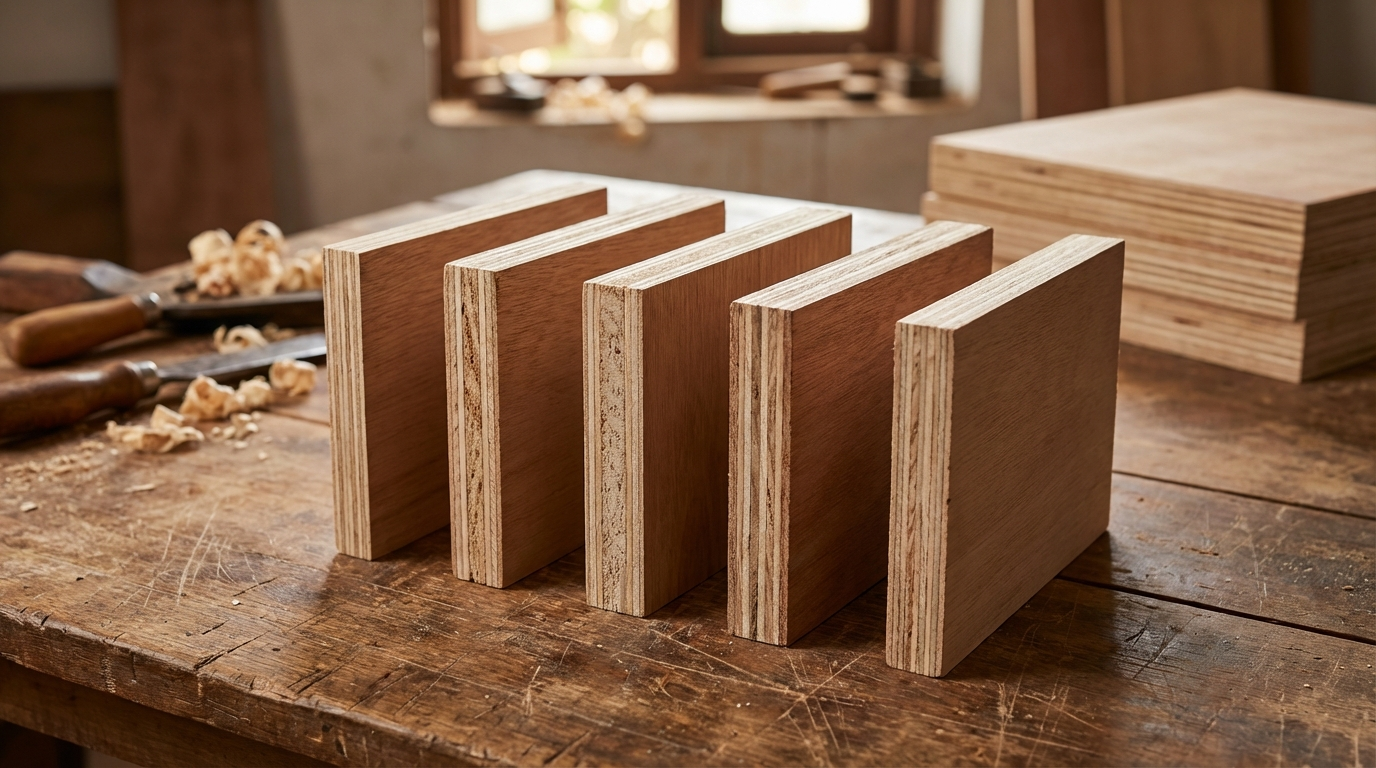
Block board is a timber-based sheet material that comprises a core, faced on both sides. The core is made from parallel, rectangular-section, bonded softwood strips (around 28mm wide); these are sandwiched between a variety of facing materials which can include veneers of softwood, hardwood, thin MDF or particle board. The assembly is glued under high pressure.
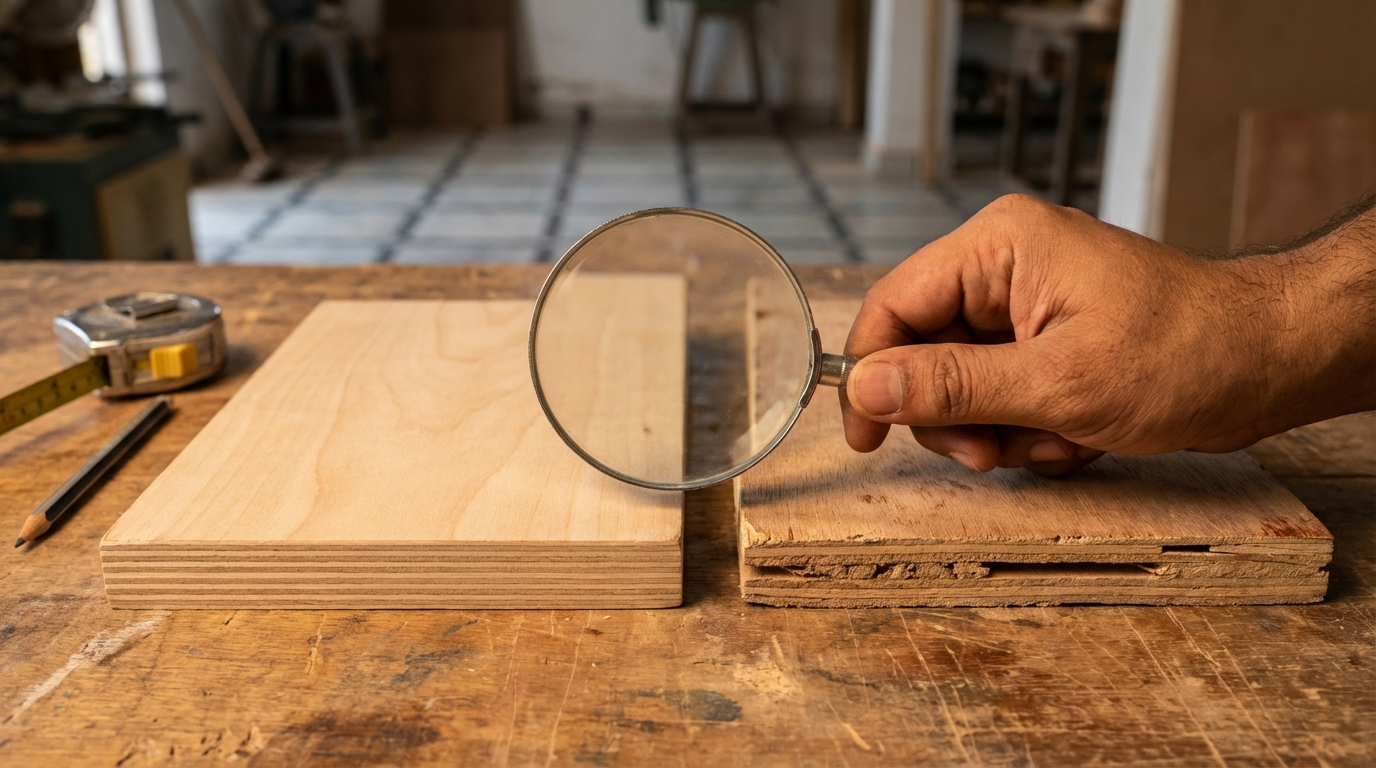
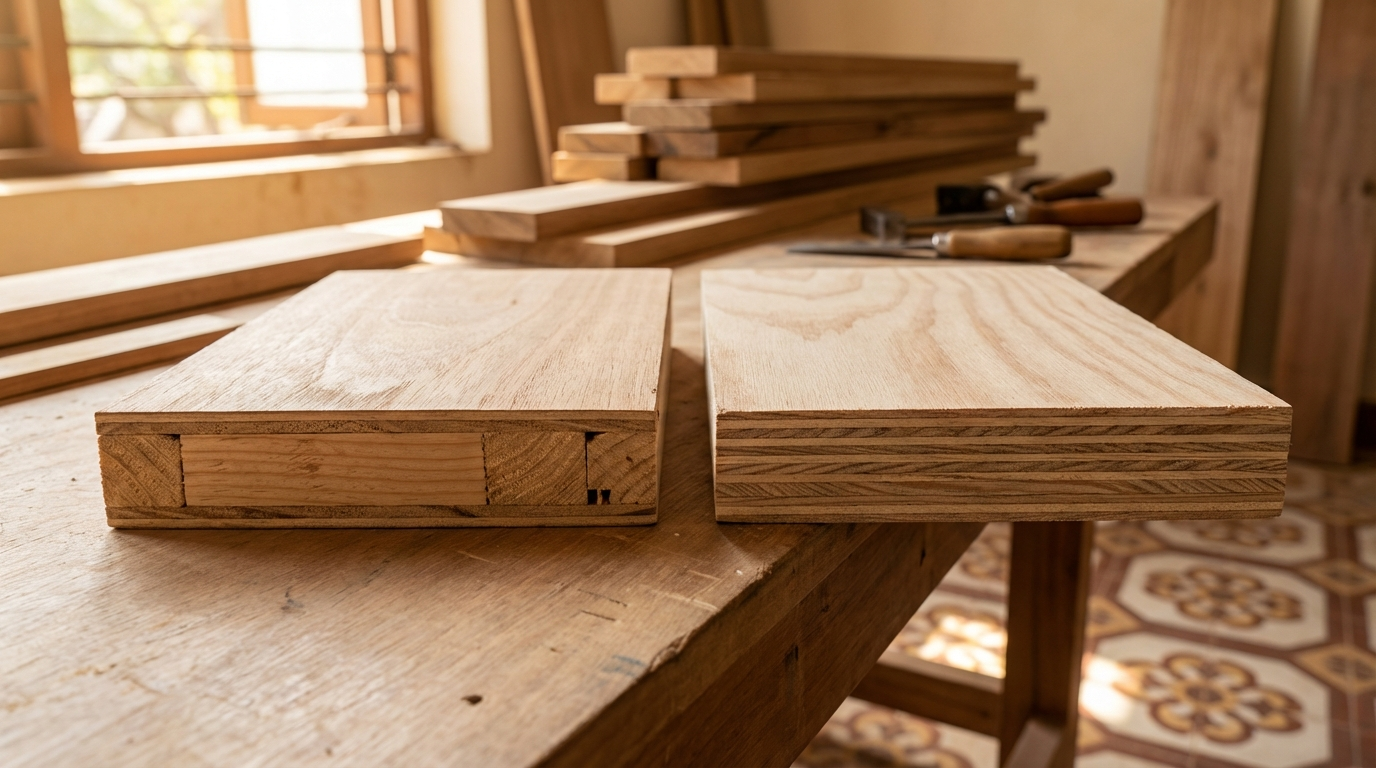
Most people think block board and plywood are the same thing. They're not. Plywood consists of solid wood layers (veneers), while block boards are made of softwood strips sandwiched between solid wood veneers. Picture it like this—plywood is multiple thin sheets stacked with alternating grain, while block board has actual wood strips (like narrow battens) in the middle. That's why block board behaves differently.
Here's the misconception I keep hearing: "Block board is just cheaper plywood." Actually, it's designed for a specific purpose. Blockboard, with its solid core, resists long-span sagging better than plywood. That's not a cost-cutting feature—that's engineering. The solid strips running lengthwise act like tiny beams, preventing the board from bending under its own weight over long spans.
One more thing people get wrong: they assume all block boards are the same. BWP denotes boiling waterproof and BWR denotes Boiling water resistant block boards—these are actually designed for wet areas, unlike standard MR grade. The core material also varies—some use pine, some use poplar, and the expensive ones use hardwood strips. Big difference in durability.
Why Block Board Matters in Indian Homes
Block board tends to absorb and retain moisture, so it has to be used with caution in places where it is likely to get wet. Now here's where it gets interesting for us in India—this property affects how you use block board depending on where you live.
In coastal cities like Mumbai and Chennai, relative humidity routinely hits 80-90% during monsoon. Standard MR grade block board can swell at the edges if not sealed properly. I've seen this happen in a Bandra flat—the bedroom door started sticking by September. The owner blamed the carpenter. Actually, it was the wrong grade for the location.
Bengaluru and Pune? Different story. Drier climate, moderate humidity most of the year. MR grade works fine for most applications there. But even in these cities, don't put standard block board in the bathroom—that's asking for trouble.
In places like Kolkata, the combination of high humidity and heat creates expansion-contraction cycles. Blockboard may require more maintenance and protection from moisture to ensure longevity. Blockboard should be kept away from water and moisture. If you're in humid Bengal, edge banding becomes non-negotiable, not optional.
For Delhi-NCR, the extreme summer-winter temperature swings (5°C to 45°C) can stress any engineered wood. Block board handles this reasonably well because it has good dimensional stability so is highly resistive to warping and cracking. That's why flush doors made from block board are so common in North India.
Can you use block board in bathrooms?
Standard block boards are not waterproof, but you can get BWP (Boiling Water Proof) grade block boards for areas exposed to moisture, like kitchens and bathrooms. Even with BWP grade, I wouldn't recommend block board for bathroom vanity bases that sit on the floor—constant water splashing is a different beast. Use it for upper cabinets or medicine cabinets where water contact is minimal. For anything touching the floor or sink area, go with marine plywood or HDHMR instead. Our HDHMR guide covers this in more detail.
Types and Grades of Block Board: Breaking It Down
Right, moving on to the technical stuff. The classification of block boards depends on different properties such as quality, use, raw wood used for the core.
Based on Moisture Resistance
MR Grade (Moisture Resistant): In this type of blockboard, the veneers of hardwood are pressed together with strips or battens of softwood in between them. This type of block board is usually meant for use in the interiors and the MR grade block boards are those that usually have softwood core. Good for bedrooms, living rooms, anywhere that stays dry.
BWR/BWP Grade: In hardwood block board, hard, dense and expensive hardwood strips are glued and pressed together under high pressure. The glue used is also one that is meant for use in the exteriors. The BWR and BWP block boards have hardwood sheets in their core.
Based on Core Material
| Core Type | Weight | Strength | Best For | My Take |
|---|---|---|---|---|
| Softwood (Pine) | Lightest | Moderate | Interior doors, light shelving | Need a lightweight material? Go for softwood. |
| Hardwood | Heavier | Highest | Heavy furniture, commercial use | Will the surface bear heavy loads? Hardwood core is better. |
| Poplar | Medium | Medium | General furniture | Mixed or poplar cores strike a balance between cost and quality. |
| Finger Joint | Medium | Good | Painted/laminated work | Finger joint cores work well if you're planning to paint or laminate. |
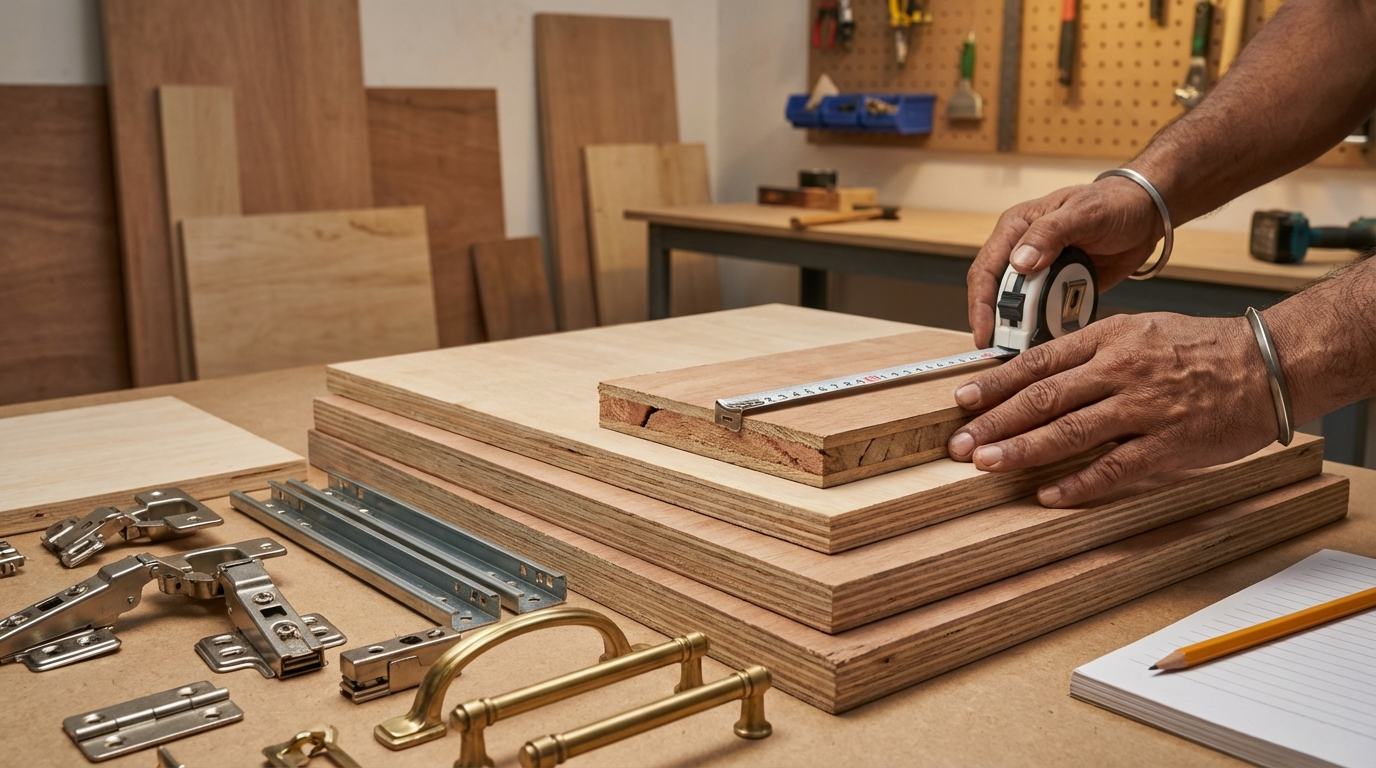
As per I.S Code: 1659, the thickness of blockboards can be of 12mm, 15mm, 19mm, 25mm, 30mm, 35mm, 40mm, 45mm or 50mm. Most commonly, you'll find 19mm and 25mm in the market.
Honestly? For 90% of home furniture applications, 19mm MR grade with softwood core is sufficient. Don't let dealers upsell you to 25mm BWP when you're just making a bookshelf for the guest room. Save the premium grades for doors, kitchen shutters, or anything that might see water.
Price Reality Check (2026 Market)
Block board prices may vary depending upon the type of inner core wood species used (softwood or hardwood), size and thickness of the sheet. The price approximately ranges for commercial blockboard from 90 to 150 Rs/Sq.ft. And for waterproof blockboard from 120 to 200 Rs/Sq.ft.
Commercial grade block board starts from around Rs. 99 per sq. ft., while waterproof (BWP) variants start from Rs. 110 per sq. ft. Branded options like Duro Titanium can go up to ₹130+ per square foot.
Here's what actually affects your final bill:
- Brand premium: Century, Greenply, Duro command 15-25% more than local manufacturers. Sometimes worth it, sometimes not.
- Core material: Hardwood core costs 20-30% more than softwood. Ask what's inside before comparing prices.
- Thickness: The 25mm blockboard price ranges between Rs. 2499 and Rs. 3712 per sheet. That's roughly ₹78-116 per sq ft for a 8x4 sheet.
- Grade: BWP grade commands a significant premium over MR grade—but don't pay for waterproofing you don't need
Quick budget estimation for common uses:
- Single flush door (3x7 ft): Roughly ₹2,000-3,500 for material alone
- 6-foot bookshelf with 19mm board: Around ₹1,800-2,500
- Full wardrobe with block board shutters: ₹8,000-15,000 depending on size and grade
Pro tip: Block board prices fluctuate with timber import costs. If you're doing a big project, ask dealers about current trends. Sometimes waiting 2-3 weeks can save 5-8%.
Block Board vs Plywood: The Real Comparison
Blockboard vs plywood—one can choose depending on what the project needs are. Plywood is stronger and is more resistant to moisture. Blockboard has greater affordability and lightness when used indoors.
| Parameter | Block Board | Plywood | My Preference |
|---|---|---|---|
| Weight | Generally lighter, making it easier to handle and install | Heavier, denser | Block board for large panels, doors |
| Strength | Good for long spans | Excellent strength and durability due to cross-layered structure, highly resistant to warping and splitting | Plywood for load-bearing |
| Sag Resistance | Long panels of blockboard do not sag | Can sag over long spans | Block board wins clearly |
| Moisture Handling | Softwood core is more susceptible to moisture, material can warp or swell when exposed to moist air | Better with proper grade | Plywood for wet areas |
| Workability | Easier to cut, drill, and shape without splintering due to softwood core | May splinter at edges | Block board easier |
| Screw Holding | Holds fasteners well when driven into strips, though edge gaps may sometimes cause looseness | Excellent screw-holding across veneer layers and resists splitting | Plywood for hinges |
| Price | Cheaper than plywood | Higher, especially premium grades | Block board for budget |
| Lifespan | Durable, but may require more maintenance and protection from moisture to ensure longevity | If maintained properly, can easily last up to 50 years or more | Plywood lasts longer |
Choose block board when: Making doors, long shelving, partition panels, tables, bed frames where sag resistance matters more than load bearing.
Choose plywood when: Building kitchen cabinets, load-bearing shelves, bathroom furniture, anything in humid conditions, or wherever you need maximum screw-holding for hardware.
The best furniture often uses a thoughtful mix of both materials—plywood for the body, blockboard for the front-facing parts. This way, you get strength where it matters and stability where it's needed. That's actually solid advice.
How to Choose the Right Block Board
Here's my decision framework after 18 years of dealing with this stuff:
Step 1: Identify your application. Door? Shelf? Table? The use dictates everything else.
Step 2: Check the environment. Indoor dry area? MR grade. Any chance of water? Go BWP or skip block board entirely.
Step 3: Determine the span. Blockboard is mostly used when a lengthy piece of wood is required which makes furniture stiffer and prevents it from bending. While using blockboard always take care that core runs lengthwise to achieve maximum strength.
Step 4: Consider the load. Light use like wardrobe shutters? Softwood core is fine. Heavy books or display items? Consider hardwood core.
Step 5: Set a realistic budget. Don't buy BWP grade for a bedroom bookshelf. Don't use MR grade for kitchen shutters.
| Situation | Recommendation | Why |
|---|---|---|
| Flush doors (interior) | 19mm MR grade, softwood core | Light, stable, cost-effective |
| Main entrance door | 25mm BWP grade, hardwood core | Weather exposure, needs durability |
| Long bookshelf (5ft+) | 19mm MR grade | Sag resistance is key |
| Wardrobe shutters | 18-19mm MR grade | Lightweight reduces hinge strain |
| Kitchen cabinet doors | BWP grade OR use marine ply instead | Steam and splashes are inevitable |
| Dining table top | 25mm, hardwood core preferred | Needs strength and stability |
| Partition panels | 12-19mm MR grade | Large surface, weight matters |
Red flags to walk away from:
- Gaps or voids in the core—hold the sheet up to light if possible
- Uneven thickness across the sheet
- Strong chemical smell indicating poor-quality adhesive
- Dealer can't tell you the core material or grade
- Suspiciously low prices—usually means inferior wood or bad glue
Is block board actually worth the extra cost over particle board?
Absolutely. This isn't even close. Block boards have better life and durability compared to MDF and particle boards. Particle board swells at the first sign of water and has terrible screw holding. I've seen particle board furniture fall apart in 3-4 years. Block board, properly used, lasts 15-20 years easy. The extra cost upfront saves you from replacement headaches later. For anything structural—doors, tables, shelving—block board is worth every rupee over particle board.
Common Mistakes People Make with Block Board
1. Using MR grade in kitchens. I see this constantly. Someone saves ₹500 and then spends ₹15,000 on replacement when the cabinet doors swell. Just get BWP grade for kitchen shutters.
2. Ignoring core orientation. While using blockboard always take care that core runs lengthwise to achieve maximum strength. If the carpenter cuts against the grain direction for shelves, you'll get sagging. Make sure the strips run along the longer dimension.
3. Skipping edge sealing completely. This one really frustrates me. Blockboard may have small gaps between strips inside the core. Those gaps absorb moisture from the edges. Edge banding isn't decorative—it's protective. I had a client in Thane who insisted on saving ₹2,000 by skipping edge treatment. By the second monsoon, every shelf edge had swelled. Complete redo.
4. Expecting plywood-level screw holding at edges. Edge gaps may sometimes cause looseness when you drive screws into block board edges. Use proper edge reinforcement or drill pilot holes. Better yet, use cam locks for demountable furniture.
5. Buying 25mm when 19mm would work. Thicker isn't always better. 25mm block board costs significantly more and adds unnecessary weight for most applications. Unless you're making a dining table or main door, 19mm handles most furniture needs.
6. Not checking for voids. A poorly manufactured core, no matter the type, can lead to trouble later. I've seen sheets that look fine on the surface but have gaps inside the core. Tap the board—hollow sounds indicate voids. Check edges for visible gaps between strips.
7. Storing block board flat on the floor. It absorbs ground moisture. Always store vertically or on raised supports. This is basic but I still see contractors leaving sheets on bare concrete floors during monsoon. Disaster waiting to happen.
8. Using outdoor without BWP grade. Since the glue used to press the plywood under high pressure to make standard blockboard is only good enough for interior use, it cannot be used in the exteriors. I had a builder use commercial grade for covered balcony furniture. Looked great for six months. Then the rains came.
9. Comparing prices without checking thickness and grade. ₹80/sq ft commercial grade is not comparable to ₹150/sq ft BWP grade. Ask specifically: what thickness? What core? What grade? Then compare.
Quality Checks You Can Do Yourself
Visual inspection:
- Surface should be smooth without visible bumps or depressions
- Veneer should be uniform without patches or repairs
- Edges should show tightly packed strips with minimal gaps
- Go for boards with uniform thickness and smooth surfaces
- Check for delamination—veneer shouldn't lift at corners
- Color should be consistent across the face
Questions to ask your dealer:
- "What's the core material—softwood or hardwood?" (They should know immediately)
- "Is this MR or BWP grade?" (Don't accept vague answers)
- "Which factory is this from?" (Branded products should have clear origin)
- "Can you show me the ISI marking?" (Regular testing should be conducted to maintain quality as per IS:1659 standards)
- "What's your return policy if there's a manufacturing defect?"
Simple field tests:
Tap test: Knock on the board surface at different points. Consistent sound means uniform core. Hollow spots indicate voids. Move your knuckle around—you'll notice differences quickly.
Weight check: 19mm blockboard is a wood-based panel made of wood battens and veneers, which is a strong alternative to plywood. It should feel substantial but noticeably lighter than same-size plywood. Too light might mean poor-quality core or thin veneers.
Edge inspection: Look at the exposed edge. Strips should be close together—gaps wider than 1-2mm are a quality red flag. Check if strips are uniform or randomly sized.
Flex test: Try to bend the board slightly (on longer sheets). Good quality block board has minimal flex. Excessive bending suggests weak core or thin strips.
Here's a trick most dealers don't like: ask to see a cut piece from the same batch, exposing the full core cross-section. You'll immediately see the core quality—strip width, gaps, wood type. If they refuse, consider buying elsewhere.
Why do carpenters prefer block board over plywood for doors?
Block board has good dimensional stability so is highly resistive to warping and cracking. This is the reason why blockboard is used mostly for manufacturing doors. It is light in weight than plywood due to its softwood which extends lifespan of furniture. On large-format furniture like doors or wardrobe panels, the lighter blockboard reduces strain on hinges and frames, easing installation. Plus, carpenters find it easier to cut and shape without splintering. Less dust, cleaner edges, faster work. That's why experienced mistrits usually prefer block board for flush doors.
Workmanship and Installation Tips
Cutting requirements:
Blockboard is easy to cut, shape, and join using common woodworking tools. This makes it convenient for carpenters and DIY enthusiasts. Use a fine-toothed blade to minimize chipping on the veneer face. Cut with the good face up if using a circular saw (teeth enter from bottom), or face down if using a jigsaw (teeth exit from top).
Edge sealing—why it matters:
Those softwood strips in the core are basically moisture sponges at exposed edges. Options for edge treatment:
- PVC edge band: Most common, affordable, decent moisture barrier. 0.8mm minimum for durability.
- Veneer tape: Better aesthetics, less moisture protection
- Solid wood lipping: Blockboard forms a good base material for veneering, but the edges will have to be lipped with solid wood. It can also be painted after a light sanding but the edges will still require lipping.
- ABS edge band: Higher cost but excellent durability, good for premium work
Screw guidance:
- Face screwing: 3.5mm x 25mm screws work well for 19mm boards
- Always drill pilot holes—prevents splitting
- Edge screwing is tricky—use reinforcement blocks where possible
- For hinges, consider hinge-mounting plates that distribute load
What to tell your carpenter (briefing checklist):
- "Core should run lengthwise for any shelf or horizontal surface"
- "Seal all edges with edge band—no exceptions"
- "Drill pilot holes before any screwing"
- "Don't expose to rain or direct sun during work"
- "Use cam locks for wardrobe shelving, not just screws"
- "Apply primer or sealer before final laminate/veneer"
I've seen carpenters skip edge banding to save time and then blame the material when problems appear. Had a job in Mulund where the carpenter did beautiful work but left raw edges on shelves hidden inside wardrobes. "No one will see," he said. Within 18 months, every internal shelf was swelling from the edges inward. The owner wasn't happy.
Storage notes:
- Store vertically, not flat
- Keep off ground—use battens or pallets
- Cover with tarp if in open godown
- Let boards acclimatize 48-72 hours at site before cutting, especially if coming from air-conditioned storage to non-AC site
How Long Does Block Board Actually Last?
Blockboard is less strong and durable than plywood, but it can still last a few decades when maintained and protected correctly. In my experience, well-maintained block board furniture lasts 15-25 years depending on conditions.
What affects longevity:
- Grade selection: BWP grade in appropriate locations can outlast MR grade by years
- Edge treatment: Sealed edges last dramatically longer—this is the single biggest factor
- Climate exposure: Coastal cities see faster degradation; interior cities like Nagpur or Indore are kinder
- Usage patterns: High-traffic areas like kitchen cabinet doors see more wear
- Initial quality: Good core material and proper bonding extend life
Signs of wear to watch:
- Edge swelling—earliest warning sign
- Veneer lifting or bubbling
- Stiffness loss—shelves that start to bow
- Hinges loosening repeatedly despite re-tightening
- Musty smell indicating internal moisture damage
When to consider replacement:
If edges have swelled more than 5mm, or if veneer is lifting in multiple places, or if the board has lost structural rigidity—it's time. Partial repairs rarely work once moisture has penetrated the core. Better to replace the affected piece than keep patching.
How long does block board really last compared to plywood?
Plywood generally has a longer service life compared to blockboard. If maintained properly, plywood can easily last up to 50 years or more. Block board typically gives you 15-25 years with proper care. The difference comes down to moisture vulnerability—plywood's cross-grain construction handles humidity cycling better over decades. That said, for doors and panels that stay dry, I've seen block board furniture from the 1990s still holding up fine. It's all about right material for right application.
Alternatives Worth Considering
Block board isn't always the answer. Here's when to look elsewhere:
Plywood: Because of its strength and durability, plywood is the first preference for outdoor furniture, kitchen and bathroom cabinets, and any application where good resistance to moisture is of importance. If budget allows and you need maximum durability, BWP plywood beats block board for wet areas. Our marine plywood guide covers grades in detail.
HDHMR: HDHMR boards are resistant to termites and borers, making them an excellent choice for interior woodwork. Compression techniques and chemical treatments help strengthen and make the HDHMR board sturdier than other woodwork. For modular kitchens especially, HDHMR has become popular. Costs more but handles humidity better and offers better edge finishing. The kitchen cabinet material comparison on our site covers this extensively.
MDF: If you're doing extensive paint finishing and don't need structural strength, MDF gives smoother painted surfaces. But it's heavier and less moisture-resistant than block board. Not for kitchens or bathrooms.
WPC boards: For bathroom applications specifically, WPC (Wood Plastic Composite) handles water much better than any wood-based product. More expensive, but zero moisture absorption. Our WPC door frame guide discusses this option.
If budget is tight, consider using block board for large surfaces (doors, panels) and plywood for structural elements (carcass, shelves). This hybrid approach optimizes cost while maintaining strength where needed.
FAQs
What exactly is the difference between block board and MDF?
Block board has a core of solid wood strips sandwiched between veneers—it's essentially real wood inside with good structural strength for long spans. MDF (Medium Density Fiberboard) is made from wood fibers compressed with resin—no grain structure, completely uniform, excellent for paint finishing but much heavier and vulnerable to moisture. Block board holds screws better, weighs less, and resists sagging over length. MDF gives smoother paint surfaces and costs less. For structural furniture—block board. For decorative panels or detailed painting work—MDF might make sense.
Is it true that block board is always cheaper than plywood?
Blockboards are cheaper than plywood—generally true for equivalent grades, but not always. Premium BWP block board from branded companies can cost as much as commercial plywood. Some sources claim plywood is always available at very low price while block board costs are a little high—but this varies by region and availability. In Mumbai, commercial plywood and MR block board are roughly comparable in price range. Compare specific products, not categories.
Can I use block board for modular kitchen cabinets?
Block board is best suited for indoor furniture such as bookshelves, tables, and wardrobes. It is not recommended for exterior use or areas with high humidity. For kitchen cabinet shutters (doors), BWP grade block board works if you maintain good edge sealing and ventilation. For the carcass—the structural body of cabinets—I'd recommend marine plywood or HDHMR instead. Kitchen sink cabinets specifically should never be block board; constant water exposure is too risky.
What if I live in Chennai or other coastal cities with high humidity?
Coastal humidity is brutal on wood products. If you must use block board in Chennai, Kochi, or Mumbai's seaside areas, only BWP grade with complete edge banding on all surfaces including hidden edges. Still, for bathrooms and kitchens, I'd push you toward marine plywood or HDHMR. The extra cost is worth avoiding the headache of swelling furniture during monsoon. I've had clients in Bandra (coastal Mumbai) who insisted on block board in bathrooms—100% of them had problems within 3 years.
Is it true that block board is stronger than plywood?
Not exactly. Blockboard is less strong than plywood because of its softwood core. But strength isn't the whole story. Blockboard, with its solid core, resists long-span sagging better than plywood. For long shelves or cantilevered furniture parts—where stiffening is crucial—blockboard often delivers firmer, more beam-like support. So plywood wins on raw strength and load-bearing, but block board wins on stiffness over length. Different properties for different needs.
How do I know if a dealer is selling me genuine branded block board?
Check for ISI marking (IS:1659 standard) printed on the board face. Branded products have clear factory stamps or stickers—Century, Greenply, Duro all mark their products. Ask for invoice with proper product name and batch details. Before placing your order, ask suppliers about the wood species used in the core and inspect samples if possible. Start with the right materials, and the rest of your work will follow. If dealer can't provide documentation or gets defensive about brand authenticity, walk away.
What thickness should I use for a 6-foot bookshelf?
Blockboards are available in various thicknesses, typically ranging from 12mm to 25mm. Thicker boards are ideal for furniture pieces like tables, wardrobes, or heavy-duty shelves that require extra strength. For a 6-foot bookshelf, 19mm is usually sufficient if you're using one shelf support in the middle. For unsupported spans of 4 feet or more with heavy books, go 25mm. Also ensure the core grain runs along the shelf length, not across.
Is it true that block board has better sound insulation than plywood?
Block board has better sound insulation properties than plywood due to its construction. The solid wood strips in the board help to absorb sound waves, making it a popular choice for soundproofing applications such as in recording studios or home theaters. The air gaps between strips actually help dampen sound transmission. Not dramatic, but noticeable compared to solid plywood. If you're building a media room or need partition walls with some acoustic benefit, block board is a reasonable choice.
Can block board be used for exterior applications like balcony furniture?
Since the glue used to press the plywood under high pressure to make standard blockboard is only good enough for interior use, it cannot be used in the exteriors. Even covered balconies get moisture from rain spray and humidity. For outdoor furniture, consider boards with waterproof adhesives—BWP grade specifically. But honestly? For true outdoor exposure, I'd recommend treated solid wood or marine plywood over block board. The core strips just don't handle weather cycling well.
Why does my block board smell so strong?
New block board often has a strong smell from the formaldehyde-based adhesives used in manufacturing. This usually dissipates over 2-4 weeks. If the smell persists longer or is extremely strong, it might indicate excess formaldehyde—which is both a quality and health concern. Premium brands now offer low-emission options. Some products like Century Ply's Premium Plus range are designed for interior residential and commercial spaces with low emission and paintable finish. If smell is a concern, ask specifically for low-formaldehyde options and air out the material before installation.
What's the best block board for making flush doors?
Premium BWP Marine Grade blockboard developed to IS:1659 standards, that is borer-termite proof and comes with 15-year warranty would be ideal for main doors exposed to weather. For interior room doors, 19mm MR grade with softwood core is perfectly adequate and more economical. Due to its stability and strength, 19mm blockboards are popularly used for indoor applications like partition walls, cabinetry, and furniture. This warp-resistant, durable material is often used to make shelves, doors, and other structural elements.
How does block board compare to particle board for wardrobe making?
No contest—block board wins. Particle board is cheaper but has terrible screw-holding, swells instantly when moisture touches it, and sags quickly. Block board costs more but lasts years longer and handles hardware much better. For any furniture you expect to use for more than 5 years, skip particle board entirely. The only exception is if budget is extremely tight AND the wardrobe will stay in a dry room AND you're okay replacing it in a few years.
That covers the essentials. One final note: Don't forget to check if the block board is seasoned and bonded properly. A poorly manufactured core, no matter the type, can lead to trouble later. Spend a few extra minutes checking quality before buying, and make sure your carpenter understands the material. Block board is a solid choice for the right applications—just don't ask it to do plywood's job in wet areas.
Good luck with your project. And seriously—don't skip the edge banding.
Disclaimer: This content is provided for general informational purposes based on industry practices and publicly available information. Product specifications, standards, prices, and availability may vary by manufacturer, region, and time. Readers should independently verify details with manufacturers, dealers, or qualified professionals before making purchase or construction decisions.Want Plywood Suggestions?
Share a few details and a Sainik 710 specialist will suggest suitable brands and connect you to responsive dealers.