Best Plywood for Kitchen Cabinets: Grade, Thickness, Under-Sink Waterproofing & Finish Checklist
Choose the right plywood for kitchen cabinets with thickness rules, under-sink waterproofing tips, finish options, and a checklist to prevent swelling.
Quick Decision Summary
Best plywood for kitchen cabinets: BWP marine grade, 18mm thick for carcasses, with 1.5mm laminate finish and full edge sealing.
If you're in a hurry, prioritize BWP grade for full water resistance in high-moisture kitchen zones like under sinks and above stoves. Use 18mm for main cabinets to ensure screw holding and no sagging, dropping to 12mm for shelves if weight is low. Always seal all edges with matching laminate strips or PU sealant to block monsoon humidity. Skip MR plywood unless budget-constrained and in dry interiors—opt for calibrated sheets from reputed mills to avoid core gaps during CNC cutting. This setup lasts 15+ years in Indian homes with proper installation.
- Choose BWP 18mm if: Coastal area, heavy use, modular kitchen with wet zones, or family cooking daily with spills.
- Choose BWR 18mm if: Inland dry climates, semi-modular setup, moderate budget, good ventilation.
- Avoid MR if: Any proximity to water, poor ventilation, or monsoon-prone regions—leads to swelling.
- Avoid under 16mm if: Main frame or heavy utensils—risks warping under load.
How to Choose in 5 Steps
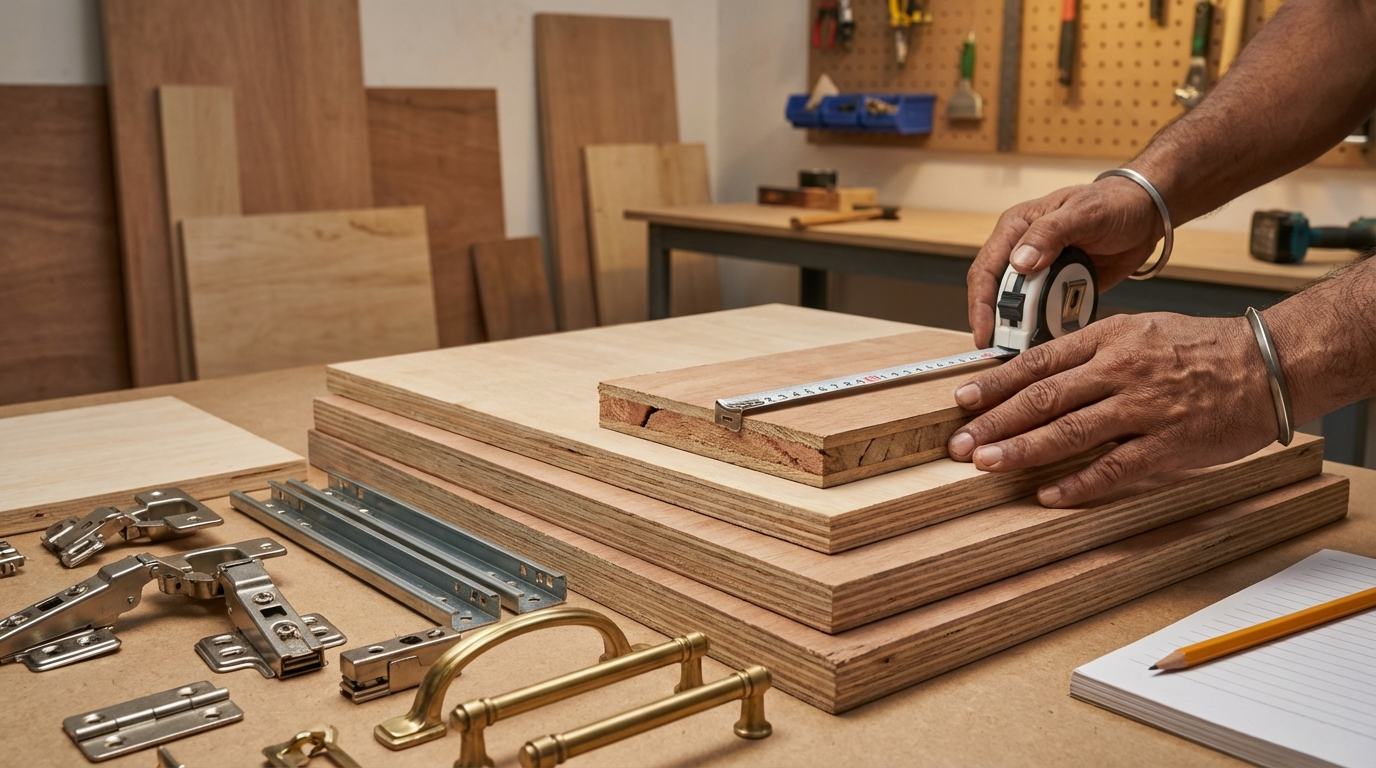
Selecting plywood for kitchen cabinets starts with assessing your kitchen's risk profile, then matching specs to grades and thicknesses. Step 1: Map wet zones—under sinks, above hobs, near fridges get BWP; dry shelves can take BWR. Step 2: Measure load—crockery cabinets need 18mm, utensil drawers 16mm minimum. Step 3: Check calibration—ensure sheets are sanded to ±0.3mm for flush laminates and CNC routing without steps. Step 4: Inspect core—hardwood core over mixed for better screw holding in humid India. Step 5: Test moisture content on-site (under 12%) and ask for recent boil test proof from vendor.
- Assess exposure: High steam/spills? Mandate BWP. Ventilation poor? Add thickness.
- Budget vs lifespan: BWP costs 30-50% more but survives monsoons; BWR suffices for 8-10 years.
- Vendor checks: Rub edges for smoothness, tap for hollow sounds (voids), weigh sample for density.
- Finish match: Laminate over veneer for wipeable surfaces; PU polish only if teak finish planned.
- Installer input: Confirm screw pull-out strength via sample test before bulk buy.
This framework prevents 80% of post-install regrets like delamination or sagging shelves.
What This Actually Means (Grade, Construction, and Use)
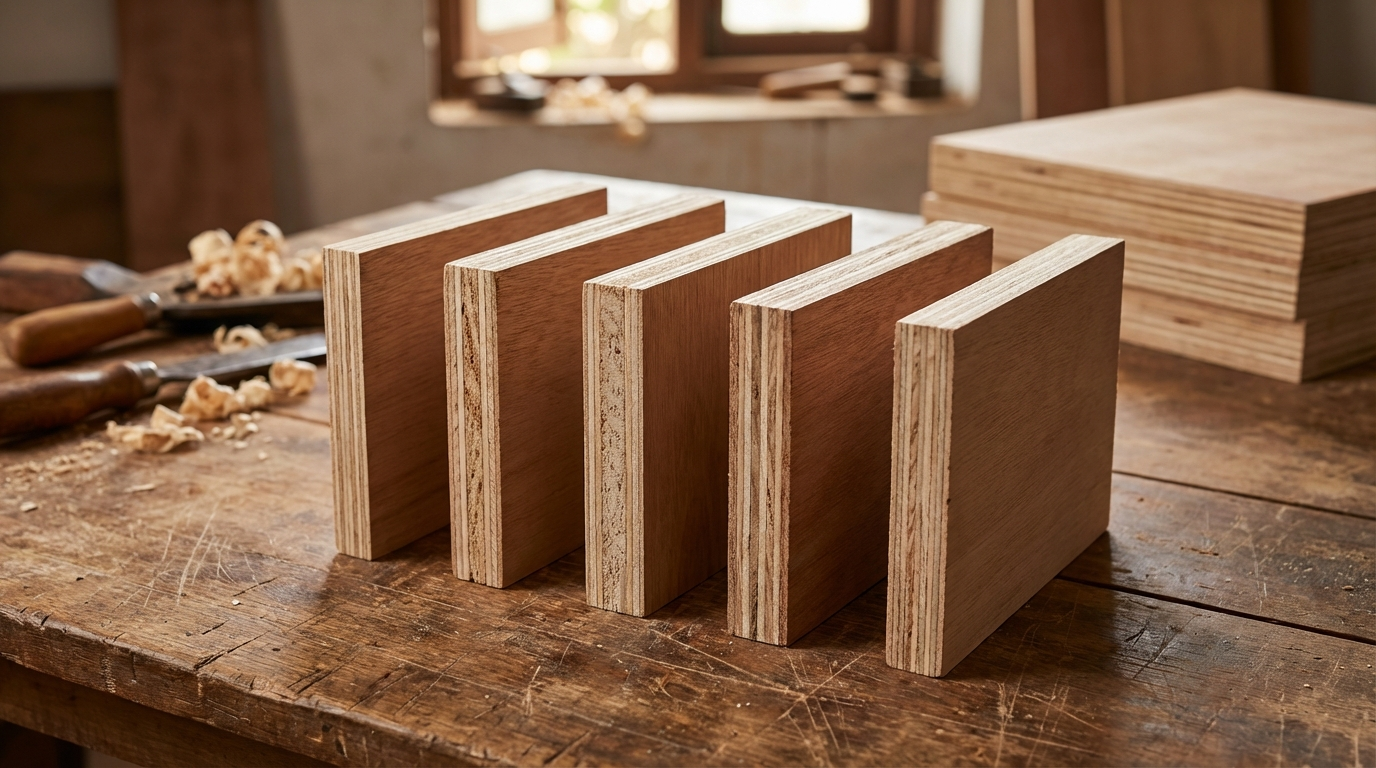
Plywood grades for kitchen cabinets refer to glue types and boil resistance: MR (moisture resistant) uses urea formaldehyde, fine for dry walls but swells in kitchens. BWR (boiling water resistant) handles steam better with phenolic resins, suitable for inland modular units. BWP (boiling water proof/marine) employs full waterproof PF glue, ideal for under-sink bases exposed to leaks. Construction-wise, 100% hardwood core (gurjan/poplar) outperforms mixed core (softwood strips) in screw holding—critical for hinges in cabinets loaded with pots.
Thickness dictates rigidity: 12mm for partitions/light shelves, 16-18mm for carcasses/frames, 25mm for base platforms handling water. Calibrated plywood is pre-sanded for uniform thickness, essential for laminate adhesion without air bubbles. In kitchens, use means carcasses (outer boxes), shutters (doors), and shelves—each with tailored specs. For example, shutters need smooth faces for high-pressure laminates (HPL), while carcasses prioritize edge strength.
Real use breakdown: Modular kitchens demand calibrated BWP 18mm carcasses with 1mm veneer faces for routing chamfers. Semi-custom setups use BWR 16mm to cut costs. Always pair with proper sealing to counter India's 80-90% monsoon humidity spikes.
India-Specific Reality Check (Moisture, Termites, and Workmanship)
Indian kitchens face relentless moisture from cooking steam, sink splashes, and monsoon humidity (up to 95% in Mumbai/Kochi). Coastal homes amplify this with salt-laden air corroding unprotected edges. Termites thrive in untreated cores during rainy seasons, especially in layered city apartments with poor cross-ventilation. Workmanship pitfalls abound—carpenters often skip full edge sealing, leading to capillary water ingress and core rot within 2 years.
Storage mishaps: Sheets stacked outdoors absorb rain, warping before cutting. On-site acclimatization (48 hours in room conditions) is skipped, causing expansion gaps post-install. Contractor practices vary—Tier-1 cities use CNC for precision, but smaller towns rely on manual saws chipping calibrated edges. Ventilation logic: Wall cabinets above stoves need BWP vents to escape steam; under-sink bases require elevated platforms (50mm) over PVC liners.
Termite defense: PF glue in BWP resists better, but add oil-based preservatives for extra layers. Expect 20-30% higher failure in humid belts without these checks—prioritize vendors with covered godowns and recent desi standards compliance.
Best Grades for Kitchen Cabinets: Comparison Table
Grades differ sharply in kitchen suitability based on glue, core, and exposure. Here's a scannable comparison for Indian conditions:
| Grade | Glue Type | Best Kitchen Use | Monsoon Survival | Cost Premium | Limitations |
|---|---|---|---|---|---|
| MR | Urea Formaldehyde | Dry wall panels only | Poor (swells fast) | Base | No wet zones; termite prone |
| BWR | Phenolic Modified | Inland cabinets, shelves | Fair (3-5 years) | 20-30% over MR | Avoid direct water; edge seal mandatory |
| BWP Marine | Phenolic Formaldehyde | All zones: under-sink, hob-adjacent | Excellent (15+ years) | 40-60% over MR | Heavier; needs skilled routing |
Choose BWP for 90% of urban kitchens; BWR if budget under ₹100/sqft and dry setup.
Thickness Guide: Carcass, Shutters, and Shelves
Thickness ensures no sagging under 50-100kg loads in Indian kitchens packed with steel utensils. 18mm is gold standard for carcasses—provides 5-7mm screw depth for hinges without pull-out. Shutters use 16-18mm for rigidity against repeated opens/closes. Shelves: 12mm adjustable ones, 18mm fixed heavy-duty. Under 16mm risks bowing in humid warp-prone areas.
Trade-offs: Thicker adds weight (harder for installers), cost (₹20-40/sqft per mm), but boosts lifespan. Calibrated versions prevent laminate telegraphing (core lines showing through). For L-shaped kitchens, reinforce corners with 25mm blocks. Scenario: Coastal Goa home? 18mm BWP everywhere. Dry Delhi? 16mm BWR suffices for uppers.
Failure Modes by Thickness
- 12mm: Shelf sag under 20kg pots.
- 16mm: Hinge failure after 2 years in steam.
- 18mm+: Stable but overkill for kids' snack cabinets.
Under-Sink Waterproofing Essentials
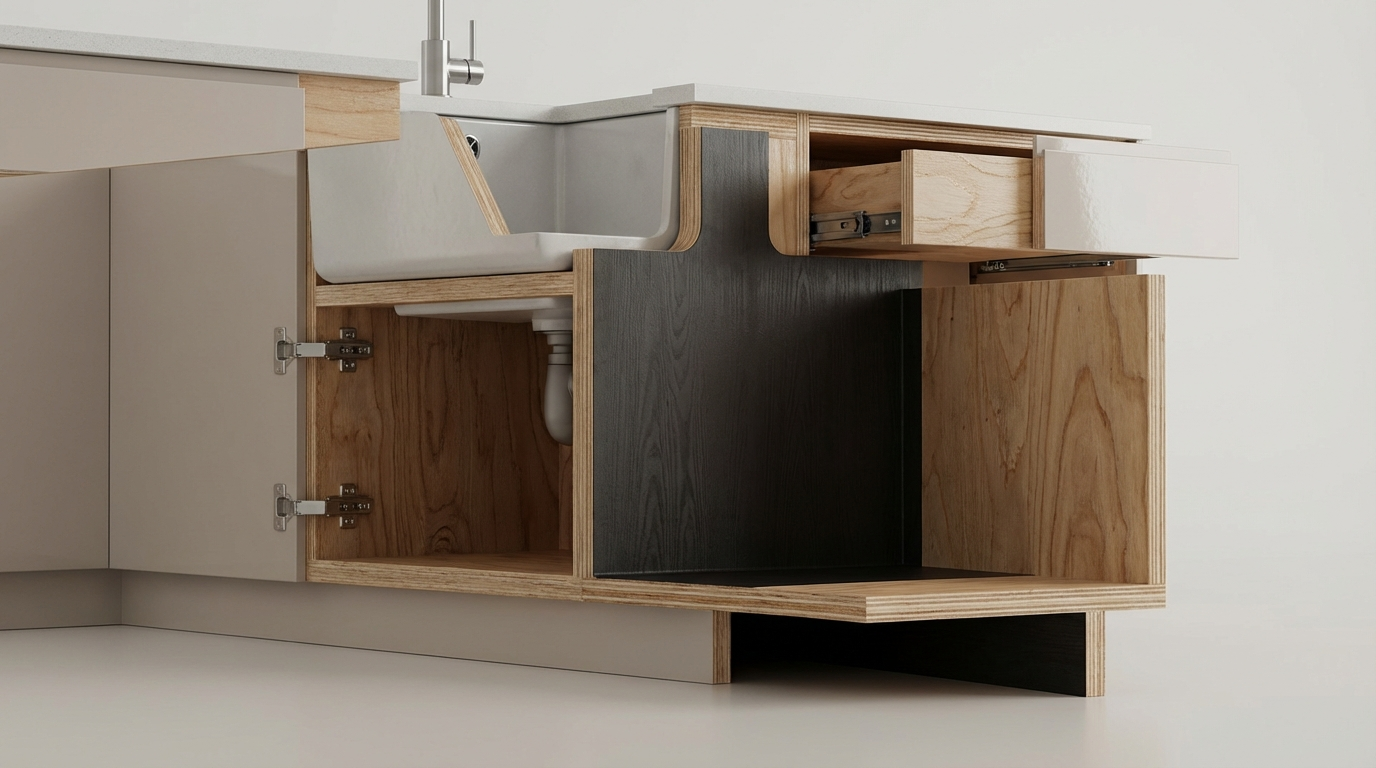
Under-sink cabinets bear drips, leaks, and cleaning floods—demand BWP 18-25mm base with upturned lips (20mm rise). Line floor with PVC sheets (2mm thick) sloped to drain holes. Seal joints with silicone, not just glue. Elevate pipes 100mm to avoid contact. In monsoons, add exhaust fans to cut humidity buildup.
Common fail: Water seeps via cut edges, rotting core in 6 months. Solution: Double-seal with epoxy + laminate skirt. For families with RO units, use 25mm platforms. Coastal tip: Salt accelerates corrosion—opt for stainless clips over steel.
Finish Options: Laminates, Veneers, and Edge Protection
Laminates (0.8-1.5mm HPL) top choice for wipeable, stain-resistant doors/shelves—matte over gloss in steamy kitchens to hide fingerprints. Veneers (0.6mm) for wood-look aesthetics but need PU polish + edge bands. Edge sealing: PVC/ABS tapes matching laminate, pressed hot for no peel-off.
Trade-offs: Laminate durable/cheap but plain; veneer premium/warm but moisture-sensitive. Polish traps dirt—avoid under sinks. Checklist: Full six-side sealing on carcasses; router 2mm chamfer pre-finish.
Workmanship and Installation Tips
Cut with circular saws on calibrated ply to avoid splintering—mark waterline for under-sink. Fasten with 45mm screws at 100mm centers; pre-drill to prevent splits. Hinges on 35mm cups need 18mm min thickness. Acclimatize sheets 72 hours site-side. Seal edges same day post-cut.
Zone-Specific Reinforcement
- Handles: 25mm blocking behind.
- Drawers: 16mm sides with metal tracks.
- Wall cabinets: Anchor to studs, not just ply.
Common Buyer Mistakes and How to Avoid Them
Mistake 1: Ignoring wet zones—using MR under sinks. Avoid: Zone-map first. 2: Skimping on thickness for shelves. Avoid: Load-test sample. 3: No edge sealing. Avoid: Mandate in contract. 4: Buying uncalibrated for modular. Avoid: Micrometer check. 5: Poor storage—outdoor stacking. Avoid: Insist covered transit. 6: Skipping acclimatization. Avoid: 48hr rule. 7: Wrong finish for steam—veneer only. Avoid: HPL everywhere. 8: No termite treatment query. Avoid: Ask for oil proofing. 9: Over-relying on brand without core check. Avoid: Tap test. 10: Fixed budget sans logistics. Avoid: Factor 10% extra.
Quality Checks You Can Do Without Lab Tests
Visual: Uniform color, no patches—warps signal poor drying. Edges: Smooth, no fuzz—sand marks mean non-calibrated. Tap center: Solid thud, no hollow (voids). Weight: Heavier better density. Rub face: No powdering glue. Moisture: Plastic wrap overnight—if sweat inside, >14%. Ask: Core wood type? Last boil test? Batch date? Warning: Gaps on cut edge = reject sheet.
Decision Framework Table
| Kitchen Type | Grade | Thickness (Carcass/Shelves) | Finish | Extra for Wet Zones |
|---|---|---|---|---|
| Coastal Modular | BWP | 18mm/16mm | 1.5mm HPL | 25mm base + PVC liner |
| Inland Semi-Custom | BWR | 16mm/12mm | 1mm Laminate | Silicone seal joints |
| Budget Dry | BWR | 16mm/12mm | Veneer + PU | Elevate sink 50mm |
FAQs
Can I use 12mm plywood for entire kitchen cabinets?
12mm works only for lightweight upper shelves or partitions in dry, low-load areas like spice racks, but not carcasses or heavy-duty bases. In Indian kitchens with steel kadhais and pressure cookers, it sags under 15-20kg within months, especially post-monsoon. Upgrade to 16-18mm for frames to maintain level shelves and secure hinges—carpenters report 50% fewer callbacks this way. Always pair with metal supports if budget limits thickness.
Is BWP plywood worth the extra cost for kitchens?
BWP's full waterproof glue justifies 40-60% premium in moisture-heavy setups like Mumbai flats or under-sink units, preventing delamination from leaks or steam. Inland dry homes can save with BWR, but expect edge swelling if sealing skipped. Lifespan doubles to 15+ years, offsetting cost via no repairs. Check vendor for PF glue certification via sample boil test—bubbles mean fake grade.
How to prevent plywood swelling in monsoon kitchens?
Seal all six edges with laminate/PVC before exposure, use exhaust over hobs, and elevate bases 50mm. BWP grade resists better, but acclimatize 48hrs and avoid floor storage. Common fail: Unsealed cuts absorb humidity overnight. Add silica gel packs in cabinets pre-use. Coastal users: Extra silicone at joints blocks salt mist.
What thickness for kitchen shutters?
16-18mm for shutters ensures no flex on 600-900mm wide doors, vital for soft-close hinges. Thinner warps from handle torque in daily 50+ opens. Calibrated faces prevent veneer cracks. For bi-fold designs, reinforce mid-rails with 25mm strips. Test: Lift sample—shouldn't bow.
MR plywood safe for any kitchen part?
MR limits to absolutely dry zones like upper dry storage, away from steam/sinks. Swells 10-15% in humidity, ruining laminates. Even inland, cooking vapors penetrate unsealed edges. Avoid entirely for cabinets—opt BWR minimum. If forced, fully seal and ventilate heavily.
Best finish for easy-clean kitchen cabinets?
1-1.5mm high-pressure laminate (HPL) in matte texture wipes spills instantly without scratches, outperforming veneers that stain from turmeric/curry. Gloss hides less but reflects light in small kitchens. Edge-band fully to match. Avoid polish near water—it yellows.
How to check screw holding in plywood?
Screw a 40mm chipboard screw 25mm deep into edge/carcass—should hold 50kg pull without stripping. Hardwood core pulls cleaner than mixed. Test multiple spots for consistency. Weak? Reject batch. Reinforce hinge zones with blocks.
Calibrated vs regular plywood for CNC kitchens?
Calibrated (±0.3mm tolerance) ensures flush laminates and precise routing without steps, mandatory for factory modulars. Regular varies 1mm, causing wavy edges post-cut. Costlier but saves rework—check with straight edge on stack. Always for kitchens.
Termite-proof plywood for Indian kitchens?
BWP's PF glue resists termites better, but add preservatives like boron oil treatment. Store off-ground, seal gaps. Mixed cores invite faster—prefer full hardwood. Inspect annually for frass; coastal soils worse. No plywood 100% proof—combine with baits.
Cost-saving tips without compromising kitchen plywood?
Mix grades: BWP only wet zones, BWR elsewhere. 16mm uppers save 15% vs 18mm. Bulk buy calibrated halves premium. Negotiate edge-banding inclusive. Avoid extras like fancy veneers—stick HPL. Factor city variance: 20% higher metros.
Disclaimer: This content is provided for general informational purposes based on industry practices and publicly available information. Product specifications, standards, prices, and availability may vary by manufacturer, region, and time. Readers should independently verify details with manufacturers, dealers, or qualified professionals before making purchase or construction decisions.Want Plywood Suggestions?
Share a few details and a Sainik 710 specialist will suggest suitable brands and connect you to responsive dealers.