Bedroom Door Design: 30+ Stylish Modern Ideas for Indian Homes with Material Guide
Explore 30+ bedroom door designs—wooden, flush, panel & glass options. Get material comparison, size guide & tips for choosing stylish room doors.
Quick Decision Summary
The best bedroom door design for most Indian homes is a solid flush door with veneer or laminate finish in 30-35mm thickness, offering the ideal balance of privacy, durability, and aesthetics.
If you're short on time: For standard bedrooms, a flush door with commercial ply core and laminate finish works perfectly—budget-friendly, low maintenance, and suits most interior styles. For master bedrooms, consider panel doors or glass-insert designs for visual impact. Coastal and high-humidity areas need marine-grade cores or PVC doors to prevent warping. Always verify the core quality before purchase, as many dealers substitute inferior materials.
- Choose flush doors if: You want clean modern looks, easy maintenance, and budget-friendly options
- Choose panel doors if: You prefer traditional aesthetics and have higher budget allocation
- Choose sliding doors if: Space is limited or you want contemporary styling
- Avoid hollow-core doors if: Sound insulation matters or the room faces external noise
- Avoid untreated solid wood if: You're in a coastal or high-humidity zone without climate control
Key takeaway: Door material and core quality matter more than surface design—always check the inside before deciding on the outside.
What Bedroom Door Design Actually Means: Types, Construction, and Purpose
Bedroom door design refers to the combination of structural construction, surface finish, and aesthetic style that determines how a door looks, performs, and lasts. Modern bedroom doors in India range from simple flush designs to elaborate carved wooden panels, with materials varying from solid hardwood to engineered composites, glass combinations, and PVC alternatives.
Understanding bedroom door construction helps avoid the common mistake of choosing purely by appearance. A door's performance—sound insulation, durability, moisture resistance, and security—depends primarily on its core construction and frame quality, not just the visible surface.
Core Construction Types Explained
Solid core doors feature a dense interior of particle board, MDF, or solid wood blocks, providing excellent sound insulation and durability. These typically weigh 25-40 kg and feel substantial when operated. Hollow core doors use a cardboard honeycomb structure inside, making them lightweight (8-15 kg) but poor for sound blocking. Semi-solid cores offer middle-ground performance with tubular chipboard or lattice structures.
For Indian bedrooms, solid core doors are recommended wherever privacy and sound control matter—master bedrooms, children's rooms, and home offices. Hollow cores work acceptably for attached bathrooms, walk-in wardrobes, or storage areas where weight and cost matter more than acoustics.
Common Misconceptions About Bedroom Doors
Many homeowners believe that expensive-looking veneers indicate quality construction—this is frequently false. A beautifully finished door can hide a low-grade honeycomb core that dents easily and transmits sound. Similarly, "solid wood" claims often refer to solid wood frames with particle board cores, not genuine timber throughout. Always ask specifically about core material, not just surface finish.
India-Specific Reality Check: Moisture, Climate, and Local Conditions
Indian climate conditions create unique challenges for bedroom doors that generic international advice doesn't address. Monsoon humidity reaching 70-90% in coastal and eastern regions causes wood swelling, while dry northern winters lead to shrinkage and cracking. These seasonal extremes demand specific material choices and installation practices.
Monsoon and Coastal Risk Factors
In Mumbai, Chennai, Kolkata, and Kerala, bedroom doors face constant humidity assault from May through September. Standard MR-grade (moisture resistant) doors often show edge swelling within 2-3 monsoons if not properly sealed. Coastal areas add salt air corrosion that attacks metal fittings and accelerates wood degradation.
Recommended approach for high-humidity zones:
- Use BWR-grade (boiling water resistant) plywood cores or marine-grade alternatives
- Ensure all four edges are sealed with PU or acrylic sealant, not just top and bottom
- Specify stainless steel or brass hinges and hardware
- Maintain 8-10mm floor clearance to allow for monsoon swelling
- Apply edge banding with waterproof adhesive on laminate-finished doors
How Termites Affect Door Selection
Termite damage remains a significant concern across India, particularly in older buildings and ground-floor apartments. While treated plywood and particle board offer some resistance, the real vulnerability lies in door frames. A BWR-grade door mounted in an untreated wooden frame provides false security—termites enter through the frame and spread to the door.
For termite-prone areas, consider PVC door frames with wood or composite door shutters. Alternatively, ensure both frame and shutter receive anti-termite treatment during construction, not as an afterthought.
Regional Variations in Door Requirements
| Region | Primary Challenge | Recommended Door Type | Special Considerations |
|---|---|---|---|
| Coastal (Mumbai, Chennai, Goa) | High humidity + salt air | BWR ply core, marine-grade, or PVC | SS hardware mandatory, sealed edges essential |
| Eastern (Kolkata, Assam) | Extreme monsoon humidity | BWR flush doors, laminate finish | Allow extra door clearance for swelling |
| Northern Plains (Delhi, UP) | Dry winters, hot summers | MR-grade sufficient, veneer or laminate | Watch for winter shrinkage gaps |
| South Interior (Bangalore, Hyderabad) | Moderate conditions | MR-grade works well | Standard installation practices adequate |
| Hill Stations | Cold, damp conditions | Solid wood or BWR with insulation | Thermal performance matters |
Design Ideas with Practical Material Choices
Bedroom door design in Indian homes must balance aesthetic preferences with practical performance. Below are 30+ design concepts grouped by style, each with specific material recommendations suitable for Indian conditions. These suggestions consider typical room sizes, climate factors, and budget realities across different market segments.
Flush Door Designs (Clean, Modern Look)
- Plain white laminate flush door: 30mm commercial ply core with 1mm laminate—ideal for minimalist bedrooms, maintains clean lines, easy to maintain in dusty conditions
- Wood-grain laminate flush door: 32mm MDF core with textured laminate mimicking teak or walnut—delivers wood aesthetics without solid wood maintenance
- High-gloss acrylic finish flush door: 35mm calibrated core with acrylic sheet bonding—contemporary look for modern apartments, shows fingerprints easily
- Matte grey or charcoal flush door: Particle board core with anti-fingerprint laminate—suits industrial-style interiors, hides dust well
- Two-tone flush door (contrasting edge band): Standard flush with colored edge banding—adds visual interest without complexity, budget-friendly upgrade
- Flush door with metal inlay strips: Aluminum channels embedded in laminate surface—modern premium look, requires precise cutting
Panel Door Designs (Traditional and Transitional)
- Three-panel raised design: Solid wood frame with plywood panels, 35-38mm thickness—classic Indian aesthetic, works with most interior styles
- Six-panel colonial style: Engineered wood or solid teak—formal appearance for larger master bedrooms, requires higher ceiling heights to look proportionate
- Shaker-style recessed panels: MDF with routed panels and paint finish—clean traditional look without ornate details, suits transitional interiors
- Single large panel with frame molding: Plywood core with decorative molding—creates focus without busy patterns, works in compact rooms
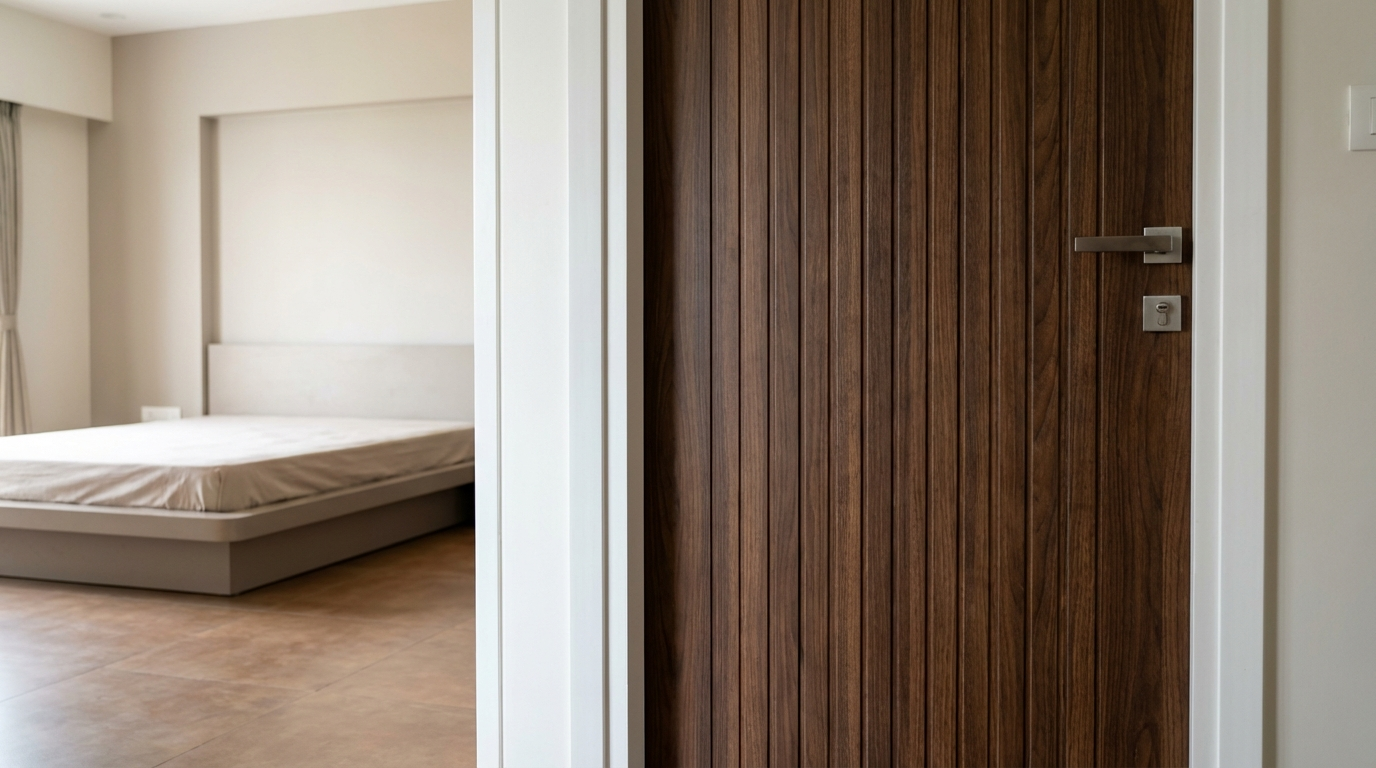
- Vertical grooved panel door: MDF with CNC-routed vertical lines—modern take on paneling, adds height perception
Glass Insert Door Designs (Light and Privacy Balance)
- Frosted glass strip insert: Flush door with 150mm vertical frosted glass—allows light while blocking views, ideal for internal bedrooms
- Full-height frosted glass panel: Wooden frame with 300-400mm frosted glass center—dramatic effect, best for attached bathrooms or walk-in closets
- Decorative glass with black frame: Fluted or reeded glass in powder-coated aluminum frame—trending contemporary look, premium pricing
- Small square glass inserts: 4-6 small glass panels in upper portion—allows visibility check without full opening, works for children's rooms
- Colored stained glass accent: Traditional leaded glass or film-applied color—adds character to heritage-style homes
Is a Glass Insert Door Good for Indian Bedrooms?
Glass insert doors work well in Indian bedrooms when privacy is properly addressed through frosted, fluted, or textured glass options. They're particularly useful for internal bedrooms that lack natural light or attached bathroom entrances where you want to monitor if lights are on. However, avoid clear glass for main bedroom entries facing common areas. The practical concern in India is cleaning—glass panels in dusty cities like Delhi or construction-heavy areas require frequent wiping. For coastal regions, ensure the glass is properly sealed against humidity penetration at the frame joints.
Sliding and Barn Door Designs (Space Savers)
- Barn-style wooden plank door: Solid or engineered wood with visible metal hardware—rustic industrial aesthetic, requires wall space beside opening
- Minimalist sliding panel: Flush door on concealed track—seamless modern look, track requires ceiling or wall mounting
- Glass sliding partition door: Aluminum frame with frosted glass—maximizes light in studio apartments, doubles as room divider
- Pocket sliding door: Door slides into wall cavity—complete space saving, requires advance planning during construction
- Double sliding bypass doors: Two panels sliding past each other—ideal for wide closet openings or connecting bedrooms
What Thickness is Best for Bedroom Sliding Doors?
Bedroom sliding doors typically perform best at 25-30mm thickness for standard residential use. Thinner panels (18-25mm) work for lightweight bypass closet doors, while heavier 35mm+ panels suit main bedroom entries where sound insulation matters. The critical factor is matching door weight to track capacity—Indian market tracks commonly handle 40-60 kg, so verify the combined weight of door panel and hardware before finalizing thickness. Thicker doors require heavier-duty tracks and may need floor guides for stability.
Carved and Decorative Door Designs (Statement Pieces)
- Traditional jaali pattern carved door: Solid teak with geometric lattice carving—heritage aesthetic, requires skilled craftsman, expensive
- CNC-routed geometric pattern: MDF or plywood with machine-cut designs—achieves carved look at lower cost than hand carving
- 3D textured panel door: Factory-made textured MDF panels—adds depth without custom carving, limited design options
- Art deco style with brass inlay: Veneer door with metal accent strips—statement piece for luxury bedrooms
- Minimalist etched pattern: Subtle groove patterns on flush surface—modern interpretation of traditional design
PVC and Composite Door Designs (Moisture-Resistant Options)
- Wood-finish PVC door: Full PVC with printed wood grain—maintenance-free, ideal for bathroom-attached bedrooms
- WPC (Wood Plastic Composite) door: Hybrid material with wood fiber and plastic—better structural stability than pure PVC
- Fiber-reinforced polymer door: FRP with paint or laminate finish—highest moisture resistance, institutional appearance
- PVC frame with wooden shutter: Combines termite-proof frame with traditional wood door—practical hybrid for older buildings
Material Comparison: Which Door Material Suits Your Bedroom?
Selecting bedroom door material requires balancing durability, maintenance, appearance, and budget. Each material type offers distinct advantages and limitations that suit different situations, climates, and preferences. The following comparison focuses on practical performance in Indian conditions rather than theoretical specifications.
| Material | Durability | Moisture Resistance | Sound Insulation | Maintenance | Price Range | Best For |
|---|---|---|---|---|---|---|
| Solid Teak Wood | Excellent (30+ years) | Good (natural oils) | Excellent | Annual polishing | ₹15,000-45,000 | Premium master bedrooms, traditional homes |
| Engineered Wood (Veneer) | Very Good (15-20 years) | Moderate (MR) to Good (BWR) | Good to Very Good | Occasional polishing | ₹8,000-20,000 | All bedrooms, balanced choice |
| Flush Door (Laminate) | Good (10-15 years) | Moderate to Good | Moderate to Good | Minimal (wipe clean) | ₹4,000-12,000 | Budget-conscious, rental properties |
| MDF Panel Door | Moderate (8-12 years) | Poor to Moderate | Good | Moderate (avoid water) | ₹6,000-15,000 | Air-conditioned rooms, dry climates |
| PVC Door | Good (15-20 years) | Excellent | Poor to Moderate | Minimal | ₹3,000-8,000 | Coastal areas, high humidity zones |
| WPC Door | Very Good (15-20 years) | Excellent | Moderate | Minimal | ₹5,000-12,000 | Bathroom-attached bedrooms |
| Glass (with frame) | Very Good (20+ years) | Excellent | Poor | Regular cleaning | ₹8,000-25,000 | Contemporary designs, internal rooms |
Decision Framework: Matching Door Type to Your Situation
| Your Situation | Recommended Door Type | Reasoning |
|---|---|---|
| First-time homeowner, limited budget | Laminate flush door (30mm, MR core) | Affordable, durable enough, easy maintenance |
| Master bedroom in premium apartment | Veneer door with solid core or teak | Aesthetic quality, sound insulation, longevity |
| Children's bedroom | Laminate flush (scratch-resistant grade) | Handles abuse well, easy to clean crayon marks |
| Bedroom in coastal city | BWR flush door or WPC/PVC | Humidity resistance prevents swelling and warping |
| Bedroom with attached bathroom | WPC or PVC door for bathroom, wood for bedroom | Separates moisture zones appropriately |
| Heritage or traditional home | Solid wood carved or panel door | Matches architectural character |
| Studio apartment divider | Sliding glass partition | Maximizes light, maintains openness |
| Rental property investment | Standard laminate flush doors | Cost-effective, tenant-proof, replaceable |
Size Guide: Standard Bedroom Door Dimensions for Indian Homes
Standard bedroom door sizes in India typically measure 7 feet (2100mm) height and 3 feet (900mm) width, though actual requirements vary based on room size, ceiling height, and architectural style. Understanding dimensional standards helps avoid costly modifications during installation.
Common Bedroom Door Sizes
- Standard single door: 2100mm × 900mm (7′ × 3′)—fits most bedroom openings
- Compact single door: 2100mm × 750mm (7′ × 2.5′)—suitable for smaller bedrooms or secondary rooms
- Master bedroom (single wide): 2100mm × 1000mm (7′ × 3.3′)—slightly wider for furniture movement
- Double door entry: 2100mm × 1200-1500mm total (two panels)—statement entries for large master suites
- Sliding door panels: 2100mm × 900-1200mm per panel—depends on opening width
How to Calculate Door Size for Your Opening
Measure the structural opening (brick to brick), then subtract frame thickness to determine shutter size. Standard wooden frames are 100-125mm wide, so a 1000mm opening accommodates approximately 750-800mm door shutter width. Always measure at three points (top, middle, bottom) as walls are rarely perfectly plumb—use the smallest measurement for door sizing.
For renovation projects, verify existing frame condition before ordering new doors. Replacing only the shutter requires matching exact dimensions, while changing both frame and shutter allows standard sizing.
Common Buyer Mistakes and How to Avoid Them
Bedroom door purchases frequently go wrong due to overlooked details and assumptions. These seven common mistakes cost Indian homeowners money, time, and satisfaction—learning from others' errors saves considerable trouble.
Mistake 1: Choosing by Appearance Only
What goes wrong: A visually attractive door with poor core construction dents easily, transmits sound, and deteriorates within 3-5 years. Why it happens: Dealers display finished surfaces, not internal construction, and buyers rarely ask about core material. How to avoid: Always ask specifically: "What is the core material—solid, semi-solid, or hollow?" Request to see a cut sample if available, or ask for written specification of core type.
Mistake 2: Ignoring Humidity Conditions
What goes wrong: MR-grade doors in coastal cities or humid eastern regions swell at edges, jamb tight, and eventually delaminate. Why it happens: Buyers use national specifications without regional adaptation, or dealers don't clarify grade differences. How to avoid: In Mumbai, Chennai, Kolkata, Kerala, and other high-humidity zones, insist on BWR-grade cores or moisture-proof alternatives like WPC/PVC.
Mistake 3: Mismatched Frame and Shutter Quality
What goes wrong: Premium door shutters installed in inferior frames fail at hinges, develop gaps, or allow termite entry. Why it happens: Frames are ordered separately from contractors while buyers focus only on visible shutters. How to avoid: Specify frame material and quality in writing—ideally matching or exceeding shutter grade. Consider PVC frames in termite-prone areas.
Mistake 4: Insufficient Floor Clearance
What goes wrong: Doors scrape flooring after monsoon swelling or when flooring is changed. Why it happens: Doors fitted precisely in dry season don't account for seasonal expansion. How to avoid: Maintain minimum 8-10mm floor gap in moderate climates, 12-15mm in high-humidity areas. Use door sweeps for draft sealing rather than tight fits.
Mistake 5: Specifying Wrong Thickness for Hardware
What goes wrong: Standard mortise locks don't fit thin doors, or heavy doors overwhelm standard hinges. Why it happens: Hardware selection happens independently of door specification. How to avoid: Standard mortise locks need minimum 35mm door thickness. Verify hinge weight rating matches door weight—heavy solid core doors need 4-inch hinges, not standard 3-inch.
Mistake 6: Not Sealing Cut Edges
What goes wrong: Custom-cut doors expose raw core material to moisture, leading to localized swelling and edge deterioration. Why it happens: Factory edge sealing is removed during site cutting; carpenters don't always reseal. How to avoid: Ensure all cut edges receive sealer application—wood primer for veneer doors, PU sealant for laminate doors. Verify this during installation inspection.
Mistake 7: Ordering Exact Quantities Without Buffer
What goes wrong: Transport damage, cutting errors, or defects leave projects short with no matching replacement available. Why it happens: Tight budgeting doesn't account for real-world wastage. How to avoid: For custom orders, order one extra door per 8-10 units. For standard sizes, verify dealer stock availability before committing to avoid batch-matching issues during replacement.
Workmanship and Installation Tips
Even the best bedroom door fails with poor installation. These practical guidelines help homeowners supervise carpenter work and ensure lasting performance. For detailed carpentry guidance, our woodwork installation checklist covers broader principles applicable across furniture types.
Pre-Installation Checklist
- Verify door dimensions match frame opening with 3-4mm clearance on each side
- Check door for warping by laying flat on floor—all corners should touch evenly
- Inspect surface for transport scratches or edge damage before accepting delivery
- Ensure frame is plumb and level—use spirit level on both verticals and horizontal
- Confirm wall around frame is cured and dry—fresh plaster moisture damages doors
Critical Installation Practices
Hinge placement: Position top hinge 150-200mm from door top, bottom hinge 200-250mm from bottom. For doors over 2000mm height or exceeding 25kg, add a center hinge. Mortise hinges fully into both door and frame—surface-mounted hinges on bedroom doors look cheap and loosen faster.
Lock positioning: Standard handle height is 900-1000mm from floor, comfortable for adults and accessible for children. Mortise lock pocket should be cut precisely—oversized cutouts weaken the door stile and cause loose locksets.
Edge treatment: All exposed edges on laminate doors must have proper edge banding with waterproof adhesive. Veneer door edges should receive two coats of sealer before final installation. This single step prevents 80% of premature door failures.
Carpenter Briefing Points
Before work begins, clearly communicate these requirements:
- No field modifications without approval—cutting vents, changing hinge positions, etc.
- All cut edges must be sealed same day—don't leave overnight
- Verify hardware compatibility before making mortise cuts
- Leave specified floor clearance—don't trim for "better fit"
- Test door operation before final adjustments—should open and close smoothly without force
Quality Checks Without Lab Tests
Homeowners can verify bedroom door quality without professional testing equipment. These field-practical checks help identify problems before and after purchase, enabling informed decisions and justified complaints.
Visual Inspection Points
- Surface check: Look for laminate bubbles, veneer cracks, or uneven finish under raking light
- Edge inspection: Check for gaps between edge band and substrate, delamination starting points
- Corner examination: Corners should be crisp, not rounded from poor pressing or damaged in transit
- Flatness test: Place door on flat surface—any rocking indicates warping
- Color consistency: Compare multiple doors from same batch for shade variation
Can You Check Bedroom Door Core Quality Without Cutting?
While you can't see inside a sealed door, several indicators suggest core quality. Weight provides the first clue—a solid core 2100×900mm flush door weighs 25-35kg, while hollow core versions weigh 10-18kg. Pick up the door and judge whether it feels substantial or worryingly light. The knock test helps too: solid cores produce a dull thud when knocked, while hollow cores sound distinctly resonant and drum-like. Edge hardness also indicates core type—press your thumbnail firmly into the door edge; if it dents easily, the core is likely low-density particle board or hollow honeycomb.
Questions to Ask the Dealer
- "What is the specific core material—particle board, block board, MDF, or honeycomb?"
- "Is this MR grade or BWR grade construction?"
- "What is the face thickness of the laminate or veneer?"
- "Do you have a sample cutaway showing the door construction?"
- "What warranty coverage do you provide for warping and delamination?"
- "Are these doors from a single production batch for color matching?"
Warning Signs to Walk Away
Certain red flags suggest quality or integrity problems worth avoiding:
- Dealer refuses to specify core material or gives vague answers
- Significantly lower prices than market average without clear explanation
- No written warranty or only verbal assurances
- Visible edge gaps or bubbles on showroom samples
- Weight feels suspiciously light for claimed construction
- Strong chemical odor indicating poor adhesive curing
How Long Do Bedroom Doors Last in Indian Conditions?
Bedroom door lifespan in India typically ranges from 10-30 years depending on material quality, climate conditions, and maintenance practices. Solid teak doors in favorable climates can exceed 40 years with proper care, while budget flush doors in humid coastal areas may show significant deterioration within 7-10 years.
The primary lifespan determinants are moisture exposure and maintenance consistency. Doors in air-conditioned bedrooms last longer than those in non-AC rooms due to reduced humidity cycling. Annual inspection and timely repairs—addressing loose hinges, resealing edges, fixing hardware—extend service life significantly. Our maintenance guidelines for wood products cover these practices in detail.
Realistic lifespan expectations:
- Solid teak/hardwood: 25-40+ years with maintenance
- Veneer with BWR core: 15-25 years
- Laminate flush (MR grade): 10-15 years in dry climates, 7-12 years in humid areas
- PVC/WPC doors: 15-20 years (color fading may occur earlier)
- Budget hollow-core: 5-10 years maximum
Price Range and Budget Planning (2026 Market)
Bedroom door prices in India vary significantly based on material, construction quality, brand, and city. Rather than exact figures that quickly become outdated, understanding cost drivers helps realistic budget allocation and value assessment.
Price Influencing Factors
Material cost hierarchy: Solid teak commands premium pricing, followed by imported veneers, domestic veneers, high-pressure laminates, and finally PVC/WPC options. Core material also affects price—BWR-grade costs 15-25% more than MR-grade equivalents.
Size and thickness: Standard 7×3 feet doors cost less than wider or taller custom sizes. Thicker doors (35mm+) use more material and cost proportionally more than 25-30mm versions.
Finishing level: Raw doors requiring site finishing cost less than factory-finished ready-to-install versions. However, site finishing quality varies with carpenter skill, potentially affecting final appearance.
Hardware inclusion: Quoted prices may or may not include hinges, handles, and locks. Clarify this upfront—hardware can add ₹1,500-5,000 per door depending on quality level.
Budget Estimation Approach
For typical bedroom door projects, allocate budget in these proportions:
- Economy range: Laminate flush doors at ₹4,000-7,000 per door (shutter only)
- Mid-range: Veneer doors or premium laminate at ₹8,000-15,000 per door
- Premium range: Solid wood or designer doors at ₹15,000-30,000+ per door
- Frame cost: Add ₹2,000-6,000 per door for wooden frames, ₹3,000-5,000 for PVC frames
- Hardware cost: Add ₹1,500-4,000 per door for hinges, handles, and locks
- Installation labor: Add ₹800-2,000 per door depending on city and complexity
Metro cities (Mumbai, Delhi, Bangalore, Chennai) typically price 15-25% higher than tier-2 cities for equivalent products. Factor transport costs for heavy solid wood doors ordered from distant suppliers.
Trade-offs and Limitations to Consider
Every bedroom door choice involves compromises. Understanding these trade-offs prevents disappointment and enables informed prioritization based on what matters most for your specific situation.
Appearance vs. Durability
High-gloss finishes and light colors show scratches and dust more readily than matte finishes and darker tones. Natural veneer looks premium but requires more careful maintenance than laminate. Carved doors collect dust in crevices requiring detailed cleaning.
Sound Insulation vs. Cost
Effective sound blocking requires solid-core construction that costs 40-60% more than hollow-core alternatives. There's no budget workaround for acoustic performance—lightweight doors transmit sound regardless of surface treatment.
Moisture Resistance vs. Aesthetics
PVC and WPC doors offer excellent moisture resistance but limited design options and less premium appearance. Natural wood looks beautiful but requires careful climate management. The compromise is marine-grade plywood cores with quality veneer or laminate—but this combination carries higher cost.
Sliding vs. Hinged Operation
Sliding doors save floor space but require clear wall area for door travel, cost more due to hardware, and typically provide less sound insulation than well-fitted hinged doors. They also require more maintenance to keep tracks clean and rollers smooth.
Ready-Made vs. Custom
Factory-made standard doors offer consistent quality and immediate availability but limited size and design options. Custom doors allow exact specifications but involve longer lead times, higher costs, and quality dependent on manufacturer capability.
Frequently Asked Questions
What is the best material for bedroom doors in India?
The best material depends on your climate, budget, and priorities. For most Indian homes in moderate climates, engineered wood doors with quality veneer or laminate finish offer the optimal balance of durability, appearance, and cost. These typically feature MR-grade or BWR-grade plywood cores that resist humidity better than solid MDF while costing less than solid hardwood. For coastal and high-humidity regions, specifically choose BWR-grade cores or consider WPC doors that handle moisture extremes without warping. Solid teak remains the premium choice for those prioritizing longevity and willing to invest in periodic maintenance, lasting 30+ years with proper care.
How much does a good bedroom door cost in India?
A good quality bedroom door suitable for most Indian homes costs between ₹6,000-15,000 for the shutter alone, with frames, hardware, and installation adding another ₹4,000-10,000. This mid-range spending gets you solid-core construction with quality laminate or veneer finish that should last 15-20 years with normal use. Budget options below ₹5,000 typically use hollow cores and thinner laminates, suitable only for secondary rooms or rental properties. Premium solid wood or designer doors range from ₹15,000-40,000+, justified for statement master bedrooms or heritage homes. Metro cities price approximately 20% higher than tier-2 towns for equivalent quality.
Is PVC door good for bedroom use?
PVC doors work well for specific bedroom applications, particularly in high-humidity areas like coastal cities or for bathroom-attached bedrooms where moisture resistance is critical. They're termite-proof, maintenance-free, and won't warp in humid conditions—significant advantages over wood in challenging climates. However, PVC doors have notable limitations: they provide poor sound insulation, have limited design options compared to wood, may fade in direct sunlight over time, and lack the premium aesthetic of natural materials. They're best suited as practical solutions for secondary bedrooms, children's rooms, or humid-zone applications rather than master bedroom statement pieces.
What is the difference between flush door and panel door?
Flush doors feature flat, smooth surfaces without raised sections or depressions—essentially a rectangular slab with uniform face on both sides. They suit modern, minimalist interiors and are typically more affordable due to simpler construction. Panel doors feature visible sections (panels) surrounded by stiles and rails, creating dimensional interest through raised or recessed areas. They suit traditional, colonial, or transitional interior styles and generally cost more due to complex construction. Functionally, both can offer similar performance—the choice is primarily aesthetic. Flush doors are easier to maintain and clean, while panel doors provide more visual character and can hide minor surface imperfections better.
Can bedroom doors be made soundproof?
Complete soundproofing requires specialized acoustic doors typically used in recording studios—impractical and expensive for residential bedrooms. However, significant sound reduction is achievable with proper door selection and installation. Choose solid-core doors weighing 25kg+ rather than hollow-core versions. Ensure proper sealing with weatherstripping on all four edges and door sweeps at the bottom. Install doors with minimal gaps—maximum 3mm between door and frame. These measures can reduce sound transmission by 25-30 decibels, adequate for blocking typical household noise. The weak points are typically gaps rather than the door panel itself, so installation quality matters as much as door construction.
How do I maintain a wooden bedroom door?
Wooden bedroom door maintenance involves regular cleaning, periodic inspection, and protective treatments. Dust weekly with dry cloth and clean monthly with damp cloth followed by dry wiping—never use wet mops or excess water. Inspect hinges every six months and tighten screws before they become loose. Check edges annually for early delamination or moisture damage, especially before monsoon season. For veneer doors, apply furniture polish every 2-3 months to maintain sheen and protect the surface. Solid wood doors benefit from annual wax or polish application. Address any hardware issues immediately—dragging doors or loose hinges cause accelerated wear. In humid climates, ensure adequate ventilation in bedrooms to reduce moisture exposure.
What size door is standard for Indian bedrooms?
Standard bedroom door size in Indian homes is 7 feet (2100mm) height and 3 feet (900mm) width. This dimension fits most residential construction and accommodates furniture movement adequately. Secondary bedrooms sometimes use 2.5 feet (750mm) width doors where space is constrained. Master bedrooms in larger homes may feature 3.25-3.5 feet (1000-1050mm) width for grander appearance or double doors totaling 4-5 feet width. Custom heights of 7.5-8 feet suit high-ceiling premium apartments. Always measure your specific frame opening before ordering—older buildings particularly may have non-standard dimensions. The structural opening should be 100-125mm wider and taller than the desired door shutter to accommodate the frame.
Are sliding doors better than hinged doors for bedrooms?
Sliding doors offer advantages in space-constrained bedrooms—they don't require swing clearance, making them ideal for small rooms or areas where furniture placement conflicts with door swing. They also provide contemporary aesthetic appeal and work well as room dividers in studio apartments. However, hinged doors generally outperform sliding versions in sound insulation, security, and long-term reliability. Sliding door tracks require regular cleaning and periodic roller replacement, while hinged doors need only occasional hinge tightening. For primary bedrooms where privacy and acoustics matter, hinged doors typically prove superior. Consider sliding doors for closet openings, bathroom entries in compact layouts, or as design statements where their limitations are acceptable.
How do I prevent bedroom doors from warping?
Door warping primarily results from uneven moisture exposure—one face absorbing humidity while the other remains dry. Prevention starts with proper specification: choose BWR-grade cores in humid climates, ensure factory edge sealing is intact, and verify all cut edges are resealed after site modifications. During installation, maintain adequate clearances that don't force the door against the frame. Store doors horizontally before installation, not leaning against walls where humidity differs between faces. In use, maintain consistent room humidity through ventilation or climate control. If one side faces an air-conditioned room while the other faces humid areas, apply additional sealant to the humid-exposure side. Early warping is sometimes recoverable through controlled exposure—consulting a skilled carpenter before replacement makes sense.
What hardware is needed for bedroom door installation?
Complete bedroom door installation requires: hinges (typically 3 units for standard doors—two if lightweight, three for doors over 25kg), mortise lock set with handles, door stopper, and optional additions like door closers or viewers. Hinge specification depends on door weight—3-inch hinges suffice for lightweight doors under 20kg, while 4-inch heavy-duty hinges suit solid core doors. For coastal areas, specify stainless steel or brass hardware to prevent rust. Mortise locks require minimum 35mm door thickness; thinner doors need cylindrical locks. Budget ₹1,500-4,000 per door for quality hardware—cheap fittings fail quickly and compromise security. Match finish across all hardware (chrome, satin, antique brass) for professional appearance.
Is it necessary to seal bedroom door edges?
Edge sealing is essential for bedroom door longevity, yet frequently neglected. Factory-finished doors arrive with sealed edges, but any site cutting—for height adjustment, lock installation, or hinge mortising—exposes raw core material. This exposed substrate absorbs moisture, leading to localized swelling, edge delamination, and eventual structural damage. The repair cost for edge-related damage far exceeds the minimal effort of proper sealing. Apply appropriate sealant (wood primer for veneer, PU or acrylic sealant for laminate) to all cut surfaces before the door is installed. Verify this during installation inspection—carpenters sometimes skip this step to save time. Even factory edges benefit from additional sealant application in high-humidity environments.
Can I install a bedroom door myself, or should I hire a carpenter?
DIY door installation is possible for those with basic woodworking skills and proper tools, but professional installation is recommended for most homeowners. Proper installation requires accurate measurement, precise mortising for hinges and locks, correct alignment for smooth operation, and appropriate gap management. Errors lead to doors that stick, don't latch properly, have excessive gaps, or damage frames. Professional carpenters charge ₹800-2,000 per door depending on complexity and location—reasonable considering the skill required and consequences of poor installation. If attempting DIY, start with a secondary room door where imperfections are less critical, and have a carpenter available to correct any issues. Quality tools are essential—trying to cut mortises with inadequate chisels or drills guarantees poor results.
Do bedroom doors need ventilation gaps or grilles?
Standard bedroom doors don't require ventilation gaps when the room has adequate air circulation through windows or HVAC systems. However, certain situations benefit from door ventilation: bedrooms in non-AC homes in hot climates, rooms with attached bathrooms needing moisture egress, or areas where cross-ventilation improves comfort. Ventilation options include louvered door sections, transfer grilles installed in the door body, or deliberate undercutting (larger floor gap). The trade-off is reduced privacy and sound insulation—louvered sections particularly allow sound and light transmission. For AC rooms, ventilation in doors is counterproductive as it allows conditioned air escape. If adding ventilation, position it in lower door sections where it's less visually prominent and doesn't compromise security.
What is the difference between MR and BWR grade for bedroom doors?
MR (Moisture Resistant) and BWR (Boiling Water Resistant) grades indicate adhesive quality used in plywood and engineered wood construction—directly affecting performance in humid conditions. MR-grade uses urea formaldehyde adhesive that withstands normal humidity but degrades with prolonged moisture exposure or high humidity cycles. BWR-grade uses phenol formaldehyde adhesive that maintains bond integrity even in extreme moisture conditions, verified by boiling water immersion tests. For bedroom doors in moderate climates (Delhi, Bangalore interior), MR-grade performs adequately and costs less. For coastal cities, eastern India, Kerala, or any high-humidity environment, BWR-grade is strongly recommended despite 15-25% higher cost. The price difference is minor compared to premature door replacement costs from adhesive failure.
Disclaimer: This content is provided for general informational purposes based on industry practices and publicly available information. Product specifications, standards, prices, and availability may vary by manufacturer, region, and time. Readers should independently verify details with manufacturers, dealers, or qualified professionals before making purchase or construction decisions.Want Plywood Suggestions?
Share a few details and a Sainik 710 specialist will suggest suitable brands and connect you to responsive dealers.