Bathroom Door Design: 25+ Waterproof WPC, PVC & Glass Door Ideas for Indian Homes
Get 25+ bathroom door designs—waterproof WPC, PVC & glass options. Compare materials, sizes & prices for moisture-resistant bathroom doors in India.
Quick Answer: What's the Best Bathroom Door for Indian Homes?
The best bathroom door for Indian homes is a WPC (Wood Plastic Composite) door with a WPC frame—it's 100% waterproof, termite-proof, and handles humidity without warping. Simple as that.
Short version: WPC doors are a blend of wood fiber and high-quality thermoplastics. They are solid, durable, and built specifically for high-humidity areas like bathrooms. If your budget is tight, PVC doors work for a few years but feel hollow and cheap. Glass doors look stunning for shower partitions but need privacy solutions. And for the love of your sanity, don't put a wooden door in a bathroom unless you enjoy watching it swell every monsoon.
This is right for you if:
- You want a door that survives 10+ years in humid conditions
- Your bathroom doesn't have great ventilation (most Indian bathrooms, honestly)
- You shouldn't purchase white coloured doors for bathrooms because they show stains, dust, and marks very quickly in high-moisture areas
- You're building new or renovating and can replace the frame too—half the battle is getting the frame right, not just the door shutter
Skip this if:
- You're just looking for a temporary fix on a rental property—a basic PVC hollow door will do for now
- Budget is under ₹2,500 for the complete door with frame
Bottom line: WPC doors cost more upfront but save you the hassle of replacement every 3-4 years that cheaper options demand.
What Waterproof Bathroom Doors Actually Mean
A waterproof bathroom door is a door shutter and frame combination designed to resist moisture absorption, swelling, and decay in high-humidity environments. WPC doors are 100% waterproof and mildew-resistant, and will not crack in humid environments such as kitchens and bathrooms for a long time.
Most people think "waterproof" means you can throw a bucket of water at it. Actually, it means the door material doesn't absorb moisture from humid air—and that's the real killer in Indian bathrooms. Steam from hot showers, splashing during bucket baths, that wet towel hanging on the door handle... all of it adds up.
Bathrooms are high-moisture areas, which makes traditional wooden door frames vulnerable to problems like swelling, rotting, or termite attacks over time. In comparison, WPC door frames are specifically designed to withstand humid conditions without compromising strength or appearance.
Here's what confuses people: the door shutter might be waterproof, but if you stick it on a wooden frame, the frame rots and you're back to square one. I've seen this happen in at least forty flats across Mumbai and Pune—client spends ₹6,000 on a nice WPC door, but the builder used a sal wood frame to save ₹800. Three years later, the frame is gone.
Why This Matters More in Indian Homes
Indian bathrooms face a brutal combination: high humidity, poor ventilation, and bucket bathing that splashes water everywhere. In places like Chennai or Mumbai, relative humidity regularly hits 85-90% during monsoon months. Bengaluru is gentler at 70-75%, but even that's enough to destroy an MR-grade flush door in under two years.
Coastal cities are the worst. This makes WPC a preferred choice for small bathrooms where water splashes are more likely to occur. The Ghatkopar side of Mumbai gets more humid than Borivali because of the creek nearby—sounds minor, but I've seen the same door material behave differently across these areas.
Here's the reality most guides won't tell you: Indian bathrooms are typically smaller than Western ones. Compact bathrooms (3 x 6 to 4 x 7 feet) typically accommodate only a wash basin and a water closet. Wall-mounted WC models are highly recommended as they free up floor space, and sliding or pocket doors are essential for compact spaces to prevent door swings from obstructing fixtures. When you're bucket-bathing two feet from the door, that door is basically getting a direct water attack every morning.
Kolkata and Chennai—both humid, both coastal—see the fastest door deterioration. Ahmedabad and Jaipur, being drier, give doors a longer life, but even there the bathroom is a microclimate of its own. Don't let dry-state dealers convince you that a cheaper option will work because "humidity is low here." The bathroom doesn't care about the city weather.
Types of Bathroom Doors: A Proper Breakdown
PVC doors are made entirely from plastic resin. They are lightweight and hollow from inside (not solid), which makes them suitable mostly for extremely budget-conscious projects. Most PVC doors come pre-fabricated in limited sizes and designs.
WPC Doors (Wood Plastic Composite)
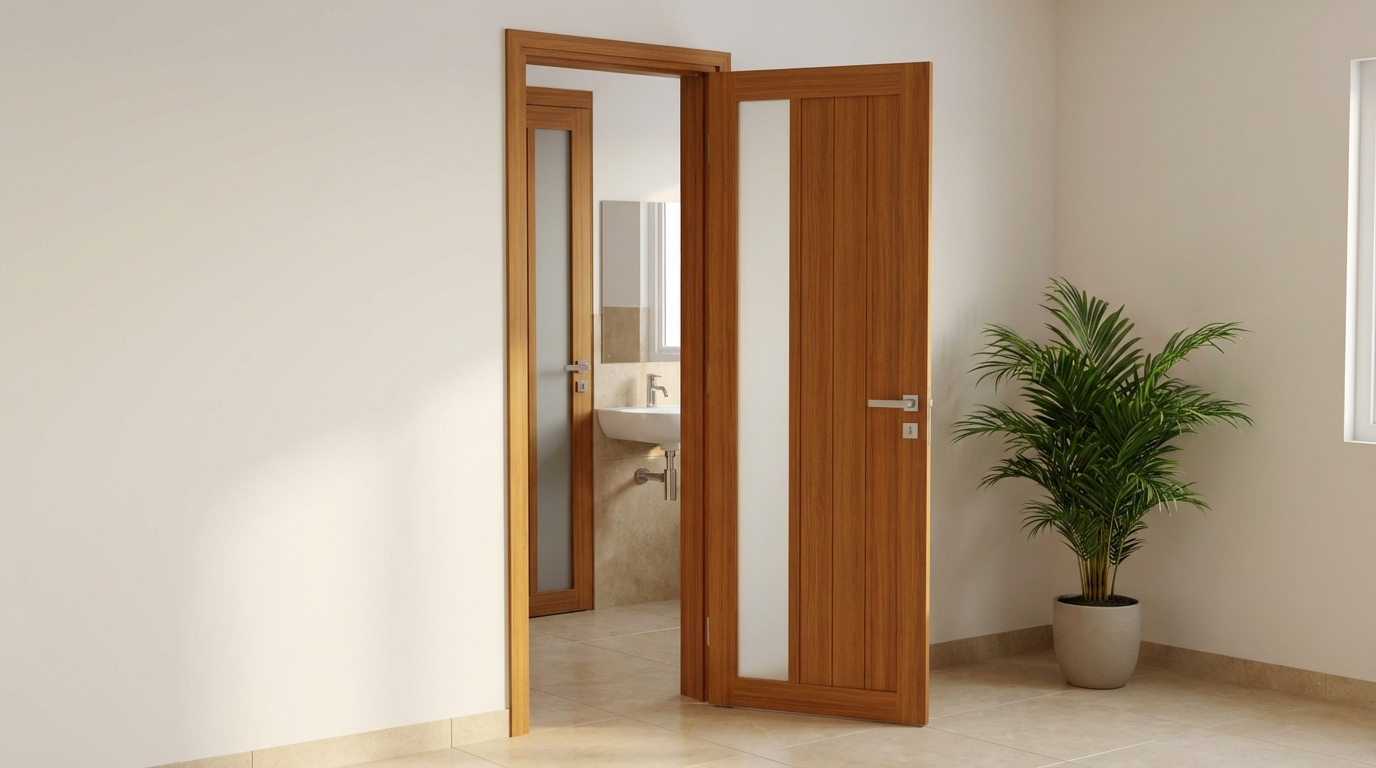
WPC door frames are made from a blend of wood fibers and plastic, offering the look and feel of wood but with added durability and resistance to water, moisture, and pests. These are solid, heavy, and feel like quality when you knock on them. WPC solid doors are most suitable for Bathroom, Balcony and even Bedroom doors. They are 100% Waterproof and easy to install. They are easily machinable and there are lots of CNC designs that can be carved on the doors.
My take: This is what I recommend to 8 out of 10 clients. The only exceptions are ultra-tight budgets or temporary setups.
PVC Doors (Polyvinyl Chloride)
PVC doors are very light and hollow inside—poor strength for long-term use. Low screw holding power means locks and handles loosen easily. They have a cheap appearance, often look plasticky, are easily discolored with harsh bathroom cleaners, and can become brittle at joints over time.
Honestly: If you're doing a PG hostel or staff quarters where doors get replaced anyway, fine. For your own home? Skip.
Glass Doors (Frosted/Tempered)
Frosted glass blurs the view while still allowing natural light in. It's a balance between open and private and is one of the most suitable glass bathroom door designs. Frameless shower doors use sturdy tempered glass that is sleek and modern and offers no visual obstructions. These frameless designs display exquisite stonework, intricate tile designs, and gleaming hardware.
These work best for shower enclosures inside the bathroom, not the main entrance door. For the main door, privacy becomes an issue unless you use heavily frosted options.
FRP Doors (Fiber Reinforced Plastic)
FRP doors pass different quality tests and are 100% waterproof, which makes them one of the best choices for bathroom doors. FRP fibre doors and frames are utilized particularly in bathrooms owing to their waterproof quality.
These are common in commercial setups—hotels, hospitals, hostels. For homes, WPC gives a more premium look at similar pricing.
Aluminium Doors
Glass doors are most commonly used for modern bathrooms, especially in homes where space is limited. They create an open and airy feel and are generally used in bathrooms that are not shared by many people.
Aluminium frames with glass or composite panels work well in high-end projects. But condensation can be an issue, and they feel cold in winter months—minor annoyance, but worth noting.
Comparison Table: Bathroom Door Materials
| Material | Waterproof? | Durability | Look & Feel | Approx. Price Range (₹/sq ft) | Best For | My Verdict |
|---|---|---|---|---|---|---|
| WPC (Solid) | 100% | 10-15 years | Wood-like, premium | ₹130-300 | Homes, premium projects | Top pick |
| PVC (Hollow) | Yes | 3-5 years | Plasticky, basic | ₹80-150 | Budget projects, rentals | Temporary only |
| FRP | 100% | 8-12 years | Industrial | ₹160-275 | Commercial, hostels | Good alternative |
| Glass (Tempered) | Yes | 15+ years | Modern, luxurious | ₹350-800+ | Shower enclosures | Partitions only |
| Wooden | No | 2-4 years in bathrooms | Traditional | ₹150-400 | Dry areas only | Avoid for bathrooms |
Price Reality Check (2026 Market)
Alright, let's talk money. WPC Bathroom Doors with designs in 30mm thickness and 72x30 size range approximately ₹3,060 to ₹3,740 per piece. That's for a ready-to-install door without frame.
Here's what actually affects your final bill:
- Door thickness: Thickness ranges from 24mm, 28mm, to 30mm for WPC doors. Thicker = more expensive, more solid feel
- Density grade: High-density WPC costs 15-25% more but holds screws better and lasts longer
- Frame material: WPC door frames are suitable for all weathers and are 100% water and termite proof. WPC frames add ₹800-1,500 to your cost but are essential
- Finish type: Plain WPC is cheapest; laminated, CNC-carved, or UV-printed doors cost 30-50% more
- Size: Width ranges from 26, 27, 30, 32, 33, 36, 38 inches and length ranges from 75, 78, 81, 84 inches.
For a complete budget estimation:
- Basic PVC door + PVC frame: ₹1,800-2,800 complete
- Standard WPC door + WPC frame: ₹4,500-7,000 complete
- Premium WPC with CNC design + frame: ₹7,500-12,000 complete
- Glass shower door (sliding): ₹8,000-25,000 depending on glass type and hardware
In terms of price, WPC door frames are slightly costlier than traditional wooden frames or PVC alternatives. However, they offer much better value for money in the long run because of their durability and low maintenance.
WPC vs PVC: The Real Difference
Many customers think WPC and PVC are the same, but the reality is—they're very different in performance, design, and durability.
| Parameter | WPC Doors | PVC Doors | Winner |
|---|---|---|---|
| Core Structure | Solid throughout | Hollow inside | WPC |
| Weight | Heavy (feels premium) | Very light | WPC |
| Screw Holding | Excellent | Poor (handles loosen) | WPC |
| Waterproof | 100% waterproof and remain stable in humid bathroom environments | Water-resistant | WPC |
| Design Options | Options like real wood texture through UV digital printing, CNC router designs, CNC groove designs, and solid color finishes | Limited patterns | WPC |
| Lifespan | 10-15 years | 3-5 years | WPC |
| Initial Cost | Higher | Lower | PVC |
| Long-term Value | Although PVC doors appear less expensive upfront, their less durable nature causes them to be replaced often. WPC doors are a little pricier upfront but provide long-term savings. | Needs replacement | WPC |
Choose WPC when: You're building your own home, renovating for long-term, or want something that feels substantial and looks decent.
Choose PVC when: You're on a strict budget, it's a rental property, or you need a quick temporary fix while planning a proper renovation later.
Is WPC actually worth the extra cost?
Short answer: yes, if you plan to stay in that home for more than 3 years. WPC doors are stronger than PVC doors that tend to bow or lose their shape due to continued usage. When subjected to humid bathroom conditions, WPC does not warp, thus offering years of consistent service.
I had a client in Thane who replaced his hollow PVC bathroom door twice in four years. Each time cost him around ₹2,500 with installation. After the second failure, he finally put in a WPC door at ₹5,500. It's been five years now—still going strong. The math isn't complicated.
How to Choose the Right Bathroom Door
Step 1: Measure your door opening accurately
Bathroom doors are slightly smaller, with a standard size of 2 feet 4 inches to 2 feet 6 inches wide and 7 feet high (28 to 30 inches by 84 inches). But don't assume—measure the actual opening. Older buildings often have non-standard sizes.
Step 2: Check if you need to replace the frame
If your existing frame is wooden and shows any swelling or discoloration, replace it. No point putting a new waterproof door on a rotting frame.
Step 3: Decide on swing direction
Bathroom doors should ideally open outward for safety. If someone falls inside, you can open the door without their body blocking it. This is especially important for homes with elderly family members.
Step 4: Consider sliding doors for tight spaces
Sliding or pocket doors are essential for compact spaces to prevent door swings from obstructing fixtures. If your bathroom opens into a narrow passage, a sliding door saves about 2 feet of clearance space.
Step 5: Match the door thickness to usage
Bathroom/WC doors in India are commonly 700mm x 2100mm. Thickness should be 30mm to 35mm for internal doors. For master bathrooms that need more privacy and sound insulation, go with 30mm. Guest bathrooms can work with 28mm.
Decision Matrix
| Your Situation | Recommendation | Why |
|---|---|---|
| Building new home | WPC door + WPC frame | Best long-term investment |
| Replacing old wooden door | WPC door + replace frame too | Wooden frame likely damaged |
| Rental property (landlord) | Standard PVC | Tenants won't maintain it anyway |
| Rental property (tenant) | Live with existing door | Not your investment |
| Small bathroom, no ventilation | High-density WPC, outward swing | Maximum moisture resistance |
| Premium master bath | Glass partition + WPC entrance | Looks modern, practical |
| Coastal city (Mumbai, Chennai, Kolkata) | WPC only, no wooden components | Humidity destroys wood fast |
Red flags to walk away from:
- Dealer insisting wooden doors are "sealed" and waterproof—they're not, not for bathrooms
- WPC doors priced below ₹100/sq ft—likely low-density material that won't last
- Doors without any brand marking or warranty documentation
- "Waterproof plywood doors"—marketing nonsense, plywood is never truly waterproof for bathroom use
Common Mistakes People Make
1. Keeping the old wooden frame when installing a new WPC door
This drives me crazy. You spend money on a waterproof door, but the frame—which sits in direct contact with the floor and wall—is still the old wooden one. When it comes to bathroom doors, the door frame is just as important as the door itself. A WPC door frame is one of the best choices for bathrooms due to its durability, water resistance, and low maintenance requirements. Two years later, the frame rots, the door starts sagging, and people blame the WPC material.
2. Choosing white doors for bathrooms
White-coloured WPC doors show stains, dust, and marks very quickly in bathrooms, making them look dirty in a short time. Go with cream, ivory, or wood tones instead.
3. Ignoring the gap at the bottom
Some installers leave a 2-inch gap at the bottom for "ventilation." In Indian bathrooms where you're splashing water everywhere, that gap means water constantly hitting the bottom edge. Keep it to 10-15mm maximum.
4. Not checking door density before buying
Low-density WPC looks the same as high-density but weighs less and holds screws poorly. Ask for the density specification—anything below 0.55 g/cm³ is likely to give you trouble.
5. Installing hinges meant for wooden doors
WPC needs specific hinges that distribute load properly. Regular wooden door hinges can crack the composite material around the screw holes. There was this builder in Andheri who used standard hinges on twenty WPC doors in a project—six months later, half of them were sagging.
6. Skipping the door stopper
Without a proper stopper, the door handle keeps banging into the wall. WPC doors are heavier than PVC, so the impact is harder. Eventually, the handle or the wall gives way.
7. Using the wrong adhesive for frame installation
WPC frames need PU (polyurethane) adhesive or proper mechanical fixing. Regular cement slurry doesn't bond well with the material. I've seen frames come loose within months because the mistri used whatever was available.
8. Believing "waterproof" means "never clean"
Waterproof doors still accumulate soap scum, mould on the surface, and hard water stains. Wipe them down monthly with mild detergent. This one really frustrates me—people buy premium doors and then neglect basic maintenance, then complain about discoloration.
9. Installing glass doors for the main bathroom entrance
Glass shower partitions are great. Glass doors as the main bathroom entrance? Privacy nightmare unless you use heavily frosted glass, and even then, silhouettes are visible. Stick to solid doors for the entrance, glass for internal partitions.
10. Ordering online without checking actual samples
Online photos don't show quality. That "teak finish" WPC door might look orange in person. Always visit a dealer, feel the weight, check the finish quality, and knock on it to hear if it's solid or hollow.
Quality Checks You Can Do Yourself
Visual Inspection:
- Surface should be uniform—no bubbles, waves, or uneven patches
- Edges should be clean-cut, not rough or jagged
- Colour should be consistent across the entire surface
- No cracks or stress marks visible, especially near corners
- Lamination (if any) should be firmly bonded with no peeling edges
- Check both sides—some manufacturers cut corners on the back surface
Questions to Ask the Dealer:
- "What's the density of this WPC?" (should be 0.55 or higher)
- "Does this come with a warranty? What does it cover?"
- "Can I see a cross-section or cut sample?"
- "What's the recommended frame for this door?"
- "Do you supply the matching hardware (hinges, locks)?"
Field Tests:
- Weight test: Lift the door. Solid WPC is heavy—a 7x2.5 ft door should weigh 15-20 kg minimum. If it feels light, it's either hollow or low-density
- Knock test: Tap at different points. Consistent solid sound = good. Hollow sounds in some areas = hollow core or voids
- Edge inspection: Look at the cut edge if available—should show uniform material throughout, not layers or gaps
- Flex test: For PVC doors especially—press the center firmly. It shouldn't flex more than a few millimeters
- Scratch test: Run your fingernail firmly across the surface. Quality doors shouldn't scratch easily
Here's a trick most dealers don't like: ask to see the door in different lighting. Showroom lighting hides a lot of defects. Take the door near the entrance, check it in natural light. Surface imperfections suddenly become visible.
Warning Signs:
- Dealer refuses to show cut samples or cross-sections
- No brand marking anywhere on the door
- Price seems too good to be true (below ₹100/sq ft for WPC)
- Warranty terms are vague or not in writing
- "Just as good as" comparisons without specifications
- Pre-drilled holes in odd positions (might be a defective piece)
Installation: What to Tell Your Carpenter
WPC doors can be easily installed on existing wood, granite, cement, or any type of frame. PVC doors, on the other hand, are typically fixed only on PVC frames and not compatible with other frame types.
Briefing checklist for your carpenter:
- Frame installation first, door later: Let the frame set properly (24-48 hours with PU adhesive) before hanging the door
- Use appropriate screws: For 28-30mm thick WPC doors, use 1.5-inch screws for hinges, not longer—they'll poke through the other side
- Pre-drill all holes: WPC can crack if you drive screws directly without pilot holes
- Check for level: Frame must be perfectly plumb. Even 2-3mm deviation will cause the door to not close properly
- Bottom gap: Maintain 10-15mm gap from floor. Less means the door scrapes; more means water splashes in
- Apply silicone sealant: Where frame meets wall and floor, run a bead of bathroom-grade silicone to prevent water seepage
I've seen carpenters skip the pilot holes and then wonder why the WPC cracked around the hinge. This happened on a site in Powai last year—eight bathroom doors, three had to be replaced because of improper installation. The material is forgiving, but not that forgiving.
Storage notes:
If doors arrive before installation is ready, store them flat (not leaning against a wall), in a dry covered area. WPC won't absorb moisture like wood, but storing vertically can cause warping over time due to its own weight.
How Long Do Bathroom Doors Really Last?
Honest expectations based on my experience with hundreds of installations:
| Material | Expected Lifespan | Conditions |
|---|---|---|
| High-density WPC | 12-15 years | With WPC frame, proper installation, basic maintenance |
| Standard WPC | 8-10 years | Same conditions |
| PVC (hollow) | 3-5 years | Before handles loosen, surface yellows |
| FRP | 8-12 years | Industrial-grade, used in homes |
| Glass (tempered) | 15-20+ years | Unless physically damaged |
| Wooden (even BWR grade) | 2-4 years in bathrooms | Before swelling, paint peeling starts |
What affects longevity:
- Ventilation: Bathrooms with windows or exhaust fans reduce humidity, extending door life by 20-30%
- Usage pattern: Four people using a bathroom means four showers of humidity daily—more stress on materials
- Maintenance: Monthly wipe-down prevents mould buildup that can discolor surfaces
- Installation quality: Properly sealed frames and correct hardware make a huge difference
Signs of wear to watch for:
- Difficulty closing (indicates warping or hinge issues)
- Visible mould on surface despite cleaning
- Loosening handles or locks
- Discoloration that doesn't clean off
- Cracking around hinge points
When to replace:
If you're tightening the same screw every few months, the material around it has given up. Time to replace. Don't wait until the door won't close properly.
Can you use wooden doors in bathrooms at all?
Wooden doors are highly sensitive to moisture—they warp, expand, or contract frequently. Bathrooms are damp and warm, ideal for termite attraction. They require expensive maintenance including regular polishing, sealing, and termite treatments. They're also heavy in weight, requiring strong frames and good hinges, and have high initial and maintenance costs.
If you absolutely must have that wooden look, go with WPC that has wood-grain UV printing. WPC doors can be designed and finished to look like any wooden door and are indistinguishable from wooden doors in their appearance. It makes them a great alternative to wooden doors.
Alternatives Worth Considering
If budget is tight:
Consider FRP doors instead of going for cheap PVC. FRP fibre doors and frames are utilized particularly in bathrooms owing to waterproof quality, and are a very good alternate to wooden doors. FRP costs similar to mid-range PVC but lasts 2-3x longer. The looks are more industrial, but they're solid and reliable.
If you want a modern aesthetic:
Look at aluminium-framed glass doors for shower enclosures combined with WPC for the main entrance. Framed partitions introduce definition without clutter. Slim aluminium bathroom door frames bring structure while allowing light to pass through freely, creating an open and airy feel. High-quality frames are resistant to rust and wear, especially those made using weather-resistant aluminium alloys.
If you need fire resistance:
Some WPC doors come with fire-retardant additives. WPC doors are waterproof, termite proof, and fire retardant materials—best fit for large scale public and private sector projects. Check specifically for fire rating if this matters for your building type.
Our HDHMR guide covers alternatives for areas where you need something between plywood and WPC. For kitchen applications where there's moisture but less direct water exposure, HDHMR with proper edge banding works well. There's a separate guide on the site comparing these options.
25+ Design Ideas for Your Bathroom Door
Since you're looking for design inspiration, here's a breakdown by style:
Minimalist / Modern:
- Plain WPC in matte white or grey finish
- Single CNC groove running vertically
- Frameless glass shower partition with minimal hardware
- Flush-mount WPC that sits flat with the wall
Traditional / Classic:
- Panel-style WPC with raised rectangles
- Teak-wood UV printed finish on WPC
- Two-panel design with brass-finish handles
- Carved WPC with traditional patterns
Contemporary:
- Frameless glass shower doors that are modern and elegant. Perfect if you want a clean, open look in your bathroom. No frames mean more space and light.
- Sliding barn-door style WPC (space-saving)
- Half-glass, half-solid combinations
- Dark walnut or charcoal finishes
Space-Saving:
- Sliding bathroom glass partition doors save a lot of room in limited spaces.
- Bi-fold doors for very tight spaces
- Pocket doors that slide into the wall
Privacy-Focused:
- Heavily frosted glass for shower enclosures
- Textured glass adds a unique look to bathrooms. The patterns can be subtle or bold, and they offer both style and privacy.
- Solid WPC with no glass elements
Budget-Conscious but Decent Looking:
- Plain WPC in ivory finish (classic, doesn't show dirt)
- Simple groove design without complex CNC
- Standard sizes to avoid customization costs
Honestly, design is personal—what works in a compact 2BHK in Mumbai won't suit a villa in Hyderabad. But some practical tips: avoid overly decorative doors for guest bathrooms (they get dirty faster), and for master baths, you can splurge a bit on premium finishes since that's your personal space.
FAQs
What is the standard size for bathroom doors in India?
Bathroom doors are slightly smaller than room doors, with a standard size of 2 feet 4 inches to 2 feet 6 inches wide and 7 feet high (28 to 30 inches by 84 inches). A functional bathroom door width typically ranges from 24 to 30 inches (61 to 76 cm). In compact layouts, ensure the door swing doesn't block fixtures; sliding or pocket doors are recommended to save space. Older buildings in cities like Kolkata or old Mumbai may have non-standard openings, so always measure first.
Is it true that WPC doors can't be painted or customized?
Not true at all. WPC material can be used for CNC carving/routing for creating decorative doors. You can paint this door with PU, Acrylic Paints, Varnishes and Duco paints. The surface takes paint well, though most people prefer the factory-applied lamination or UV printing because it's more durable than site-applied paint in humid bathroom conditions.
Why do carpenters prefer wooden doors over WPC?
Two reasons, honestly. First, they've worked with wood their whole lives and know it well. WPC requires slightly different techniques—pilot holes, specific screws, different hinges. Second, wooden doors often mean more work for them: periodic repairs, repainting, re-polishing. A WPC door installed right doesn't need their services for years. Since WPC doors don't get attacked by termites or damaged by water, their maintenance cost remains low. Not great for repeat business.
Can I use a regular lock and handle on WPC bathroom doors?
Yes, but check the door thickness. Standard bathroom hardware is designed for 30-35mm thick doors. WPC doors commonly come in 28mm or 30mm thickness. You might need a spacer or specific hardware for 28mm doors. And always pre-drill the holes—don't let the mistri just hammer screws in directly.
What if I live in a coastal city like Chennai or Mumbai—any special considerations?
Salt air accelerates corrosion of metal hardware, so go for stainless steel hinges and handles, not regular steel or brass. For the door itself, WPC handles coastal humidity well, but make sure the frame is also WPC—not wooden. WPC frames do not warp, crack, or corrode, making them ideal for bathroom spaces. Check the silicone sealant at the frame edges annually and reapply if needed.
Is it true that glass bathroom doors are unsafe?
Frameless shower doors use sturdy tempered glass that is sleek and modern. Tempered glass is designed to shatter into small, less harmful pieces rather than sharp shards. That said, for households with small children or elderly members, I'd recommend frosted glass with a visible design or frame so people can see there's a barrier there. Clear glass leads to accidents—I've heard of multiple cases of people walking into glass partitions.
How do I clean WPC bathroom doors properly?
Monthly wipe-down with mild soapy water and a soft cloth is enough. For stubborn stains, use a non-abrasive bathroom cleaner. Avoid harsh chemicals like bleach or strong acids—they can discolor the surface over time. The biggest mistake I see is people using rough scrubbers that scratch the lamination layer.
Is it true that PVC doors are better for toilets because they're cheaper?
PVC handles water well but tends to become brittle after prolonged use. For a toilet (just WC, no shower), PVC can work for a few years. But for attached bathrooms where there's showering, splashing, and steam, PVC degrades faster. The "cheaper" aspect becomes expensive when you're replacing it every 3-4 years.
What's the difference between "waterproof" and "water-resistant" doors?
Waterproof means the material doesn't absorb water at all—even if submerged. Water-resistant means it can handle splashes but prolonged exposure causes damage. WPC is far superior to wood in terms of moisture resistance. While PVC is also moisture-resistant, WPC offers a more natural look and feel, and is often more durable. WPC doesn't absorb water at all, preventing rot and decay. The difference matters when you're choosing for a bathroom where humidity is constant, not just occasional.
Can I install a WPC door myself or do I need a professional?
If you have basic carpentry skills and the right tools (drill, level, screwdriver), you can install it. The challenge is getting the frame perfectly plumb—even a few millimeters off means the door won't close properly. Most people underestimate this. For first-timers, I'd recommend paying for professional installation. The ₹500-800 labour cost is worth avoiding a crooked door you'll hate for years.
Why do some WPC doors warp even though they're supposed to be waterproof?
Usually one of three reasons: low-density WPC (below 0.50 g/cm³), improper storage before installation (stored leaning instead of flat), or extreme temperature variations during shipping. Good quality WPC from reputable manufacturers doesn't warp. But the market has a lot of low-quality products now, so always check density specifications and buy from established dealers.
Is it true that bathroom doors should always open outward?
Bathroom doors should ideally open outward for safety. This is a safety consideration—if someone collapses inside and falls against the door, an inward-opening door gets blocked. Outward opening lets rescuers open the door even if the person is lying on the floor. Not always possible in all layouts, but worth considering during design phase.
—
That's the gist of bathroom doors for Indian homes. Your carpenter might have different opinions based on what's available locally—worth hearing them out, but push back on anything wooden for bathroom use. And for the record, I haven't received any payments from WPC manufacturers for this guide. I just recommend what I've seen work over eighteen years in this business. Good luck with your project.
Disclaimer: This content is provided for general informational purposes based on industry practices and publicly available information. Product specifications, standards, prices, and availability may vary by manufacturer, region, and time. Readers should independently verify details with manufacturers, dealers, or qualified professionals before making purchase or construction decisions.
Want Plywood Suggestions?
Share a few details and a Sainik 710 specialist will suggest suitable brands and connect you to responsive dealers.