Balcony Design Ideas: 50+ Modern, Small & Budget-Friendly Designs for Indian Apartments
Get 50+ balcony design ideas for Indian apartments—small, modern, budget-friendly options with seating, plants & storage. Transform your balcony today!
Quick Decision Summary
The best balcony design approach for Indian apartments combines weather-resistant materials, vertical space utilization, and multi-functional furniture suited to your specific floor level and sun exposure.
If you're short on time: Focus first on waterproofing and drainage before any aesthetic upgrades. Most Indian balconies between 30-80 sq ft benefit from folding furniture, vertical gardens on the wall away from direct rain, and anti-skid flooring. Budget ₹15,000-45,000 for a basic makeover or ₹60,000-1,50,000 for a complete transformation including false ceiling and custom seating. Prioritize materials that handle monsoon humidity—avoid untreated plywood, MDF, or iron furniture that rusts quickly in coastal cities.
- Choose vertical gardens and folding furniture if: Your balcony is under 40 sq ft, gets heavy rain splash, or you rent your apartment
- Go for built-in seating and pergolas if: You own the property, have 60+ sq ft space, and your balcony faces east or north with manageable sun exposure
- Avoid heavy renovations if: Your society has strict balcony modification rules, you're on a high floor with extreme wind exposure, or waterproofing issues haven't been addressed
Key takeaway: A well-designed Indian balcony prioritizes weather protection first, then functionality, and finally aesthetics—in that order.
What Balcony Design Actually Involves in Indian Apartments
Balcony design in Indian apartments encompasses space planning, material selection, furniture arrangement, and weatherproofing tailored to compact outdoor spaces typically ranging from 25 to 120 square feet. Unlike Western balcony concepts, Indian apartment balconies must address unique challenges including monsoon protection, intense summer heat, dust accumulation, and building society regulations that often restrict structural modifications.
The core components of any balcony design project include:
- Flooring: Anti-skid tiles, wooden deck tiles, artificial grass, or stone finish over existing builder-grade tiles
- Railing treatment: Glass panels, grills, planters, or decorative screens within existing framework
- Ceiling/covering: Pergolas, retractable awnings, bamboo shades, or false ceiling extensions
- Furniture: Seating, tables, storage units optimized for outdoor use
- Greenery: Vertical gardens, railing planters, floor pots, or hanging arrangements
- Lighting: Weatherproof fixtures, string lights, or solar options
Common misconceptions cleared: Many homeowners believe balcony design is purely decorative. In reality, 60-70% of balcony makeover failures stem from ignoring waterproofing, drainage slopes, and material durability. A Pinterest-worthy design that uses indoor furniture or untreated wood will deteriorate within one monsoon season. Additionally, copying ground-floor bungalow designs for high-rise apartments ignores wind exposure and weight restrictions that housing societies enforce.
India-Specific Reality Check: Monsoon, Heat, and High-Rise Challenges
Indian balconies face environmental stresses that most international design inspiration ignores entirely. Understanding these factors determines whether your balcony design survives beyond its first year or becomes a maintenance nightmare requiring complete redo.
Monsoon and Humidity Factors
During June-September, relative humidity in coastal cities like Mumbai, Chennai, and Kolkata stays between 75-95% for extended periods. Even "covered" balconies receive significant moisture from wind-driven rain, especially on floors above the 10th level. This humidity penetrates wood, warps untreated plywood, rusts metal joints, and promotes fungal growth on fabric cushions left outdoors.
Practical implication: Any wood used must be BWR grade or marine-grade plywood minimum. Standard MR plywood, particle board, or MDF will swell and delaminate within 2-3 monsoon seasons regardless of surface finish. For furniture frames, prefer powder-coated aluminum or treated teak over iron or mixed hardwood.
Sun Exposure and Heat
West-facing balconies in cities like Ahmedabad, Nagpur, and Delhi experience surface temperatures exceeding 55-60°C during peak summer afternoons. This heat cracks plastic furniture, fades fabrics rapidly, and makes metal seating unusable without cushioning. East-facing balconies remain more usable but still require shade solutions for morning use during summer.
High-Rise Wind Exposure
Apartments above 15 floors face sustained winds that dislodge lightweight planters, damage delicate plants, and make hanging elements hazardous. Many societies prohibit external hanging planters precisely because of falling object risks. Your balcony design must account for whether you're on floor 3 or floor 23—the wind load differs dramatically.
Building Society Restrictions
Most Indian housing societies have bylaws restricting balcony modifications. Common restrictions include:
- No changes to external appearance visible from outside
- No permanent structures beyond original design
- Weight limits on added elements
- No drilling into external walls without permission
- Uniform railing/glass requirements for facade consistency
Bottom line: Check your society's rules before planning any permanent installation. Many homeowners have invested ₹50,000+ in pergolas or glass enclosures only to receive demolition notices from their building committee.
Design Ideas by Balcony Size: Small, Medium, and Large Spaces
Effective balcony design begins with honest assessment of your available space. Indian apartment balconies fall into three broad categories, each requiring different approaches to maximize functionality without creating cramped or cluttered spaces.
Small Balconies (25-45 sq ft): Maximize Every Inch
Most 1BHK and 2BHK apartments feature balconies in this range—essentially a 5x6 or 5x8 foot rectangle. Success here depends on vertical utilization and dual-purpose elements:
- Wall-mounted folding table: Drops flat when not in use, provides chai/coffee surface when needed
- Single statement chair: One comfortable weatherproof chair beats two cramped plastic ones
- Vertical garden panel: 4x3 foot living wall on the back wall adds greenery without floor space
- Railing planters: Utilize the railing perimeter for herbs or trailing plants
- Corner shelf unit: Waterproof shelving for plants, books, or decor in unused corners
- Hanging elements: Macrame plant holders or pendant lights use ceiling space
Avoid: Full-size furniture sets, multiple floor planters, or heavy pergola structures that overwhelm small spaces.
Medium Balconies (50-80 sq ft): Create Defined Zones
These balconies, common in 2BHK and 3BHK apartments, allow for actual seating arrangements and small garden corners:
- Two-seater bench or loveseat: Compact seating that accommodates couples or small families
- Small coffee table: Foldable or nesting options provide flexibility
- Dedicated plant corner: 15-20 sq ft section with tiered plant stands
- Floor treatment differentiation: Wooden deck tiles in seating area, tiles in plant zone
- Partial shade structure: Bamboo blind or small pergola section over seating
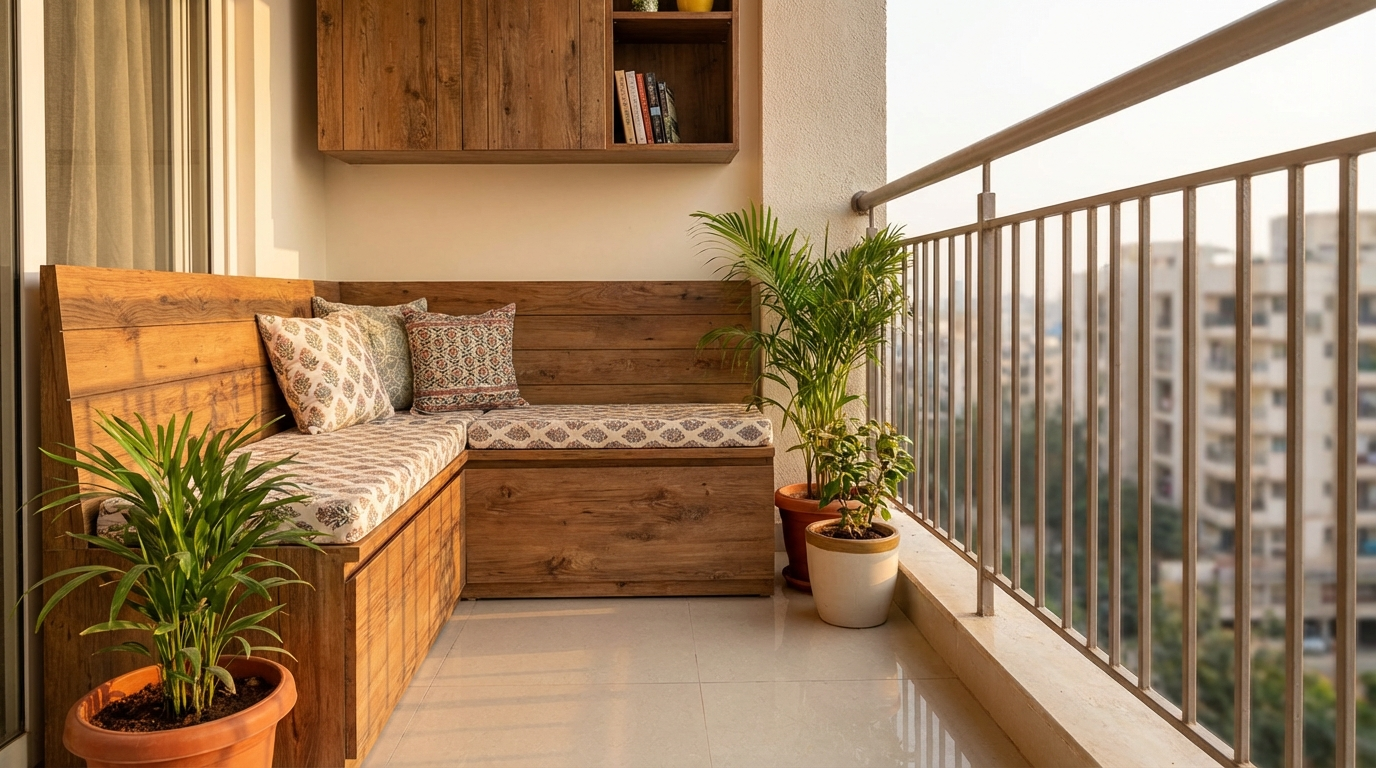
- Storage bench: Seating that doubles as waterproof storage for cushions
Large Balconies (100+ sq ft): Multi-Functional Outdoor Rooms
Spacious balconies in premium apartments can function as genuine outdoor living extensions:
- L-shaped seating arrangement: Built-in or modular outdoor sofa configurations
- Dining setup: 4-seater table for outdoor meals
- Separate garden zone: Raised planters, small trees, or herb garden sections
- Full pergola or retractable awning: Complete overhead coverage for weather protection
- Water feature: Small fountain or wall-mounted water element (requires drainage planning)
- Swing or jhula: Statement piece for larger spaces with proper ceiling support
- Outdoor kitchen corner: Small prep area or barbecue zone in covered section
Budget-Wise Balcony Design: From ₹10,000 to ₹2,00,000
Budget planning for balcony design requires understanding which elements deliver maximum impact versus which constitute expensive but unnecessary upgrades. The cost-to-impact ratio varies significantly across different interventions.
Essential Budget (₹10,000-25,000): Transformation Basics
This range covers meaningful upgrades without structural changes:
| Element | Typical Cost Range | Impact Level | Durability Notes |
|---|---|---|---|
| Interlocking deck tiles (30-50 sq ft) | ₹3,000-8,000 | High | WPC tiles last 5-8 years outdoors |
| Plastic/resin chairs (2) | ₹2,000-5,000 | Medium | UV-resistant versions essential |
| Railing planters (4-6) | ₹1,500-3,000 | High | Metal with powder coating preferred |
| String lights or solar lamps | ₹800-2,000 | Medium | IP65 rating minimum for outdoors |
| Outdoor cushions with covers | ₹1,500-4,000 | Medium | Store indoors during monsoon |
| Plants and basic pots | ₹2,000-5,000 | High | Choose hardy local varieties |
Mid-Range Budget (₹30,000-70,000): Significant Upgrades
This range enables quality furniture and custom elements:
- Quality outdoor furniture set: ₹15,000-35,000 for weather-resistant options
- Bamboo blinds or shade sails: ₹5,000-15,000 depending on size
- Vertical garden system: ₹8,000-20,000 for modular pocket planters
- Custom storage bench: ₹10,000-18,000 in BWR plywood with waterproof finish
- Professional lighting installation: ₹5,000-12,000 for weatherproof fixtures
Premium Budget (₹80,000-2,00,000): Complete Transformation
Full makeovers including structural additions:
- Pergola installation: ₹25,000-60,000 depending on material (wood vs metal vs WPC)
- Glass enclosure panels: ₹40,000-80,000 for partial glass balcony conversion
- Built-in seating with storage: ₹20,000-40,000 in marine ply with upholstery
- Artificial grass with drainage layer: ₹8,000-15,000 for quality installation
- Retractable awning: ₹35,000-70,000 for motorized options
- Custom tile flooring: ₹15,000-35,000 including labor
Is a pergola worth the cost for Indian balconies?
Pergolas provide shade and define space effectively but require careful cost-benefit analysis for Indian conditions. A basic metal pergola costs ₹25,000-40,000 and lasts 8-12 years with proper maintenance. However, open-slatted pergolas offer limited rain protection—you'll still need additional covering during monsoon. For balconies under 60 sq ft, a pergola often overwhelms the space visually and reduces usable area. Consider retractable awnings (₹35,000-70,000) as alternatives that provide both sun and rain protection while folding away when not needed. Pergolas work best for ground-floor patios or very large balconies where the overhead structure doesn't create a boxed-in feeling.
Modern Balcony Design Trends That Work in Indian Conditions
Modern balcony aesthetics favor clean lines, natural materials, and seamless indoor-outdoor transitions. However, adapting these trends for Indian apartments requires material substitutions and practical modifications.
Japandi and Minimalist Styles
The Japanese-Scandinavian fusion emphasizes simplicity, natural wood tones, and functional design. For Indian balconies:
- Use treated teak or WPC (wood-plastic composite) instead of raw wood
- Neutral color palette in greys, whites, and natural browns
- Single statement plant (like a well-maintained bonsai or fiddle leaf) rather than crowded arrangements
- Low-profile furniture with clean geometric lines
- Minimalist planters in concrete, terracotta, or matte ceramic finishes
Tropical Resort Style
Bringing resort vibes to apartment balconies works well in humid coastal cities:
- Bamboo or rattan furniture (ensure weatherproof synthetic rattan for outdoors)
- Abundant trailing plants—money plants, pothos, philodendrons in hanging arrangements
- Textured cushions in tropical prints (store indoors during rains)
- Small water feature for ambient sound
- Pebble or stone accents around plant bases
Industrial-Modern Fusion
Metal and concrete aesthetics suit urban high-rises:
- Powder-coated black metal furniture frames
- Concrete planters and accessories
- Edison-style outdoor bulb strings
- Exposed brick or brick-look tiles on accent wall
- Metal mesh plant dividers or privacy screens
Bohemian and Eclectic
Colorful, layered aesthetics with practical adaptations:
- Mix of textiles—outdoor rugs (polypropylene), cushions, throws (bring inside when not in use)
- Collected planters in various sizes, colors, and materials
- Macrame and woven hanging elements
- Floor seating options—outdoor poufs or low stools
- Fairy lights and lanterns for ambient evening lighting
Seating and Furniture Selection for Outdoor Durability
Outdoor furniture for Indian balconies must survive UV exposure, humidity fluctuations, occasional rain contact, and dust accumulation while remaining comfortable and aesthetically pleasing. Material choice determines longevity more than initial price.
Material Comparison for Balcony Furniture
| Material | Weather Resistance | Maintenance | Comfort | Price Range | Best For |
|---|---|---|---|---|---|
| Synthetic Rattan/Wicker | Excellent | Low—wipe clean | Good with cushions | ₹8,000-35,000 | Covered balconies, tropical style |
| Powder-Coated Aluminum | Excellent | Very low | Needs cushions | ₹10,000-45,000 | Any exposure level, modern style |
| Treated Teak | Very Good | Annual oiling | Good natural | ₹25,000-80,000 | Premium balconies, classic style |
| WPC (Wood-Plastic Composite) | Very Good | Low | Moderate | ₹12,000-40,000 | Humid climates, built-in options |
| Plastic/Resin | Good | Very low | Basic | ₹2,000-12,000 | Budget setups, rental apartments |
| Iron/Steel (painted) | Poor-Moderate | High—rust prone | Needs cushions | ₹6,000-25,000 | Covered balconies only, avoid coastal |
What type of furniture lasts longest on Indian balconies?
Powder-coated aluminum frames with synthetic rattan or outdoor fabric seating deliver the best longevity for Indian balcony conditions, typically lasting 8-12 years with minimal maintenance. Unlike iron which rusts even with painting (especially in coastal cities), aluminum resists corrosion completely. Unlike natural wicker which absorbs moisture and degrades, synthetic PE rattan handles rain exposure without damage. The key is ensuring the powder coating quality—cheaper furniture uses thin coatings that chip within 2-3 years. Look for furniture rated for outdoor use specifically, not indoor pieces marketed as "balcony-suitable." Brands offering 3-5 year warranties on frames generally use better coating processes. For built-in seating, marine-grade plywood (BWP grade meeting IS 710 standards) with proper edge sealing and exterior-grade finish provides 10+ years of service in covered balcony sections.
Plant Selection and Garden Ideas for Different Balcony Conditions
Successful balcony gardens in Indian apartments depend on matching plant selection to your specific conditions—primarily sun exposure, wind level, and the time you can dedicate to maintenance. The wrong plants in the wrong conditions lead to repeated plant deaths and wasted investment.
Full Sun Balconies (6+ Hours Direct Light)
South and west-facing balconies receiving intense afternoon sun need heat-tolerant varieties:
- Flowering: Bougainvillea, hibiscus, portulaca, adenium (desert rose), lantana
- Foliage: Crotons, rubber plants, snake plants, ZZ plants
- Edibles: Tomatoes, chilies, curry leaves, tulsi, most herbs
- Succulents: Excellent choice—jade, echeveria, aloe vera varieties
Partial Shade Balconies (3-5 Hours Light)
East-facing or partially covered balconies offer versatile growing conditions:
- Flowering: Peace lily, anthurium, begonias, impatiens
- Foliage: Money plant, philodendrons, pothos varieties, ferns
- Edibles: Lettuce, mint, coriander, spinach, microgreens
Low Light Balconies (Under 3 Hours)
North-facing or heavily obstructed balconies require shade-loving plants:
- Foliage only realistic: Snake plant, ZZ plant, pothos, cast iron plant, peace lily
- Most flowering and edible plants will struggle
- Consider high-quality artificial plants mixed with low-light tolerant varieties
Vertical Garden Implementation
Vertical gardens maximize growing space but require infrastructure investment:
- Pocket planter systems: ₹5,000-15,000 for 3x4 foot coverage
- Modular grid systems: ₹8,000-25,000 with self-watering features
- DIY pallet gardens: ₹2,000-5,000 with proper waterproofing
- Important: Ensure wall waterproofing before installation—water damage to building walls creates society conflicts
How often do balcony plants need watering in Indian summers?
During peak Indian summers (April-June), most balcony plants in sunny exposures require daily watering—sometimes twice daily for small pots under 8 inches diameter. The combination of intense heat, low humidity (except coastal areas), and hot dry winds desiccates soil rapidly. Signs of underwatering include wilting despite moist-looking soil surface (check 2 inches deep), crispy leaf edges, and flower/bud drop. Self-watering planters with reservoirs reduce watering frequency to every 2-3 days and prevent the root damage caused by inconsistent watering. Mulching pot surfaces with pebbles or coco chips reduces evaporation by 30-40%. During monsoon, reduce watering significantly and ensure excellent drainage—more balcony plants die from root rot in waterlogged monsoon soil than from summer heat stress.
Flooring Options: From Budget Tiles to Premium Decking
Balcony flooring impacts both aesthetics and functionality dramatically. The existing builder-provided ceramic tiles in most apartments are functional but uninspiring. Upgrading options range from simple overlays to complete replacement.
Overlay Solutions (No Removal Required)
These install directly over existing flooring:
- Interlocking WPC deck tiles: ₹150-350 per sq ft, excellent durability, easy DIY installation, 5-8 year lifespan
- Artificial grass with drainage backing: ₹80-200 per sq ft, soft underfoot, requires cleaning, 4-6 year lifespan
- Outdoor polypropylene rugs: ₹3,000-12,000 depending on size, easy to change, bring inside during heavy rains
- Stone/pebble mats: ₹100-250 per sq ft, natural look, heavy, permanent-feeling
Replacement Options (Requires Professional Work)
These require removing existing tiles and proper installation:
- Anti-skid ceramic/vitrified tiles: ₹50-150 per sq ft plus installation, most practical long-term option
- Natural stone (granite, sandstone): ₹150-400 per sq ft plus installation, premium look, heavy
- Wooden decking (treated): ₹400-800 per sq ft installed, beautiful but high maintenance in Indian conditions
Drainage Considerations
Critical for any balcony flooring upgrade:
- Maintain or create slight slope (1-2%) toward drain outlet
- Never block existing drainage points
- Raised deck systems should allow water flow underneath
- Artificial grass needs drainage layer below—avoid direct adhesion to floor
Common Balcony Design Mistakes That Waste Money and Effort
Learning from others' expensive mistakes saves significant time, money, and frustration. These errors appear consistently across Indian apartment balcony makeovers:
Mistake 1: Using Indoor Furniture Outdoors
What goes wrong: Fabric fades and rots, wood warps and cracks, cushions develop mold, metal rusts
Why it happens: Indoor furniture appears cheaper and is readily available; outdoor furniture seems expensive
How to avoid: Budget specifically for outdoor-rated furniture. A ₹15,000 outdoor chair lasting 8 years costs less than ₹5,000 indoor chairs replaced 4 times
Mistake 2: Ignoring Waterproofing Before Decorating
What goes wrong: Water seepage damages interior walls, creates damp patches, ruins expensive finishes
Why it happens: Waterproofing is invisible and unglamorous; homeowners prioritize visible upgrades
How to avoid: Check for existing seepage during monsoon before any renovation. Address waterproofing issues first (₹5,000-15,000) before aesthetic investments
Mistake 3: Overcrowding Small Spaces
What goes wrong: Balcony becomes storage area rather than usable space, plants don't get light, furniture scratches when moved
Why it happens: Enthusiasm leads to buying "just one more" planter or furniture piece
How to avoid: Plan layout on paper first. Leave minimum 2 feet clear pathway. Less is more for spaces under 50 sq ft
Mistake 4: Installing Permanent Structures Without Society Approval
What goes wrong: Demolition notices, fines, neighbor conflicts, property resale complications
Why it happens: Assuming "minor" changes don't need approval, or believing others' modifications set precedent
How to avoid: Get written approval before any glass enclosure, pergola, or railing modification. Some societies have blanket bans
Mistake 5: Choosing Plants Based on Looks Rather Than Conditions
What goes wrong: Repeated plant deaths, wasted money, discouragement from gardening
Why it happens: Nurseries sell anything; Instagram shows plants in ideal conditions
How to avoid: Honestly assess your light, time, and conditions. Start with 3-4 hardy plants suited to your specific exposure before expanding
Mistake 6: Skipping Drainage Planning
What goes wrong: Standing water, mosquito breeding, waterlogged plants, floor damage
Why it happens: Drainage is assumed to "just work" after adding deck tiles or artificial grass
How to avoid: Test existing drainage with water before any installation. Maintain clear paths to drain outlets in any overlay system
Mistake 7: Installing Heavy Elements on High Floors
What goes wrong: Wind dislodges planters, structural concerns about weight, safety hazards
Why it happens: Ground-floor designs copied to 20th floor without considering wind exposure
How to avoid: Secure all elements that could become projectiles. Consult society structural guidelines for weight limits. Avoid hanging external planters above 15th floor
Decision Framework: Matching Design Choices to Your Situation
Use this framework to make balcony design decisions suited to your specific circumstances:
| Your Situation | Recommended Approach | Reasoning |
|---|---|---|
| Rental apartment, 1-2 year stay | Portable items only: folding furniture, moveable planters, rugs | Easy relocation, no approval needed, no loss on moving |
| Owned property, tight budget | Focus on flooring overlay + 2-3 quality pieces + plants | Maximum visual impact per rupee, easy future upgrades |
| Owned property, premium budget | Complete makeover with pergola, built-in seating, lighting | Creates genuine outdoor room, adds property value |
| High floor (15+) with wind exposure | Heavy anchored furniture, no hanging externals, wind-resistant plants | Safety priority, wind damage prevention |
| Ground/low floor with privacy concern | Trellis with climbers, privacy screens, dense plant borders | Creates secluded feel without permanent construction |
| West-facing with extreme heat | Shade structure essential before any other investment | Space unusable 8 months/year without shade solution |
| North-facing with low light | Focus on seating comfort, minimal plants, good lighting | Accept limitations rather than fighting failed gardens |
| Coastal city with salt air | Marine-grade materials only, aluminum over iron, frequent cleaning | Standard materials corrode within 2-3 years |
| Busy lifestyle, minimal maintenance time | Self-watering planters, synthetic materials, hardy plants only | Design that survives neglect during busy periods |
Quality Checks and Practical Implementation Tips
Ensuring your balcony design implementation goes smoothly requires attention during both purchasing and installation phases.
Before Purchasing Furniture
- Check material specifications: Ask specifically about outdoor rating, UV resistance, warranty coverage
- Measure twice: Account for door clearance, railing depths, and movement space
- Test weight: Ensure you can move pieces yourself for cleaning or rearrangement
- Verify cushion storage: Do you have indoor space to store cushions during extended monsoon?
During Installation
- Protect existing surfaces: Use furniture pads to prevent scratch marks on tiles
- Ensure drainage clearance: Test water flow after any floor covering installation
- Secure loose elements: Lightweight items need anchoring or weighting
- Check electrical safety: Any outdoor lighting must be IP65 rated minimum, properly earthed
Ongoing Maintenance Requirements
- Weekly: Basic cleaning, plant watering, cushion rotation
- Monthly: Deep clean furniture, check for rust spots, trim plants
- Seasonally: Pre-monsoon waterproofing check, post-monsoon thorough cleaning, annual wood treatment if applicable
Can balcony design add value to apartment resale?
Well-executed balcony design can positively influence apartment resale and rental values, though the return varies based on execution quality and buyer demographics. Professional-looking balcony makeovers create strong first impressions during property viewings—agents report that well-designed balconies generate more buyer interest than equivalent investment in other areas. However, the value addition comes primarily from quality execution rather than quantity of elements. A thoughtfully designed balcony with good furniture and maintained plants adds perceived value, while cluttered or poorly maintained balconies can actually detract from property appeal. For rental properties, a ready-to-enjoy balcony justifies ₹1,000-3,000 higher monthly rent in metro cities. For resale, consider removable upgrades that don't require buyer taste alignment—permanent modifications may not suit every buyer's aesthetic preferences.
Frequently Asked Questions
What is the best flooring option for open balconies in India?
Anti-skid vitrified tiles or WPC (wood-plastic composite) deck tiles offer the best combination of durability, aesthetics, and maintenance for open Indian balconies. Anti-skid vitrified tiles (₹50-120 per sq ft installed) provide permanent, virtually maintenance-free flooring that handles monsoon rain, intense sun, and heavy foot traffic without damage. WPC deck tiles (₹150-350 per sq ft) install over existing tiles without professional help, offer a warmer wooden appearance, and can be removed if you relocate. Natural wood decking, while beautiful, requires quarterly maintenance in Indian conditions and warps without diligent care. Artificial grass works well in covered sections but develops drainage issues and algae in exposed areas during monsoon. For most Indian balconies, the practical choice between vitrified tiles (for permanent solution) and WPC overlay (for rental or reversible upgrade) depends on your ownership situation and budget.
How much does a complete balcony makeover cost in India?
Complete balcony makeovers in Indian metros typically range from ₹25,000 for basic transformations to ₹1,50,000+ for premium outdoor room conversions, with costs scaling primarily by furniture quality, structural additions, and floor covering choices. A 50 sq ft balcony with quality WPC flooring (₹10,000-15,000), weatherproof furniture set (₹15,000-25,000), plants and planters (₹5,000-10,000), and lighting (₹3,000-5,000) reaches ₹35,000-55,000. Adding a pergola structure (₹25,000-50,000), built-in seating (₹20,000-35,000), or glass enclosure (₹40,000-70,000) escalates costs into the premium range. Labor costs in metros run higher than tier-2 cities by 30-50%. Budget approximately ₹500-1,000 per sq ft for modest makeovers and ₹1,500-3,000 per sq ft for comprehensive transformations. Always add 15-20% contingency for unexpected requirements discovered during implementation.
Is it necessary to get society approval for balcony modifications?
Society approval is legally and practically necessary for any modification that changes external appearance, involves structural elements, or affects shared building components in Indian apartment complexes. Most societies require formal written approval for glass enclosures, pergola installations, railing modifications, external shade structures, or air conditioner bracket installations. Furniture, planters, and removable elements typically don't require approval unless they're visible from outside and affect building aesthetics. Violations can result in fines, forced removal at owner's expense, and complications during resale (buyers' lawyers check for unauthorized modifications). Even if neighbors have made similar modifications, their approval (or society's non-enforcement) doesn't guarantee your approval. The safest approach involves submitting a formal request with design drawings for any permanent addition before work begins. Many societies have designated balcony modification guidelines—request a copy before planning.
Which plants survive best on Indian balconies without daily attention?
Snake plants (sansevieria), ZZ plants, pothos varieties, and succulents like jade plants survive Indian balcony conditions with weekly attention rather than daily care, making them ideal for busy professionals or frequent travelers. These plants tolerate irregular watering, handle temperature fluctuations, and don't immediately die from neglect during business trips or hectic periods. For sunny balconies, add bougainvillea (once established), adenium, and crotons—these handle heat without wilting between waterings. Self-watering planters extend survival periods significantly, allowing 7-14 days between watering sessions depending on pot size and conditions. Avoid ferns, calatheas, and most flowering annuals if you can't commit to consistent moisture—these react poorly to drying out even briefly. A reliable approach involves starting with 5-6 proven hardy plants, learning their rhythms over a season, then gradually adding more demanding varieties as your routine establishes.
Can I install a swing or jhula on my apartment balcony?
Installing a swing on an apartment balcony is possible but requires careful structural assessment, society approval, and professional installation—never assume ceiling capacity based on visual inspection alone. Standard RCC balcony ceilings can typically support 150-250 kg distributed load, but concentrated swing loads require different analysis. Ceiling-mounted swings need professional-grade anchoring into concrete (not plaster), typically using expansion bolts rated for the combined weight of swing plus maximum occupants plus dynamic load from swinging motion. Floor-mounted swing stands avoid ceiling concerns but consume significant floor space (typically 6x4 feet minimum). Many societies prohibit ceiling-mounted swings due to liability concerns and noise complaints from neighbors below. Before purchasing, get structural confirmation from a qualified engineer and written society approval. Budget ₹15,000-40,000 for quality swings plus ₹3,000-8,000 for professional installation with proper hardware.
How do I protect balcony furniture during monsoon season?
Protecting balcony furniture during Indian monsoons requires a combination of waterproof covers, strategic positioning, and moisture management rather than relying solely on "outdoor rated" claims. Even weather-resistant furniture degrades faster under prolonged monsoon exposure. Use fitted waterproof covers for furniture remaining outside—generic plastic sheets trap moisture underneath and cause more damage than protection. Position furniture under covered sections if available, or pushed against walls away from rain splash zones. Bring cushions and fabric elements indoors during monsoon—no outdoor fabric truly survives 4 months of humidity without mold issues. Elevate furniture legs using rubber or plastic caps to prevent standing water contact. Apply fresh rust-proofing spray to any metal components before monsoon starts. For wooden furniture, ensure water beads on surfaces rather than absorbing—reapply sealant if absorption occurs. Weekly wipe-downs during monsoon prevent dirt accumulation that holds moisture against surfaces.
What lighting works best for balcony spaces?
Weatherproof LED fixtures with IP65 or higher rating provide reliable, energy-efficient balcony lighting suitable for Indian conditions including monsoon humidity and dust exposure. String lights (₹500-2,000) create ambient atmospheres and work well under covered sections—ensure outdoor-rated versions with sealed connections. Wall-mounted fixtures (₹1,500-5,000) provide functional lighting for seating areas and require proper electrical installation by qualified electricians. Solar-powered options (₹800-3,000) eliminate wiring concerns but perform inconsistently in covered balconies or during monsoon when charging is limited. For plant display, use uplighting with small spotlights to create dramatic evening effects. Avoid exposed bulbs that attract insects—enclosed fixtures reduce bug congregation around light sources. Smart-controlled lighting (₹2,000-8,000) allows phone or voice control for convenience. Layer lighting types: overhead for general illumination, accent lighting for plants or features, and soft ambient lighting for relaxed evening use.
Is artificial grass a good choice for Indian balcony flooring?
Artificial grass works excellently for covered or semi-covered Indian balconies but presents maintenance challenges in fully exposed spaces receiving direct rain and intense sun. Quality artificial grass with proper drainage backing (₹100-200 per sq ft) provides soft, green flooring that transforms concrete balconies into garden-like spaces. However, in fully exposed positions, artificial grass traps heat uncomfortably during Indian summers (surface temperatures can exceed 50°C in afternoon sun), develops algae or moss underneath during extended monsoon wetness, and requires more cleaning than hard flooring options. The ideal application is covered balcony sections or as partial ground cover in plant areas rather than entire floor coverage. Ensure drainage layer installation below grass—never directly adhere to balcony floor, as water trapping causes odor and deterioration. Budget ₹150-300 per sq ft for quality installation with proper substrate. Expect 4-6 year lifespan with proper care; cheaper variants may fade or flatten within 2 years.
How do I create privacy on an overlooked balcony?
Creating balcony privacy in Indian apartments typically combines permanent screening solutions with strategic plant placement while respecting society regulations about external appearance. Bamboo blinds (₹2,000-8,000 depending on size) provide adjustable privacy that rolls away when not needed—these work within most society guidelines as they're temporary. Tall planters with dense plants like bamboo palm, areca palm, or dracaena create living screens (allow 2-3 years for full effect with starter plants). Lattice panels with climbing plants (money plant, star jasmine, bougainvillea) offer permanent green screening after establishment. Outdoor curtains on tension rods provide fabric screening for evening use. Frosted film on glass railings increases privacy without blocking light—check with society before application. Avoid solid panels that block air circulation or violate building facade uniformity requirements. Layer multiple solutions: permanent plants for baseline privacy, adjustable blinds for enhanced screening when needed.
What should I consider before enclosing my balcony with glass?
Glass balcony enclosures require society approval, structural verification, ventilation planning, and substantial budget allocation—but when properly executed, they create usable all-weather spaces that function as room extensions. Structural considerations include weight of glass panels and frames, wind load calculations for your floor level, and anchor point adequacy in existing railings or walls. Ventilation planning is critical—fully sealed enclosures become unbearably hot in Indian summers and develop condensation issues in humid climates. Include operable windows or ventilation gaps in any enclosure design. Budget ₹40,000-80,000 for basic sliding glass systems for 50-80 sq ft balconies, ₹80,000-1,50,000 for premium framing and glass options. Maintenance includes regular cleaning (exterior access can be challenging on high floors) and hardware lubrication. Society approval processes can take 1-3 months and may be denied if building facade uniformity is prioritized. Consider the trade-off: enclosed balconies offer weather protection but lose the open-air outdoor experience that makes balconies valuable.
How do I maintain a balcony garden during summer vacations?
Maintaining balcony plants during extended absences requires preparation strategies including self-watering systems, neighbor assistance, and plant conditioning before departure. Self-watering planters with reservoirs sustain plants for 1-3 weeks depending on pot size and conditions—invest in these for valuable or established plants. DIY solutions include bottle drip systems (inverted water bottles with slow-release caps) and capillary mat setups that wick water to multiple pots. Grouping plants together reduces individual water loss through shared humidity. Move sun-sensitive plants to shadier positions before leaving to reduce water consumption. Prune plants and remove flowers before departure—blooming plants need more water. Ask trusted neighbors for weekly watering during absences longer than 10 days; provide clear instructions and necessary supplies. Consider hardy plant selection if frequent travel is your lifestyle—succulents, snake plants, and ZZ plants handle 2-3 week neglect that would kill moisture-dependent varieties. Avoid starting new plants right before known absences; establish watering routines first.
What are the best small balcony design ideas for 1BHK apartments?
Small 1BHK balconies (typically 25-40 sq ft) transform effectively through vertical space utilization, multi-functional furniture, and disciplined restraint against overcrowding. Wall-mounted folding tables (₹2,000-5,000) provide surface area when needed without permanent floor space consumption. Single quality chairs (₹3,000-8,000) serve better than two cramped options—choose wisely for both comfort and aesthetics. Vertical garden panels or hanging planters on back walls add greenery without floor space sacrifice. Railing planters utilize otherwise wasted perimeter space for herbs or trailing plants. Corner shelf units provide storage and display without blocking movement paths. Mirror installations on solid walls create visual depth perception. Light color choices for any permanent elements enhance spaciousness. Avoid: floor-standing planters exceeding 8-inch diameter, full furniture sets designed for larger spaces, multiple decorative items competing for attention. The goal is creating one comfortable seat with coffee surface, surrounded by carefully curated greenery—not miniaturizing a large balcony design into cramped chaos.
Disclaimer: This content is provided for general informational purposes based on industry practices and publicly available information. Product specifications, standards, prices, and availability may vary by manufacturer, region, and time. Readers should independently verify details with manufacturers, dealers, or qualified professionals before making purchase or construction decisions.
Want Plywood Suggestions?
Share a few details and a Sainik 710 specialist will suggest suitable brands and connect you to responsive dealers.