Almirah Design Ideas: 25+ Wooden, Steel & Modern Almirah for Bedroom with Price Guide
Discover 25+ almirah designs—wooden, steel & modern styles. Compare materials, get size guide & price range for bedroom almirah in Indian homes.
The Quick Answer on Almirah Design for Bedrooms
An almirah is essentially a freestanding storage cabinet—could be wooden, steel, or a mix—designed for clothing, accessories, and household items in Indian homes. Short version: In 2025 and 2026, almirahs are getting smarter, sleeker, and more stylish—from space-saving sliding doors to elegant glass finishes, there's something for every type of home and budget. Whether you want the warmth of wood or the durability of steel, your choice depends on room size, humidity exposure, and honestly—how much hassle you're willing to deal with later.
This is right for you if:
- You need dedicated storage that's not built into the wall (maybe you're in a rented flat)
- Your bedroom needs the ideal blend of space and simplicity—most double-door almirahs come with hanging rods, shelves, and occasionally even a tiny locker unit
- You want flexibility to move it when you shift houses—something built-in furniture can't offer
- Budget matters and you're not ready to commit ₹2-3 lakh to a full modular wardrobe setup just yet
Skip this if:
- You have an irregularly shaped room where custom-built wardrobes make more sense
- You're building a new house anyway and can integrate storage into the design
Bottom line: For 7 out of 10 Indian bedrooms, a well-chosen 2 or 3-door almirah in plywood, MDF, or steel will serve you better than an overpriced modular setup—especially if you're practical about maintenance.
What "Almirah Design" Actually Means in Indian Homes
An almirah is a standalone wardrobe or cupboard primarily used for storing clothes, bedding, and valuables in Indian households. In the Indian home, the almirah has long been the silent guardian of our possessions and our stories. Unlike built-in wardrobes that are fixed to walls, almirahs can be moved, sold, or taken along when you shift—a big deal if you're renting.
Most people think almirah and wardrobe are the same thing. Actually, there's a subtle difference. Wardrobes are typically wall-mounted or built-in units designed specifically for clothing. Almirahs are freestanding furniture pieces that can store anything from sarees to important documents to that collection of old photo albums your mother refuses to throw away.
Gone are the days of bulky, monolithic cabinets that dominate a room. The modern almirah design is a sophisticated blend of intelligent functionality, aesthetic appeal, and personalised style—a testament to how Indian interiors have evolved, marrying global trends with local sensibilities.
Now here's where it gets interesting. The technical side: almirahs typically come in single-door (for compact spaces), double-door (the most common), triple-door, and four-door variants. The carcass—that's the body of the almirah—is usually 18mm thick for plywood versions, while shutters can be anywhere from 12mm to 18mm depending on what finish you're putting on top.
Why Almirah Choice Matters So Much in Indian Conditions
This drives me crazy—people spend weeks choosing the almirah colour and two minutes thinking about whether it'll survive their first monsoon. High-quality plywood resists warping and damage due to humidity which means it is appropriate for Indian climate conditions.
In places like Mumbai and Chennai, humidity routinely hits 80-90% during July-August. I've seen brand new MDF almirahs swell up within six months in a Borivali flat because nobody told the owner that MDF and coastal humidity don't mix well. August 2025 saw a resurgence in "almirah wooden design" searches, coinciding with monsoon season demand for durable, moisture-resistant wooden storage solutions. There's a reason for that pattern—people learn the hard way.
Unlike their wooden counterparts, steel almirahs are incredibly resilient—they are termite-proof, moisture-resistant, and non-warping—a significant advantage in India's diverse and often humid climate.
Here's how different cities stack up:
- Mumbai, Chennai, Kolkata: High humidity (75-95% RH during monsoon). BWR plywood or steel almirahs are safer bets. MDF only if you're running AC 24x7.
- Bengaluru, Hyderabad, Pune: Moderate humidity (50-70% RH). MR grade plywood works fine for most applications.
- Delhi, Jaipur, Ahmedabad: Dry climate most of the year. Commercial plywood is usually adequate, though summer heat can affect adhesive quality in cheap boards.
The Ghatkopar side in Mumbai gets noticeably more humid than Borivali—I've seen identical almirahs age completely differently in flats just 15 km apart. Climate microvariation is real, and the mistri won't tell you this.
Types of Almirahs: Which One Fits Your Situation
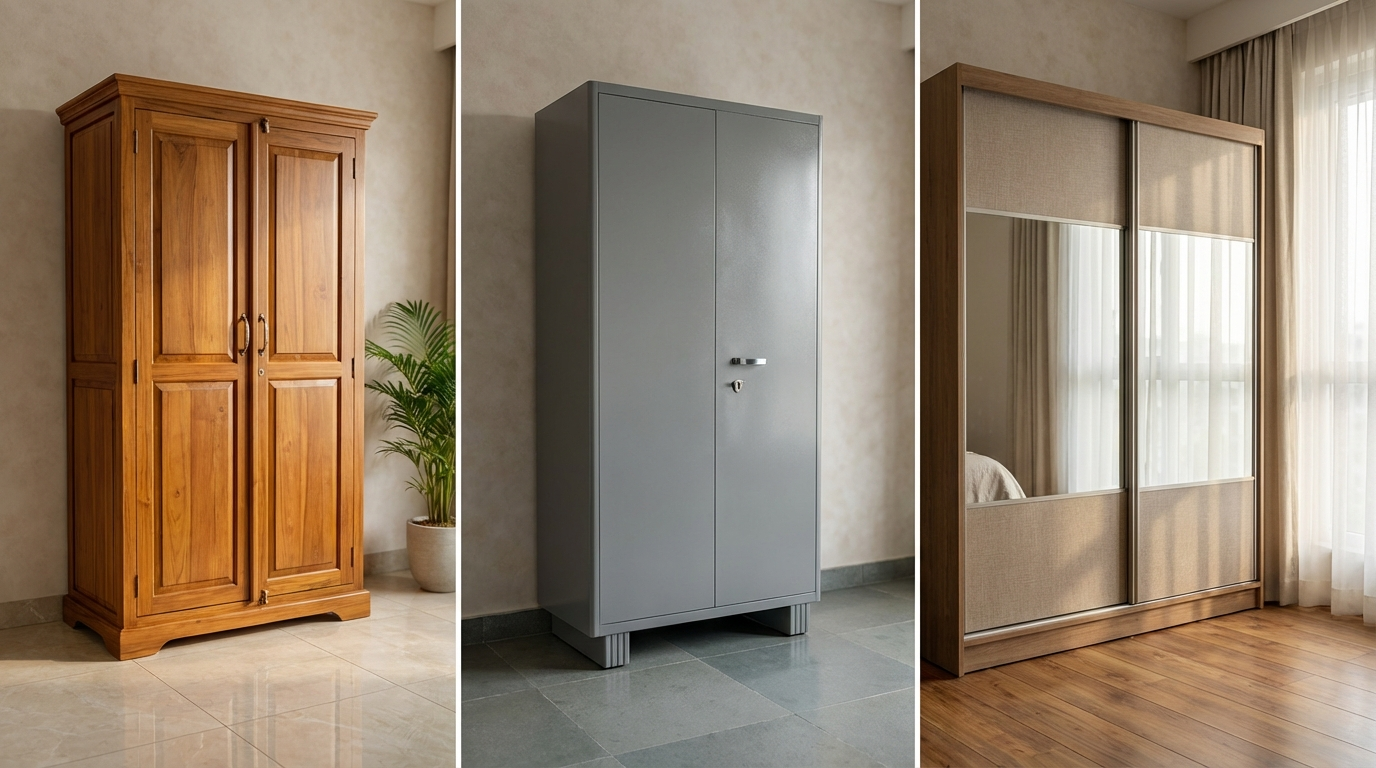
Ever the most cherished option in Indian homes, wooden almirah designs add warmth, strength, and a rich finished look. From classic teak to modern engineered wood, or even a custom modular system, they are beautiful in bedrooms and living areas. And they get better-looking with age.
Is solid wood actually worth the extra cost?
Honestly? For most budgets, no. Material selection plays a defining role in how an almirah performs over time. Engineered plywood is widely preferred over solid wood due to its consistency, strength, and adaptability to customised designs. Solid teak or sheesham almirahs look gorgeous and can last generations, but you're looking at ₹80,000-₹2,00,000 for quality pieces. Engineered wood with good laminate can achieve 80% of that look at 30% of the cost.
Low maintenance, durable, and long-lasting, steel almirah designs are ideal for areas needing hassle-free storage such as rental apartments or utility rooms. The newer varieties are in sleek profiles and powder-coated finishes that provide a less industrial appearance but more of a home-like appeal.
| Almirah Type | Best For | Humidity Tolerance | Lifespan | Price Range (2-door) | My Take |
|---|---|---|---|---|---|
| Solid Wood (Teak/Sheesham) | Permanent homes, heirloom pieces | Moderate—needs polish maintenance | 30-50+ years | ₹50,000-₹2,00,000 | Beautiful but overkill for most |
| BWR Plywood + Laminate | Coastal cities, humid zones, kitchens nearby | High | 15-25 years | ₹25,000-₹60,000 | My recommendation for Mumbai/Chennai |
| MR Plywood + Laminate | Dry inland areas, AC rooms | Moderate | 10-18 years | ₹18,000-₹45,000 | Good balance of cost and durability |
| MDF/HDHMR | Climate-controlled spaces, smooth finish lovers | Low (MDF) to Moderate (HDHMR) | 8-15 years | ₹15,000-₹40,000 | Looks premium, risky in humidity |
| Steel (Powder Coated) | Rentals, offices, kids' rooms, utility storage | Excellent | 20-30+ years | ₹7,000-₹25,000 | Underrated option—seriously consider this |
| Particle Board | Temporary solutions, very tight budgets | Very Low | 3-7 years | ₹8,000-₹20,000 | Avoid if possible |
MDF almirahs look nice and are good options for wooden almirahs since they can resist humidity and temperature fluctuations better. That said, between you and me—I've seen MDF shutters swell at the edges in plenty of non-AC Mumbai bedrooms. HDHMR is better, but still not as reliable as good plywood in my experience.
Price Reality Check: What Almirahs Actually Cost in 2026
The price range of a wooden almirah starts from Rs 5000 per piece and goes up to Rs 50000 or more depending on various factors including the wood type, design, height, finish, color, lock system, door type, etc.
Here's what actually affects your final bill—
For Wooden/Plywood Almirahs:
- Material grade: BWR plywood costs 20-30% more than MR grade. Worth it in humid cities.
- Thickness: 18mm carcass vs 12mm makes a ₹3,000-5,000 difference in a 2-door unit
- Finish type: Laminate (₹800-1,500/sheet) vs Veneer (₹2,000-4,000/sheet) vs Paint/Polish
- Hardware: Soft-close hinges add ₹200-400 per shutter. Telescopic channels for drawers: ₹300-800 per pair
- Labour: ₹400-700 per sq ft for carpentry in metros; less in tier-2 cities
For Steel Almirahs:
Steel Almirah prices vary significantly based on specifications. A basic 2-door steel almirah (6.5 feet height, 20 gauge door) ranges from ₹7,335-₹8,965 per piece. Steel almirahs with heavy powder-coated finish in 20/22 gauge steel run ₹9,450-₹11,550 per piece.
Rough budget estimation for a decent 6x3 feet (height x width) almirah:
- Steel (basic): ₹7,000-12,000
- Steel (premium with mirror): ₹12,000-20,000
- Plywood custom-made (MR grade): ₹20,000-35,000
- Plywood custom-made (BWR grade): ₹30,000-50,000
- Ready-made engineered wood: ₹15,000-45,000
- Solid wood: ₹50,000 and above
Wooden vs Steel vs Modern Modular: Direct Comparison
Steel Almirah provides superior durability to wooden almirah. Water and weather can quickly destroy a wooden almirah. Steel is much more resistant to such issues, so your clothing will last longer and look better.
But that's not the complete picture. When choosing between a wooden almirah and a steel almirah, there are several benefits to investing in wood: Aesthetics—wood adds a natural, warm, and elegant touch to any room because of the texture and the finishes. It can enhance the overall décor and create a more inviting atmosphere. Low Maintenance—wooden almirahs can be easily cleaned with a dry piece of cloth. Durability—high-quality wooden almirahs, especially those made from solid hardwood, are highly durable and can last for decades if well-maintained.
| Parameter | Wooden/Plywood | Steel | MDF/HDHMR | My Preference |
|---|---|---|---|---|
| Aesthetics | Warm, traditional, premium feel | Industrial to modern (new finishes help) | Smooth, contemporary finish | Plywood with laminate |
| Termite Risk | Moderate (treat the plywood) | Zero | Low to Zero | Steel if termite area |
| Humidity Handling | BWR good, MR moderate | Excellent | Poor to Moderate | Steel or BWR plywood |
| Customization | Unlimited | Limited to available sizes | Good | Plywood wins here |
| Weight | Heavy | Very heavy | Lighter | Depends on floor type |
| Repair ease | Carpenter can fix most issues | Dents permanent, rust needs attention | Damaged edges hard to repair | Plywood |
| Resale value | Moderate | Good (steel holds value) | Low | Steel surprisingly |
| Eco-friendliness | Moderate (depends on source) | Recyclable | Lower (formaldehyde concerns) | Steel or certified plywood |
Choose wooden/plywood when: You want custom dimensions, prefer a warmer aesthetic, or plan to integrate the almirah into your interior theme. Also if your carpenter is reliable.
Choose steel when: Steel made almirahs are maintenance free—wooden almirahs after some time of use can give you complaints like termites, losing shine and dulling polish but steel almirahs generally do not bring such complaints. Also perfect for rental situations where you'll move in 2-3 years.
Trade-off summary: You gain durability and zero-maintenance with steel but lose customization and warmth. You gain aesthetics and flexibility with plywood but need to invest in proper material grades and maintenance.
How to Choose the Right Almirah: Decision Framework
Step 1: Measure your space precisely. Height, width, depth—and don't forget to account for door swing radius if you're going with hinged doors instead of sliding. Measure the space where you plan to place the almirah. Include height, width, and depth to ensure it fits. Also, do consider space for opening doors or drawers and any obstacles around the area.
Step 2: Assess your city's humidity. This sounds boring but it's the decision that'll save you ₹20,000 in repairs later. Mumbai, Chennai, Kolkata, coastal Karnataka—go BWR or steel. Bengaluru, Hyderabad, Pune interior—MR grade is usually fine. Delhi, Rajasthan—almost anything works, worry more about termites.
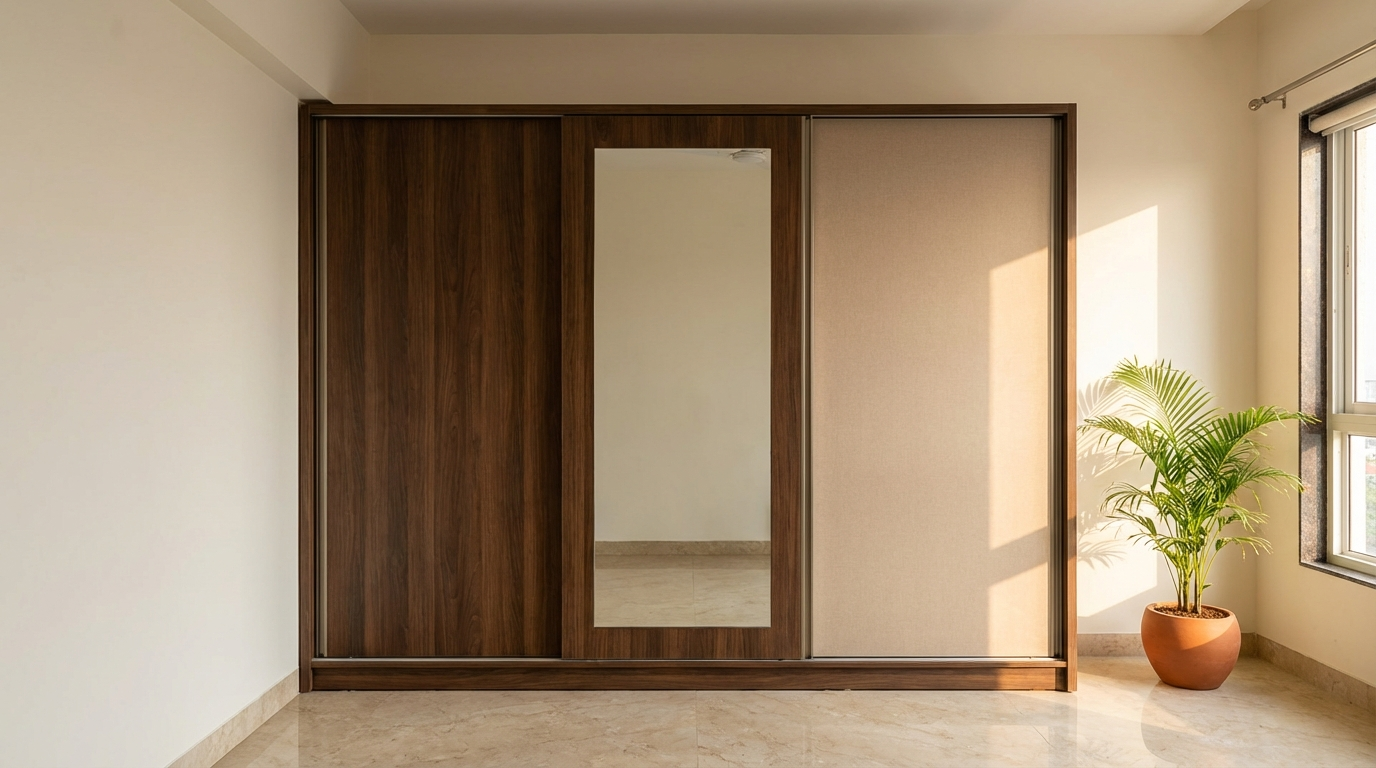
Step 3: Calculate storage needs realistically. A 6-foot x 3-foot almirah holds roughly 80-100 pieces of folded clothing plus some hanging space. Three-door almirah designs provide additional inner flexibility and are perfect for couples or families who need separated areas for clothing, accessories, and other items. Some even come with a mid-mirror door or built-in dressing section.
Step 4: Set a realistic budget including finishing costs. Material cost is usually 40-50% of total. Labour, hardware, and finishing eat the rest.
Step 5: Decide: custom-made or ready-made? Custom gives you exact fit but takes 3-4 weeks minimum and depends heavily on carpenter skill. Ready-made is faster but limited sizes.
| Your Situation | Recommendation | Why |
|---|---|---|
| Rented flat, might move in 2-3 years | Steel or ready-made modular | Easy to move, retains resale value |
| Own home in coastal city | BWR plywood with marine-grade laminate | Moisture resistance critical |
| Budget under ₹15,000 | Steel 2-door or basic particle board | Steel will last; particle board won't—choose wisely |
| Interior designer handling everything | Custom plywood with veneer or premium laminate | They should know material grades—verify anyway |
| Kids' room | Steel with rounded edges or HDHMR | Damage-resistant, easy to clean crayon marks |
| Master bedroom statement piece | Solid wood or high-grade plywood with glass/mirror panels | Aesthetics matter here |
Red flags to walk away from:
- Carpenter insisting on commercial-grade plywood "because it's all the same"—it's not
- Ready-made almirah with no brand name or material specification on the label
- Unusually low quotes (30%+ below market)—they're cutting corners somewhere
- Edges that feel rough or show visible core material
- Steel almirah without ISI certification mark
What thickness works best for almirah shutters?
For plywood almirahs, use 18mm for the carcass (sides, top, bottom, shelves) and 12mm for shutters if you're applying laminate. If you want veneer or paint finish, 18mm shutters look more substantial. For very large shutters (over 24 inches wide), go 18mm to prevent warping. The best board for an almirah is typically high-quality MR Grade (Moisture Resistant) plywood—it offers superior strength, durability, and resistance to moisture compared to standard plywood. For the shutters, one can use plywood with a laminate finish, MDF for a smoother finish, or HDHMR for even greater robustness.
Common Mistakes People Make with Almirahs
1. Choosing material based on looks alone. The number of times I've seen gorgeous veneer-finished almirahs turn into swollen messes because someone used MR plywood in a Mumbai bathroom-adjacent bedroom... it's frustrating. Looks fade; structural integrity is forever.
2. Skipping the termite treatment. If I'm being honest, this one's on both homeowners and carpenters. Plywood should be treated even if the dealer claims it's "pre-treated." I've been saying this for years—spend ₹500-1,000 on proper treatment or spend ₹30,000 replacing the whole thing in five years.
3. Not accounting for ventilation. Ensure that your almirah has adequate ventilation to prevent mold and mildew, especially if it's used to store clothes or linens. Ventilated shelves or built-in vents can help maintain airflow and keep your items fresh. Closed almirahs in humid areas develop that musty smell. Simple louvered panels or back ventilation solves this.
4. Ignoring door clearance. There was this flat in Powai—must have been 2020—where the client wanted a 4-door almirah but the room was 10x10 feet. The almirah looked great until you tried to open the doors and hit the bed. Sliding doors exist for a reason.
5. Trusting "waterproof" labels blindly. This one really frustrates me. There's water-resistant, there's boiling-water-resistant, and there's marine plywood. They're NOT the same. Dealers will call anything "waterproof" if it helps the sale. Ask for the ISI grade specifically.
6. Overloading cheap shelves. MDF may be smoother but it lacks the strength and durability of plywood. It would bend over time easily, especially if heavy loads are applied. It would probably be fine for decorative panels or lightweight furniture, but is not recommended for structural components. I've seen shelves sag within months because someone stored 40 kg of blankets on a thin MDF board.
7. Skimping on hardware. The hinges and drawer channels matter more than most people think. ₹50 hinges will squeak and sag. ₹200 soft-close hinges will work smoothly for years. Same goes for drawer telescopic channels—cheap ones derail constantly.
8. Not sealing edges properly. Exposed plywood edges absorb moisture like a sponge. Edge banding or proper sealing isn't optional in Indian conditions. Your carpenter might skip this step to save time. Don't let them.
9. Ordering online without checking return policies. Ready-made almirahs sometimes arrive damaged or with dimensions that don't match listings. Always confirm return/exchange policies and inspect on delivery.
10. Forgetting about weight on floors. A fully loaded 4-door wooden almirah can weigh 150-200 kg. If you have vitrified tile flooring, ensure your floor can handle it without cracking. Steel almirahs are even heavier.
Quality Checks You Can Do Yourself
Visual Checks:
- Look at edges closely—the core should be consistent with no visible gaps or voids
- Check for warping by placing a straight edge against the surface
- Laminate should be flush with no bubbling or peeling at corners
- For steel: examine powder coating for evenness, no rough patches
- Hinges should be aligned—doors shouldn't sag when open
- Drawer slides should operate smoothly without catching
Questions to Ask Your Dealer or Carpenter:
- "What's the actual grade—MR, BWR, or BWP? Show me the stamp."
- "What thickness is the carcass vs shutters?"
- "What brand of plywood/board are you using?" (Reputed brands have consistency)
- "Is termite treatment included or extra?"
- "What's the warranty on the structure vs the finish?"
Simple Field Tests:
- Tap test: Knock on the surface. Solid sound = good density. Hollow sound = voids or thin material
- Weight check: Quality plywood and steel have heft. Suspiciously light units are usually particle board or thin gauge steel
- Edge inspection: Run your finger along cut edges. Quality plywood has tight, consistent layers; poor quality shows gaps
- Flex test: For plywood sheets, slight flex is fine; excessive bending suggests inferior core
- Smell test: Strong chemical odour indicates high formaldehyde content—bad for indoor air quality
Here's a trick most dealers don't like— ask to see the off-cut or waste piece from your board. The cross-section tells you everything about core quality that the surface hides.
Workmanship & Installation: What to Tell Your Carpenter
Plywood is much more durable and moisture-resistant, besides being versatile in design. It is stronger than MDF and provides a premium finish. But all that goes to waste if the making is shoddy.
Cutting Requirements:
- All cuts should be clean, straight, and at right angles unless specifically designed otherwise
- CNC cutting is preferred for precision; manual cutting needs skilled hands
- Leave 2-3mm tolerance for expansion, especially in humid areas
Edge Sealing (Critical):
- All exposed edges must be sealed—either with edge banding tape, PVC strips, or wood putty + primer
- Edge banding should be heat-sealed, not just glued
- Interior edges matter too, not just visible ones
Hardware Guidelines:
- Hinges: European concealed hinges (35mm cup size) for clean look; soft-close optional but worth it
- Drawer channels: Full-extension telescopic for easy access; minimum 30kg load capacity per drawer
- Locks: 3-lever or 4-lever mortise locks for security; digital locks if budget permits
- Handles: Mount at consistent heights; verify alignment before final fixing
What to Tell Your Carpenter (Briefing Checklist):
- "Use only branded plywood—I want to see the boards before cutting."
- "Seal ALL edges, including interior ones. I'll check."
- "Soft-close hinges only. No cheap alternatives."
- "Test every drawer and door movement before calling me for inspection."
- "Keep hardware packaging for warranty purposes."
- "Clean up adhesive residue before final handover."
I've seen carpenters skip edge banding on interior shelves "because nobody sees it." Six months later, those shelves have absorbed enough moisture to warp. The cost saving was maybe ₹300. The repair cost was ₹6,000. Make it clear upfront that shortcuts aren't acceptable.
How long does a wooden almirah really last?
In my experience, well-maintained plywood almirahs with quality laminate last 15-20 years in dry climates, 10-15 years in humid coastal cities—assuming proper edge sealing and termite treatment. Quality solid hardwood almirahs are highly durable and can last for decades with proper care. They are resistant to minor wear and tear, making them ideal for families looking for long-lasting furniture that retains its charm over time.
Durability Reality: How Long Different Almirahs Last
Honest Lifespan Expectations:
- Solid wood (Teak, Sheesham): 30-50+ years with periodic polishing
- BWR Plywood + Laminate: 15-25 years (less in very humid areas without AC)
- MR Plywood + Laminate: 10-18 years in dry conditions
- MDF/HDHMR: 8-15 years in climate-controlled spaces; less if exposed to moisture
- Steel: 20-30+ years—steel almirahs offer lower costs, better lifespan, excellent durability, termites stay away, and are environment friendly
- Particle Board: 3-7 years at best—moisture kills these quickly
What Affects Longevity:
- Humidity exposure (the #1 killer)
- Termite activity (get annual inspections in older buildings)
- Load distribution—overloading shelves causes permanent sag
- Hinge quality—cheap hinges wear out, affecting alignment
- Direct sunlight—fades finishes and can warp wood
Signs of Wear to Watch For:
- Laminate peeling at edges
- Doors not closing flush anymore
- Musty smell that doesn't go away
- Visible swelling at bottom panels (moisture damage)
- Sagging shelves
- Rust spots on steel almirahs
When to Consider Replacement:
- Structural panels (sides, top, bottom) are warped or swollen
- Hardware replacement costs exceed 40% of new almirah cost
- Termite damage has reached the core
- Smell persists despite cleaning (indicates mold in the material itself)
Alternatives Worth Considering
Modular almirah designs are trending because they are suitable for modern-day apartments. They do not have handles, making them feel more contemporary. Modular designs come with useful storage solutions for all your essentials. Immensely customisable, they are usually made of HDF or MDF boards.
If budget is tight, consider:
- Open wardrobe systems with curtains instead of doors—half the cost, easier to maintain
- Used steel almirahs from OLX/marketplace—good branded steel lasts decades and resells well
- Combination approach: steel almirah for heavy storage, fabric wardrobe organizer for seasonal items
If you need better moisture resistance:
- Marine plywood construction—significantly more expensive but handles coastal conditions
- HDHMR boards (high-density, high-moisture-resistant)—better than standard MDF
- Our HDHMR vs plywood comparison guide covers this in more detail if you want the technical breakdown
If aesthetics are the priority:
- Almirahs with big mirror panels on the doors are very popular in 2025. The mirror makes your room look bigger and brighter, and you can use it as a full-length dressing mirror too.
- Glass-front almirahs for display storage
- The wardrobe design ideas guide on sainik710.com covers premium finishes in depth
Frequently Asked Questions
What's the best material for almirah in humid cities like Mumbai or Chennai?
Since plywood is generally stronger and more resistant to moisture than MDF, it would be more appropriate for wardrobes or cabinets that can bear heavy loads and may have contact with moisture. Specifically, BWR (boiling water resistant) grade plywood is your best bet. BWR refers to plywood that is resistant to boiling water—it's the kind of plywood typically utilised to create kitchen cabinets since it is water-resistant, and a kitchen is a location where moisture exposure is rather significant. Steel almirahs are even better if you can accept the aesthetic trade-off. MDF is risky in high-humidity areas, regardless of what the salesperson tells you.
Is it true that MDF almirahs are better than plywood?
Not really—it depends on application. Plywood is stronger and more resistant to wear and tear compared to other materials like MDF, ensuring your almirah lasts for years. MDF gives a smoother finish which some people prefer for paint or lacquer finishes. But MDF struggles with moisture and has lower screw-holding capacity. For structural durability in Indian conditions, plywood wins most comparisons. HDHMR is a middle-ground that combines some benefits of both.
Is it true that steel almirahs look industrial and ugly?
That was true 10 years ago. The steel almirah market is experiencing a resurgence in 2025, driven by a blend of nostalgia and modern design innovations. While traditional steel almirahs remain popular for their durability, contemporary trends emphasize sleek aesthetics, multi-functional storage, and space optimization. Design platforms highlight a shift toward mirrored doors, modular compartments, and industrial-inspired finishes. Modern powder-coated steel almirahs come in matte finishes, dual tones, and contemporary colours that fit most bedroom aesthetics.
What if I live in a coastal city but want a wooden finish look?
Use BWR plywood for the carcass and apply high-pressure laminate with a wood-grain finish. The laminate layer protects against moisture while giving you the aesthetic you want. Alternatively, some newer veneers come with protective coatings suitable for humid areas—but these cost more. Whatever you choose, ensure all edges are sealed properly.
How do sliding door almirahs compare to hinged doors?
Sliding-door almirahs dominate 2025 trends, offering space efficiency and modern aesthetics. They are ideal for small Indian bedrooms and often include mirror panels or integrated dressing tables. Hinged doors give full access to the interior at once, making organization easier. Sliding doors save floor space but you can only access half the wardrobe at a time. For rooms under 150 sq ft, sliding usually makes more sense.
Is it true that I should always buy ready-made rather than custom?
Not always. Ready-made is faster and has predictable quality from established brands. Custom-made gives exact fit for odd spaces and unlimited design options—but depends entirely on your carpenter's skill. If you have a reliable carpenter (ask for references and visit previous work), custom can be excellent. If you're unsure, ready-made from a reputed brand is safer.
What's a reasonable delivery timeline for custom almirahs?
Material procurement: 3-7 days. Fabrication for a standard 2-door almirah: 7-12 days. Installation and finishing: 2-3 days. Total: 2-4 weeks realistically. If someone promises one week for custom work, they're either cutting corners or lying. During festive seasons (Diwali period, wedding season), add another week because carpenters get overloaded.
How do I maintain a wooden almirah in the long term?
You can maintain the plywood wall almirah by wiping with a soft cloth on a regular basis. Avoid too much exposure to moisture. Periodically polish the surface to retain the shine. For laminate finishes, use a slightly damp cloth—never soak. Oil hinges annually. Check for termite signs during monsoon. Keep silica gel packets inside in humid months to absorb excess moisture.
Is it true that engineered wood is inferior to solid wood?
Inferior in prestige, perhaps. Not necessarily in performance. A modern wooden almirah design often uses engineered wood like MDF or plywood with veneers or laminates, offering stability and a vast range of finishes. Solid wood can warp with humidity changes; engineered wood is more dimensionally stable. Solid wood has repair advantages—you can sand and refinish. The choice depends on budget, aesthetics preference, and how much maintenance you're willing to do.
Can I add an almirah to a rented apartment without damaging walls?
Absolutely. Freestanding steel or wooden almirahs don't need wall mounting. Built-in almirahs are fixed inside the wall, so they don't stick out—this gives your room a clean and simple look. Most built-in almirahs come with hidden handles or push-to-open doors. But if you want built-in, that requires permanent installation. For rentals, stick with freestanding units or modular systems designed for easy assembly and disassembly.
What's the deal with "anti-termite" plywood—is it actually effective?
Factory-treated anti-termite plywood helps, but it's not foolproof. The treatment typically lasts 5-10 years depending on exposure. In older buildings with existing termite populations, you need additional treatment applied during installation. I've seen "anti-termite" boards get attacked in heavily infested buildings because the colony was already established in the walls. Get a proper pest inspection if your building is older than 15 years.
Is it true that 3-door almirahs are always better than 2-door?
The 2-door wooden wardrobe is a classic choice that combines simplicity with functionality. It's ideal for small to medium-sized bedrooms, guest rooms, or areas where space is limited. A 3-door isn't automatically better—it depends on room size and storage needs. The 3-door wooden wardrobe offers additional storage space with a balanced design. They are suitable for medium to large bedrooms. For a couple with average wardrobes, 2-door often suffices. For families or extensive collections, 3 or 4-door makes sense.
Wrapping Up
Look, at the end of the day—wait, I said I wouldn't use that phrase. Here's what matters: pick the right material for your city's climate, don't cheap out on edges and hardware, and verify what your carpenter is actually using before cutting starts. Modern, space-saving designs will dominate 2025. Mirror-integrated almirahs are the fastest-growing segment. But trends come and go. A well-made basic almirah will outlast a poorly-made trendy one every time.
Good luck with your almirah project. And seriously—seal those edges. Your future self dealing with monsoon humidity will thank you.
Disclaimer: This content is provided for general informational purposes based on industry practices and publicly available information. Product specifications, standards, prices, and availability may vary by manufacturer, region, and time. Readers should independently verify details with manufacturers, dealers, or qualified professionals before making purchase or construction decisions.Want Plywood Suggestions?
Share a few details and a Sainik 710 specialist will suggest suitable brands and connect you to responsive dealers.