Plywood Quantity Calculator: How Many Sheets Do You Need for Wardrobe, Kitchen & TV Unit?
Calculate plywood sheets needed for common furniture with examples and wastage rules, so you buy the right quantity and avoid costly extras.
Quick Decision Summary
Multiply your furniture's total surface area by 1.2-1.5 for wastage to get plywood sheets from standard 8x4 ft sizes.
If you're in a hurry, sketch your wardrobe, kitchen, or TV unit design with dimensions, calculate total square footage for sides, shelves, shutters, and backs, add 20-50% wastage for cuts/edges, then divide by 32 sq ft per sheet and round up. For a standard 6x4x2 ft wardrobe, expect 12-16 sheets of 18mm ply for carcass and 6mm for backs; double for kitchens; halve for TV units. Always verify with carpenter sketches and local sheet calibration.
- Choose this if: Custom modular furniture in humid Indian homes—prevents overbuying by 30% with exact calcs.
- Avoid this if: Prefab/ready-made units where supplier handles quantities; opt for site measurement only.
What This Actually Means (Grade, Construction, and Use)
Plywood quantity calculation refers to estimating the number of standard sheets required for building furniture like wardrobes, kitchens, and TV units, accounting for dimensions, thicknesses, cuts, and inevitable wastage. In India, plywood sheets typically measure 8 feet by 4 feet (2440x1220 mm), covering 32 square feet each, available in thicknesses from 3mm to 25mm. For furniture, 18mm and 12mm are staples for structural carcass (sides, shelves), while 6mm or 8mm suits shutters, backs, and partitions to save cost and weight.
Construction-wise, plywood layers (veneers) are glued under pressure: MR grade (moisture-resistant) for dry interiors, BWR (boiling water-resistant) for kitchens/bathrooms, BWP/marine for high-humidity coastal zones. Mixed core (softwood/hardwood mix) is common and economical; full hardwood offers better screw holding but costs more. Use cases break down as: wardrobes demand heavy-duty 18mm carcass for hanging clothes (screw-holding up to 50kg/shelf); kitchens need BWR 18mm for base units enduring spills; TV units use 12-18mm for shelves supporting electronics (vibration-resistant).
Quantity isn't just area—factor layering (backs add 10-15%), cut optimization (nesting parts on sheets), and edge banding (extra 5-10% for sealing). Poor calcs lead to mid-project shortages or excess stock warping in monsoons. Real-world: a 7ft tall wardrobe might use 10 sheets 18mm + 4 sheets 6mm; misjudge, and you're hauling unused 18mm sheets home.
Trade-offs include buying full sheets (cheaper per sq ft but wastage risk) vs cut-to-size (convenient, 20-30% pricier). For DIY carpenters, master sheet nesting via sketches; contractors prefer software but overlook site variances like uneven walls.
India-Specific Reality Check (Moisture, Termites, and Workmanship)
In India's diverse climates, plywood quantity calcs must factor monsoon humidity (70-90% RH), coastal salt air, and poor site storage, inflating effective needs by 10-20%. Unacclimatized sheets swell 2-5% post-install, causing shutter gaps or door sags—buy 5% extra for replacements. Termites thrive in tropical soils; untreated MR ply fails in 2-3 years without risers (6-inch legs) or anti-termite primers, especially ground-level TV units.
Workmanship varies: North Indian carpenters favor thick 19mm ply for rigidity but over-spec for small units; South prefers calibrated 17.5mm for CNC precision. Common pitfalls include ignoring ventilation (kitchens need perforated backs) or overloading shelves (wardrobes collapse at 40kg without gussets). Coastal Mumbai/Chennai? Mandate BWP to combat delamination from brine mist.
Storage mishaps amplify quantities: stack flat under cover, elevate off ground, use 40-50% RH acclimation 48hrs pre-cut. Contractor practices like wet cement proximity during builds ruin 1-2 sheets per project. Field reality: 80% projects overrun by 15% due to unmeasured alcoves or chimney cutouts in kitchens. Always add buffers for these—your calc is a starting point, not gospel.
Durability lens: In Delhi winters, dry air cracks edges; Hyderabad summers warp thin shutters. Solution? Overprovision backs (6mm) as they fail first from dust/moisture ingress.
Standard Plywood Sheet Sizes and Thicknesses for Furniture
Indian market standards revolve around 8x4 ft (2440x1220mm) sheets, with 7x4 ft or 6x3 ft rarer and costlier per sq ft. Thicknesses: 3-6mm for flimsy backs/partitions (lightweight, cheap); 9-12mm for shutters/drawer bases (balance strength/weight); 15-18mm (or 16/17.5mm calibrated) for load-bearing carcass/shelves; 21-25mm for heavy tabletops (rare in modular). Calibration ensures uniform thickness post-sanding, vital for laminates.
Core types influence quantity: mixed core sheets cut cleaner with fewer voids; hardwood resists warping, allowing tighter nesting (5% less waste). Glue matters—IS:303 MR delams in humidity; IS:710 BWP holds in monsoons. For wardrobes, 18mm x 8 sheets carcass + 6mm x 3 backs; kitchens double carcass for depth.
Regional twists: Tier-1 cities stock imported calibrated ply; smaller towns, uneven local grades needing extra cuts. Always measure actual sheets—variations up to 5mm occur. Pro tip: Buy in even sheet counts for symmetry; odd numbers waste on returns.
Limitations: Non-standard sizes (e.g., 8x3 ft shutters) hike costs 15%; thin ply under 12mm fails screw torque in softwood cores.
Step-by-Step Plywood Quantity Calculation Guide
Step 1: Sketch full design with dimensions—carcass (sides/top/bottom), internals (shelves/partitions), shutters/doors, backs. Use graph paper or apps for scale.
Step 2: List each part's qty x length x width in sq ft. E.g., wardrobe side: 2 x 7ft x 2ft = 28 sq ft. Total all, separate by thickness.
Step 3: Divide by 32 sq ft/sheet, round up per thickness. E.g., 100 sq ft 18mm = 4 sheets (128 sq ft capacity).
Step 4: Add wastage—20% straight cuts, 30-50% curves/CNC routs, 10% edges. Formula: Total sheets = (Area / 32) x 1.3 avg.
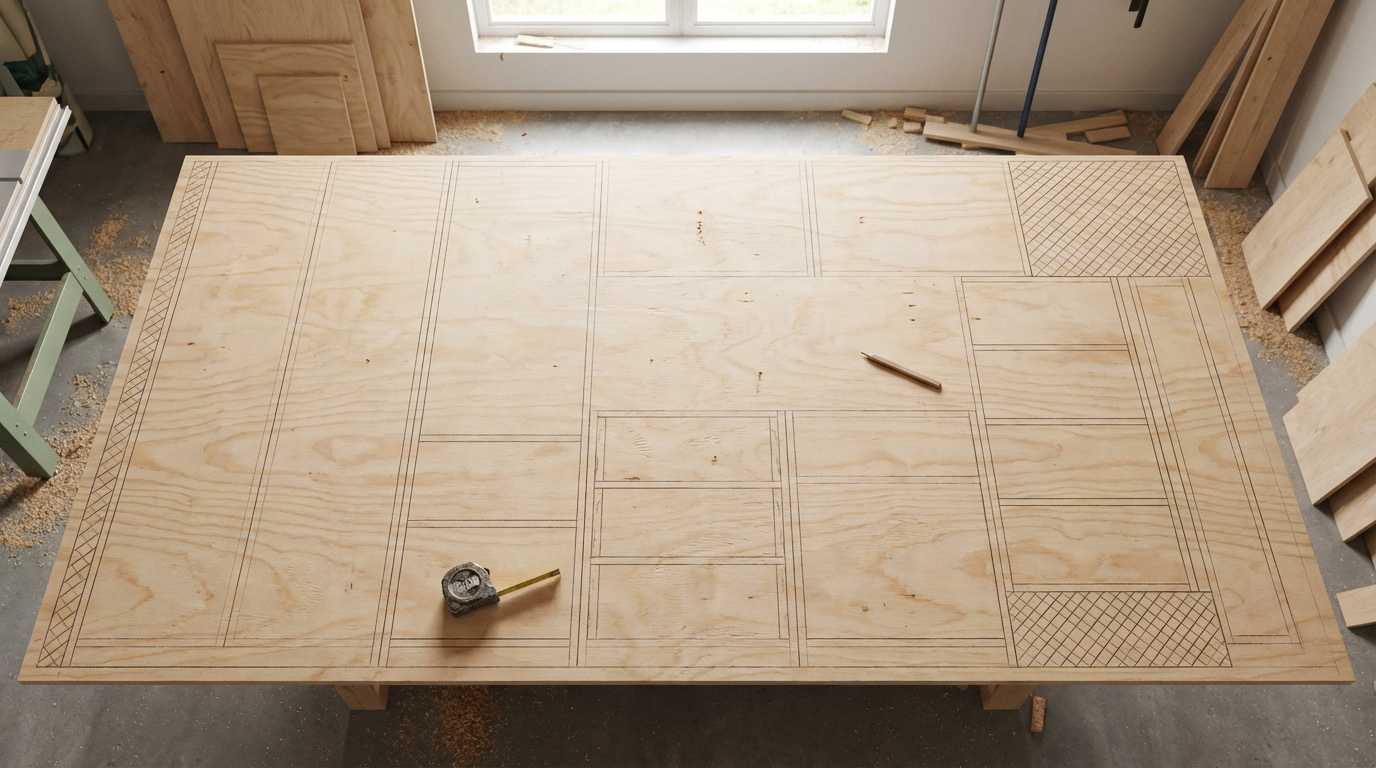
Step 5: Optimize nesting—arrange parts on sheet layouts mentally/sketch. Subtract overlaps.
Step 6: Buffer for errors: +1 sheet/10 total for defects; acclimation swelling.
Indian hacks: Factor carpenter's saw kerf (3mm/panel), alcove irregularities (+10% walls). Test on scrap: poor nesting wastes 40%.
Trade-offs: Manual calcs free but error-prone (20% overrun); pro software precise but ₹5k+ investment.
Wardrobe Plywood Calculator: Real Examples
For a standard 6ft H x 4ft W x 2ft D single wardrobe: Carcass—2 sides 6x2ft (24 sq ft), top/bot 4x2ft x2 (16 sq ft), 4 shelves 4x1.5ft (24 sq ft), 2 partitions 6x1ft (12 sq ft) = 76 sq ft 18mm → 3 sheets. Shutters: 4x 6x1.8ft (43 sq ft) 12mm → 2 sheets. Back: 6x4ft (24 sq ft) 6mm → 1 sheet. Total: 6 sheets +30% waste = 8 sheets.
Larger 7x6x2.5ft double: Carcass 120 sq ft 18mm (4 sheets), shutters 70 sq ft 12mm (3), back 42 sq ft 6mm (2), internals +2 sheets. Total 11 + waste = 15 sheets.
Slide wardrobe? Add tracks/rails groove cuts (+15% waste). Loft conversions: +20% for beams.
Coastal tip: BWR 18mm carcass prevents sagging; monsoon swells shutters 3mm without seals.
Kitchen Plywood Estimation: Carcass and Shutters
Linear 10ft L-shape kitchen: Base units (3x2ft D)—sides 12x2.5x2 (60 sq ft), tops 10x2ft (20 sq ft), shelves x6 (30 sq ft) = 110 sq ft 18mm → 4 sheets. Wall units: 12x1.5x2ft sides/tops/shelves 80 sq ft 12mm → 3 sheets. Shutters 40 sq ft 12mm (2 sheets). Chimney cabinet: 2x2x1.5ft = 1 sheet 18mm. Backs minimal 6mm (1 sheet). Total 11 +40% waste (routs/spills) = 16 sheets.
Island addition: +4 sheets 18mm. Wet zones? BWP doubles cost, same qty.
TV Unit Quantity Guide: Compact to Large
Wall-mount 6x1.5x1ft: Sides/top 30 sq ft 12mm (1 sheet), shelves x3 20 sq ft (1), back 6mm (0.5→1). Total 3 sheets +20% = 4.
Floor 8x2x1.5ft: 60 sq ft 18mm carcass (2), shelves 40 sq ft 12mm (2), total 5 + waste 7 sheets.
Wastage Factors and Minimization Strategies
Wastage averages 25-40%: kerf loss (3mm/cut), nesting inefficiency (curved doors), defects (voids). Monsoon sites +10% from rushed cuts. Minimize: CNC nesting (15% waste), straight designs, buy calibrated for even cuts. Trade-off: Fancy routs waste 50% vs plain 20%.
Decision Framework Table
| Furniture Type | Size Range | 18mm Sheets | 12mm Sheets | 6mm Sheets | Total +20% Waste |
|---|---|---|---|---|---|
| Wardrobe | 6x4x2ft | 3 | 2 | 1 | 8 |
| Wardrobe | 7x6x2.5ft | 5 | 3 | 2 | 13 |
| Kitchen 10ft | L-shape | 5 | 5 | 1 | 14 |
| TV Unit | 6x1.5x1ft | 0 | 2 | 1 | 4 |
Use this for quick starts; adjust for custom depths.
Common Buyer Mistakes and Fixes
1. Ignoring backs: Adds 10-15%; always calc separately.
2. No thickness split: Overuses 18mm; use 12mm shutters saves 20%.
3. Zero wastage: Mid-job shortages; add 30% buffer.
4. Uneven walls: +15% panels; measure site first.
5. Forgetting internals: Shelves double carcass qty.
6. Monsoon no-acclimation: Swells waste 2 sheets.
7. Poor nesting: Sketch layouts first.
8. One-size-fits-all: Kitchens need more BWR.
Quality Checks You Can Do Without Lab Tests
Visual: Even glue lines, no voids (tap for hollow), uniform color. Knock test: Solid thud = good core. Edge: Smooth, no gaps. Flex: 18mm shouldn't sag >2mm loaded. Ask: Glue type? Core wood? Calibration? Warnings: Soft core pokes finger; wet feel = stored poorly.
Workmanship and Installation Tips
Cutting: CNC for precision; manual saw + guides. Edge seal: PVA + tape pre-laminate. Screws: 2-inch confirmat for carcass; pilot holes prevent splits. Hinges: Reinforce 18mm with blocks. Acclimatize 72hrs. Monsoon: Dry storage, seal all edges.
FAQs
How much plywood for a 10x10 wardrobe? A 10ft high walk-in wardrobe typically requires 20-25 sheets total: 10-12 of 18mm for carcass and heavy shelves supporting extensive hanging space, 6-8 of 12mm for multiple shutters and drawers, and 3-4 of 6mm for backs and partitions. Factor 30% wastage for intricate loft divisions or mirror panels, pushing to 28 sheets—always sketch full internals as vertical space multiplies shelf counts in Indian homes with seasonal storage needs.
Does kitchen need more plywood than wardrobe? Yes, kitchens often use 1.5-2x more due to deeper base units, wall cabinets, and spill zones: a 12ft linear setup might hit 20 sheets vs 12 for equivalent wardrobe volume. BWR grade carcass demands thicker 18mm throughout, plus chimney cutouts wasting extra, unlike wardrobes' simpler boxes—coastal humidity further necessitates overprovisioning sealed edges.
Include laminates in plywood calc? No, plywood qty covers structural panels only; laminates add separate sq footage (same area +10% overlaps). Miscalculating leads to mismatch—measure plywood faces post-cut for laminate orders, adding 5% buffer for trimming in humid installs where edges chip.
What's average wastage percentage? Plan 25-40% depending on cuts: 20% straight shelves, 50% curved TV niches. Indian carpenters minimize via experience, but DIYers hit 45% without nesting sketches—test on one sheet first for complex kitchen shutters.
Calibrated vs non-calibrated for quantity? Calibrated (17.5/16mm exact) reduces waste 10-15% via uniform cuts/CNC; non-calibrated varies 1-2mm, forcing wider kerfs. Prefer for modular where laminates demand flatness, especially monsoon-prone areas swelling unevenly.
TV unit: wall vs floor plywood needs? Wall-mount uses 40-50% less (3-5 sheets 12mm focused) vs floor (6-10 sheets 18mm base) due to no bottom/legs. Electronics weight demands gussets either way—add 1 sheet buffer for cable routs.
Termite-proofing affect quantity? No direct qty change, but chemical-treated ply costs more, so optimize calcs tighter. Elevate units 6 inches; untreated fails fast in soil-contact TV cabinets.
Buy extra sheets always? Yes, +10-20% (1-2 sheets/project) for defects/swells. Return policies vary; stock warps if unused—ideal for future repairs in multi-room builds.
Software vs manual calc? Manual suffices for small jobs (accurate ±10%); software excels large kitchens (5% savings). Free sketches beat both initially for Indian site variances.
Coastal vs inland quantities? Coastal +10-15% BWP/marine ply for delam resistance, same base qty but thicker specs. Inland MR saves but risks warping—acclimation mandatory everywhere.
Disclaimer: This content is provided for general informational purposes based on industry practices and publicly available information. Product specifications, standards, prices, and availability may vary by manufacturer, region, and time. Readers should independently verify details with manufacturers, dealers, or qualified professionals before making purchase or construction decisions.Want Plywood Suggestions?
Share a few details and a Sainik 710 specialist will suggest suitable brands and connect you to responsive dealers.