Modular Kitchen Cost Calculator: Estimate Price by Size, Material & Finish (2026)
Estimate modular kitchen cost by size, material & finish. Get price per sq ft, material comparison & budget breakdown for Indian modular kitchens.
Modular Kitchen Cost Calculator: The Direct Answer
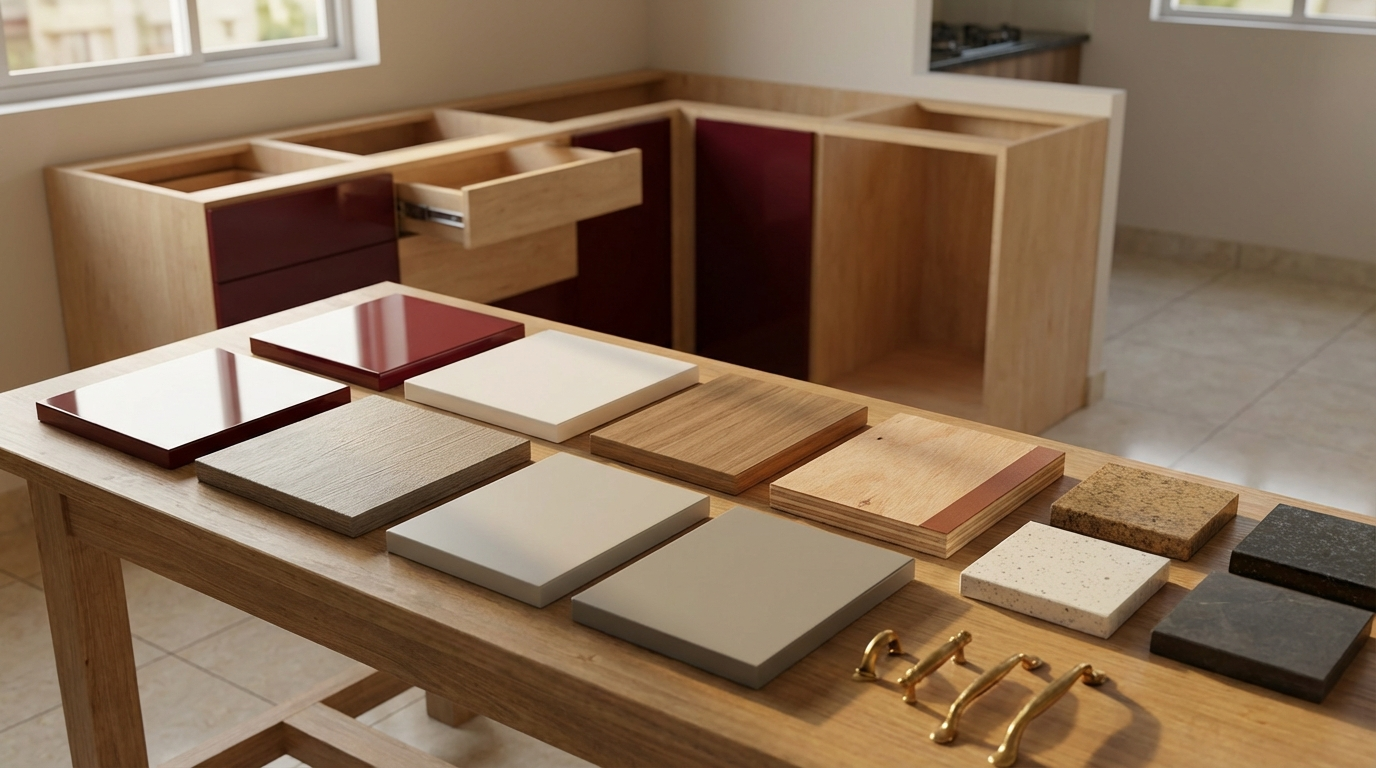
A modular kitchen cost calculator estimates your kitchen price based on size, layout, materials, and finishes—typically ranging from ₹1.2 lakh to ₹6.5 lakh for most Indian homes.
Short version: The average Indian modular kitchen cost ranges between Rs. 1,200 – Rs. 3,200 per sq ft, depending on size, layout, and materials. For a standard 80-100 sq ft kitchen, most homeowners spend ₹2–4 lakh for a standard modular kitchen. Smaller kitchens with basic materials sit at the lower end, while mid-range finishes and better hardware push the cost upward.
This is right for you if:
- You're planning a new kitchen and need a realistic budget before meeting contractors
- You want to understand what's eating up your kitchen budget—spoiler: it's usually the hardware and accessories
- You're comparing between branded modular kitchens and local carpenter-made options
- Your architect gave you a vague "₹2-5 lakh" range and you need something more specific to plan
Skip this if:
- You're looking for exact prices (these vary by city, vendor, and even the month you're buying)
- You've already finalized materials and just need installation quotes
Bottom line: Calculate your cabinet area in square feet, multiply by ₹1,500-2,500 depending on your material choice, then add 20-30% for countertops, accessories, and installation—that's your ballpark figure.
Note: sainik710.com is an independent informational site and is not affiliated with any manufacturer.
What a Modular Kitchen Cost Calculator Actually Does
A kitchen cost calculator estimates the cost of designing a modular kitchen space based on personalised additions, materials, fixtures, decor, appliances, and other accessories. After selecting your specifications, a kitchen cost calculator compares the respective costs and gives a final estimate.
Most people think these calculators give you the exact price you'll pay. Actually, they give you a starting point—a rough estimate that'll probably be 15-25% lower than your final bill. I've seen this happen repeatedly. The calculator shows ₹2.5 lakh, and the final quote comes to ₹3.2 lakh. Why? Because accessories add up, modifications happen on-site, and there's always something the calculator didn't account for.
The price estimator considers the shape and area of your kitchen, materials, and the package you choose to check the pricing in real time. The estimator will make a few assumptions based on the shape of your kitchen. The shape of your kitchen is a significant factor in calculating the price of your kitchen. For instance, the under counter space and the over counter space in an L-shaped kitchen varies from an island or a straight kitchen.
Here's what actually happens: The final price of your modular kitchen may be lower or higher than the estimate depending on the choice of products and services you make. That disclaimer is there for a reason. The estimate is the minimum—rarely the maximum.
Why Kitchen Costs Vary So Much in Indian Homes
If you've asked three different vendors for quotes, you've probably gotten three wildly different numbers. There's a reason for this—and it's not just markup.
While modular kitchen prices largely depend on materials and design, the city you live in also plays a big role. Labour rates, material availability, demand for premium finishes, and even the way homes are designed differ from one city to another.
Mumbai kitchens consistently cost more than Pune kitchens. Not because the materials are different, but because everything else is—labour, transport, rentals. Labour is cheaper in Tier-2 cities, 20–30% higher in metros like Delhi, Mumbai, Bangalore. A kitchen that costs ₹2 lakh in Indore might touch ₹2.8 lakh in Mumbai for the exact same specifications.
And then there's the humidity factor. In places like Chennai or Mumbai, you'll notice that materials behave differently. BWR or BWP grade plywood (boiling water resistant/boiling waterproof) is a great option for the kitchen area because it handles the 70-85% relative humidity during monsoon. Coastal Karnataka, the Konkan belt—these areas need marine-grade materials. Skip that, and your cabinet doors start warping by the second monsoon. I've seen ₹3 lakh kitchens ruined in 18 months because someone saved ₹15,000 on materials.
Is using a modular kitchen calculator actually worth your time?
Honestly? Yes and no. It's worth 15 minutes to get a baseline figure before you start talking to vendors. You'll at least know if someone's quoting way above market rate. But don't treat it as gospel. The calculator doesn't know that your kitchen has an awkward corner that needs custom units. It doesn't know your wall isn't perfectly straight (most aren't, by the way). It doesn't account for the electrician who'll need to relocate three switch points. Use it as a starting point, not a final answer.
Types of Modular Kitchens and Their Cost Ranges
A modular kitchen is a space built from ready-made units like cabinets, drawers, shelves, and accessories. All these parts fit together neatly. These modules are designed, manufactured, and then assembled in your home as per the space. The key difference from a normal or traditional kitchen is how flexible it is. It's faster, smarter and way easier to customise.
Here's the breakdown by layout type:
| Layout Type | Best For | Approx. Cost Range | My Take |
|---|---|---|---|
| Straight/Single Wall | Compact apartments, studio kitchens, bachelor pads | ₹1.2 – ₹2.5 lakh | Most economical option. Works if you're okay with limited counter space. |
| L-Shaped | Most Indian homes, 2BHK-3BHK apartments | ₹1.8 – ₹3.5 lakh | L-shaped modular kitchen layout is the best for Indian homes as it does not require large spaces and can be designed perfectly in smaller kitchen areas. |
| Parallel/Galley | Narrow but long kitchen spaces | ₹1.3 – ₹2.8 lakh | Great workflow. Popular in Mumbai and Chennai flats. |
| U-Shaped | Larger kitchens needing max storage | ₹2.5 – ₹4.5 lakh | L-shaped and U-shaped kitchens require more cabinetry and hence cost more. |
| Island Kitchen | Open floor plans, villa-style homes | ₹3.5 lakh – ₹6 lakh+ | Island kitchens are premium and usually 30–40% costlier. |
Since straight kitchens use fewer units, the cost usually stays on the lower side, making it one of the most budget-friendly layouts. L-shaped layouts are the most practical for many Indian homes because they offer a good balance of storage and workspace.
Price Reality Check: 2026 Market Rates
Right, moving on to what you actually want to know—the numbers.
Here's what affects your final bill, in order of impact:
1. Cabinet Carcass Material (50-60% of total cost)
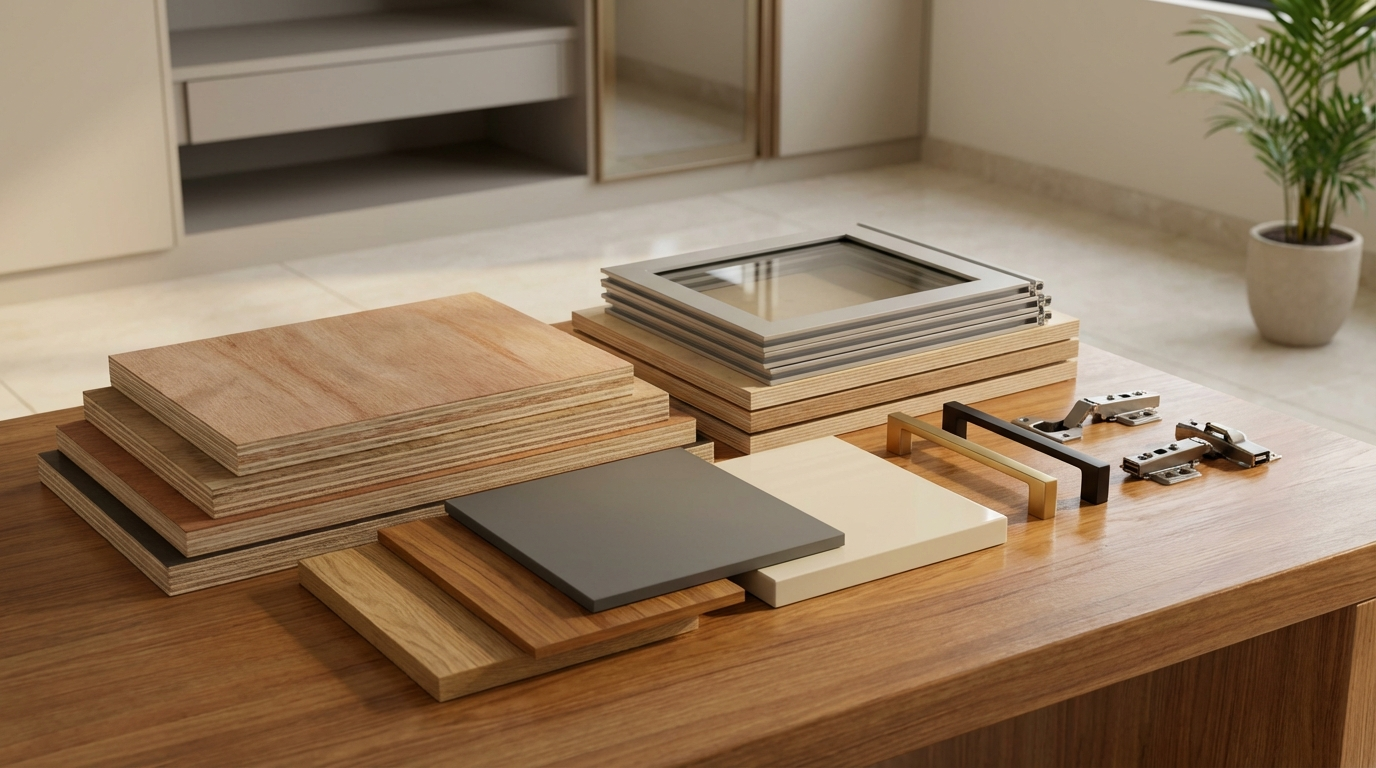
The core material defines both cost and durability: MDF/Particle Board costs Rs. 1,200 – Rs. 1,800 per sq ft (budget-friendly, less durable). Marine Ply (BWR) costs Rs. 1,800 – Rs. 2,800 per sq ft (strong, water-resistant, popular choice in India). Solid Wood/High-end Ply costs Rs. 2,500 – Rs. 3,200 per sq ft (premium, long-lasting).
2. Shutter/Door Finish (15-20% of total cost)
Acrylic shutters for your cabinets can cost you more than laminate. Laminate is the budget workhorse—durable and available in every color imaginable. Acrylic gives that high-gloss look but scratches if you're not careful. PU finish sits in the middle—good looks, reasonable durability.
3. Hardware and Accessories (15-25% of total cost)
Quality hinges, soft-close drawers, tandem boxes, and lift-up systems can add ₹30,000–₹1 lakh to your budget. This is where costs spiral fast. One carousel corner unit alone can cost ₹8,000-15,000. Add a magic corner, tall unit, and pantry pullout—suddenly you've added ₹50,000 to your budget.
4. Countertops (10-15% of total cost)
While quartz and marble for modular kitchen counters may cost around Rs 400 per sq ft, granite for modular kitchens is available for between Rs 120 and Rs 250 per sq ft.
What thickness works best for kitchen cabinets?
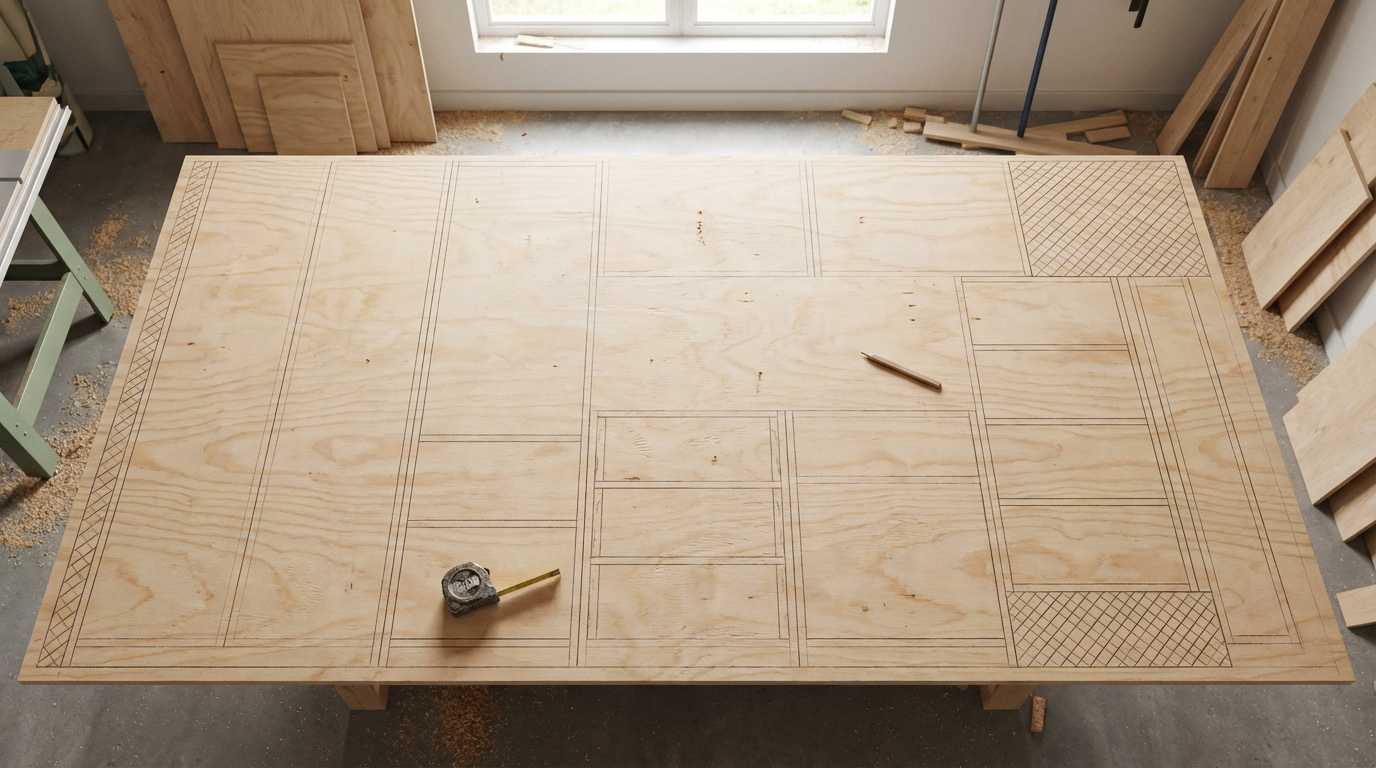
For carcass (the box structure), 18mm plywood is standard. Don't let anyone convince you that 12mm is "good enough"—it isn't, not for base units that'll carry granite and heavy vessels. For shutters, 18mm is again ideal, though 16mm works for overhead cabinets where load isn't an issue. The back panel? 6mm is fine—it's just covering the wall anyway. If your contractor is suggesting 9mm throughout to save costs, question it. You'll feel the flimsiness when you open the doors.
Material Comparison: Making the Right Choice
| Material | Water Resistance | Durability | Cost per Sq Ft | Best For | My Preference |
|---|---|---|---|---|---|
| Particle Board | Poor | 3-5 years | ₹1,200-1,500 | Dry areas, tight budgets | Avoid for base cabinets |
| MDF | Moderate | 5-8 years | ₹1,400-1,800 | Shutters, decorative panels | Good for shutter only |
| HDHMR | Good | 8-12 years | ₹1,600-2,200 | All kitchen zones | Best mid-range option |
| BWR Plywood | Very Good | 12-15 years | ₹1,800-2,500 | Base cabinets, sink area | My default recommendation |
| BWP/Marine Ply | Excellent | 15-20 years | ₹2,200-3,000 | Coastal cities, basement kitchens | Worth it in humid climates |
| Stainless Steel | Excellent | 20+ years | ₹2,500-4,000 | Commercial, ultra-modern homes | Overkill for most homes |
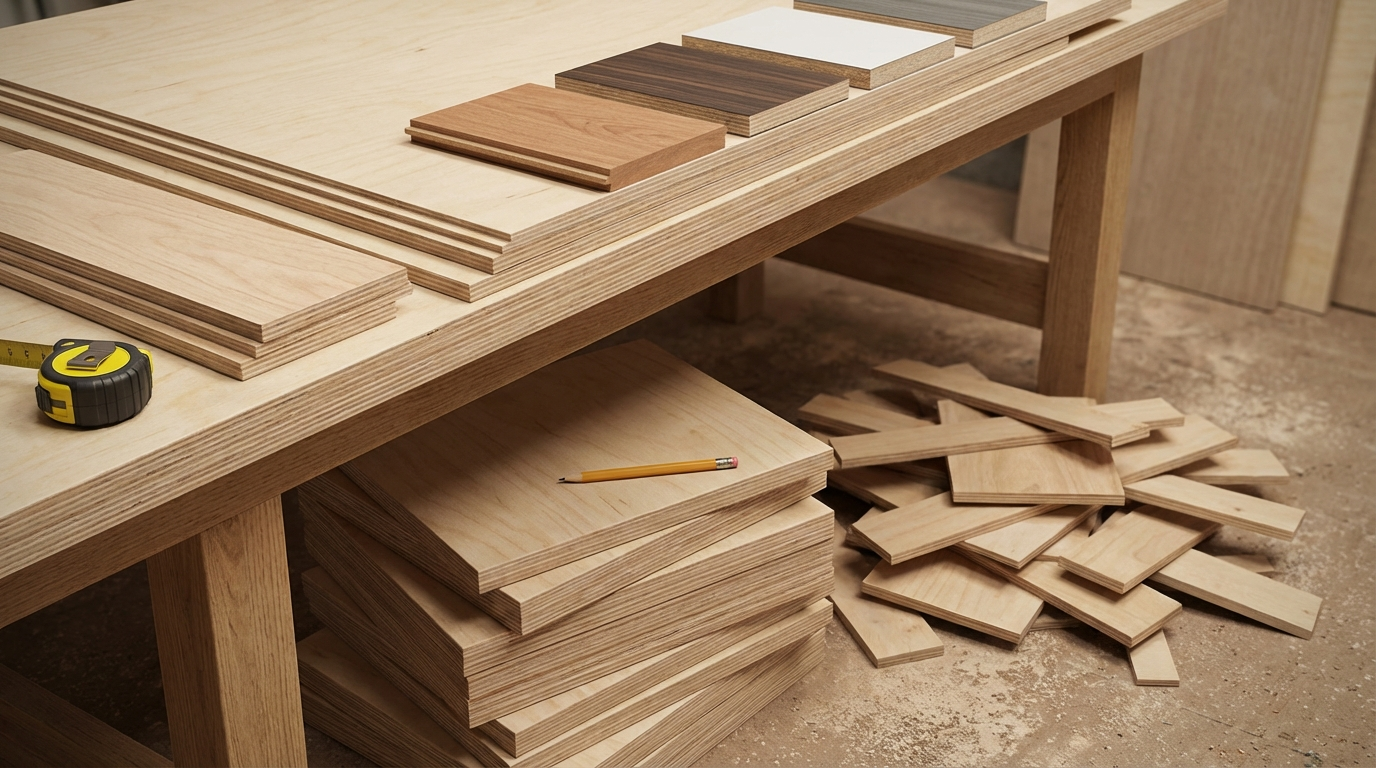
Honestly, for most Indian homes in cities like Bengaluru, Pune, or Hyderabad, BWR plywood with laminate finish is the sweet spot. Plywood is a more traditional option that not only looks premium but is also expensive. Whereas, MDF is a new-age core material that's both cost-effective and versatile. But MDF in the kitchen? I've seen it swell near the sink area even with good ventilation. The kitchen cabinet material comparison guide covers this in more detail.
How to Calculate Your Kitchen Cost: Step by Step
To calculate the basic modular kitchen price, it is important to first calculate the areas of wall units, base units, loft units and countertops. The rates for base units, loft units and wall units are obtained from their surface areas in elevations, while countertop rates are based on their surface areas in plan.
Step 1: Measure Your Kitchen's Working Walls
Only count walls where you'll actually have cabinets. That wall with the window? Subtract the window area. The wall with the door? Subtract the door opening. Get the running feet of your base cabinet line.
Step 2: Calculate Cabinet Area
Perimeter length = sum of length of each side = 8 + 8 = 16 ft. Area of base units = 16 x 2.75 sq ft = 44 sq ft. The area of wall units can be calculated by multiplying the same perimeter length by the height of wall units (which is generally around 2').
Step 3: Apply Material Rate
Multiply your total cabinet area by the per-sq-ft rate for your chosen material. Use ₹1,500 for budget, ₹2,200 for mid-range, ₹3,000 for premium.
Step 4: Add Countertop Cost
Measure countertop length × 2 feet (standard depth). For granite, multiply by ₹180-250. For quartz, use ₹400-600.
Step 5: Factor in Hardware
Add 20-30% of your cabinet cost for hardware and accessories. Basic hinges and handles? Stay at 15%. Soft-close everything with pullouts? Budget 30% or more.
Step 6: Installation and Labour
Installation usually accounts for 8–10% of the total cost. Varies by city – labour is cheaper in Tier-2 cities.
Can you get a decent modular kitchen under ₹1.5 lakh?
Yes, but with compromises. The modular kitchen cost starts at ₹1.75 lakhs for a minimally sized kitchen with an area of around 65 sq ft. If you have a straight kitchen under 50 sq ft, use particle board with laminate, stick to basic hinges and handles, and go with local granite—you can squeeze into ₹1.2-1.5 lakh. But here's my honest opinion: that kitchen might need replacement in 5-6 years. Spending ₹50,000-70,000 more on better materials often makes sense for longevity.
Decision Framework: Choosing the Right Setup
| Your Situation | Recommended Approach | Why |
|---|---|---|
| Rental apartment, staying 2-3 years | Budget materials (particle board, basic laminate) | No point investing in premium for temporary stay |
| Own flat, living 10+ years | BWR plywood with quality hardware | Durability matters when you're staying long-term |
| Coastal city (Mumbai, Chennai, Kochi) | BWP marine ply, stainless steel accessories | Salt air and humidity destroy standard materials faster |
| Tight budget but own property | Good carcass, basic finish—upgrade later | You can change shutters after 5 years; carcass is permanent |
| Resale value matters | Neutral colors, quality brands, L-shaped layout | Buyers prefer classic over quirky |
| Heavy cooking daily (Indian style) | Heat-resistant countertop, chimney provision, good ventilation | Spice stains, oil splatter, and heat damage are real concerns |
Red flags to walk away from:
- Quote that's 40% below everyone else—they're cutting corners somewhere
- No warranty mentioned in writing
- Vague "including all accessories"—get itemized list
- "We'll adjust on site"—that means unexpected charges later
- Reluctance to show material samples or factory visit
Common Mistakes That Blow Your Budget
1. Ignoring the accessories trap
This one really frustrates me. People obsess over cabinet material but blindly accept whatever accessories the designer suggests. A magic corner unit, tall pantry, wicker baskets, cutlery tray—each adds ₹5,000-15,000. Suddenly your ₹2 lakh kitchen is ₹2.8 lakh. Accessories such as tall units, carousel corners, or pull-out pantries look attractive but can inflate costs quickly. Include only what you'll actually use in daily cooking.
2. Choosing finish before function
Acrylic looks stunning in showrooms. High-gloss finishes photograph beautifully. But high glossiness highlights imperfections. Needs to be taken care of to avoid or clean scratches. In a real Indian kitchen with turmeric, oil, and kids—matte laminate is far more forgiving.
3. Underestimating countertop installation
The countertop material price is just half the story. Cutting, polishing, edge profiling, sink cutout, installation—these add 30-40% to the material cost. A ₹15,000 granite slab might cost ₹22,000 installed.
4. Not planning electrical points early
There was this flat in Malad I consulted on last year. Beautiful ₹4 lakh kitchen. Then they realized they needed to add points for mixer grinder, microwave, and water purifier after installation. Breaking the backsplash, rewiring, repairing—added ₹25,000 and three weeks of headache.
5. Skipping the site check
Wall not plumb? Floor not level? Old plumbing that needs rerouting? These things come up during installation, not before. And they cost money. Budget 10% contingency for surprises.
6. Going for lowest quote blindly
Never settle for the first quote. Reach out to at least 2–3 contractors or interior firms, compare prices, and check inclusions before making a decision. The cheapest quote often becomes the most expensive project.
7. Forgetting ventilation
Chimney specifications, exhaust placement, window positioning near cooking zone—ignore these and your beautiful cabinets start yellowing from smoke residue within a year.
Quality Checks Before Paying the Final Amount
Visual Checks:
- All shutters align properly—no gaps, no overlaps
- Edges are sealed completely (run your finger along them)
- No visible screws or exposed laminate edges on face side
- Handles are installed at consistent heights
- Countertop joints are flush—no lippage
- Drawers close fully without sticking
Questions to Ask Your Vendor:
- "What's the warranty period, and what does it cover?"
- "Is the quote inclusive of installation and GST?"
- "What happens if something doesn't fit on site?"
- "Can I see the material samples before you start fabrication?"
- "Who handles the after-installation service calls?"
Simple Tests You Can Do:
- Tap test: Hollow sound in cabinet panels means poor material or bad gluing
- Drawer test: Soft-close should work even when you slam—if it bounces open, mechanism is cheap
- Weight check: BWR plywood feels heavier than particle board. Pick up a cutoff piece.
- Edge inspection: Peel-resistant edge banding shouldn't lift even when you try to pick at it
Here's a trick most dealers don't like: Ask for IS 710 certification for boiling water resistant plywood, or IS 303 for marine plywood. If they can't show you the sticker or certificate, the "BWR" claim is probably false.
What to Tell Your Carpenter or Fabricator
Your briefing checklist:
- All base cabinets must have adjustable legs, not direct floor contact—prevents water damage during mopping
- Sink cabinet needs 6mm waterproof back panel or stainless steel base—the most moisture-prone area
- Chimney zone cabinets should have 50mm gap from the chimney hood for heat dissipation
- Edge banding is mandatory on all exposed edges—not just visible ones
- All hinges should be 3D adjustable (height, depth, angle)—makes alignment corrections easier later
- Provide 10mm expansion gap between wall and cabinet for tiling irregularities
I've seen carpenters skip the leg adjusters to save time and rest the cabinets directly on the platform. Saves maybe ₹500-700. Then the first time someone mops aggressively, water seeps in from the bottom, and the particle board swells. ₹15,000 repair job. Not worth it.
Why do carpenters sometimes prefer MDF over plywood?
Easier to work with. MDF cuts cleanly without splintering, takes router edges beautifully, and paints more smoothly. It's also cheaper. But moisture resistance? Much lower than BWR plywood. A carpenter suggesting MDF for kitchen carcass is thinking about his convenience, not your longevity. Push back on this—plywood for carcass, MDF only if you're doing painted shutters and need that smooth finish.
How Long Your Modular Kitchen Should Last
This depends almost entirely on two factors: material quality and maintenance.
Realistic lifespan expectations:
- Particle board kitchen: 4-6 years before visible degradation
- MDF kitchen: 6-8 years with proper care
- HDHMR kitchen: 10-12 years
- BWR plywood kitchen: 12-15 years
- BWP/Marine plywood: 15-20 years
- Stainless steel: 20+ years (commercial grade)
In my experience, well-maintained BWR plywood kitchens in dry cities like Bangalore or Pune last 15+ years without major issues. The same kitchen in Chennai or coastal Mumbai? Maybe 10-12 years because of humidity.
Signs your kitchen needs attention:
- Shutter edges starting to lift or bubble—moisture damage
- Hinges squeaking despite oiling—time to replace
- Drawers not closing flush—runners wearing out
- Laminate chipping near handles—high-touch area wear
- Musty smell from corner cabinets—hidden water damage
Regular care can also help reduce your long-term modular kitchen costs. Wipe down cabinets weekly, fix leaky pipes immediately, don't place hot vessels directly on countertops. Basic stuff, but most people skip it.
Alternatives Worth Considering
Semi-Modular Kitchen
Semi-modular kitchen solutions where some components are built-in, and others are factory-made. Pre-designed modular kitchens cost significantly less than custom builds. You get factory-made base cabinets but site-built countertop and loft. Saves 20-25% versus fully modular. The HDHMR guide covers material options for this approach.
Carpenter-Made with Quality Materials
If you have a good local carpenter you trust, consider buying plywood yourself (ensures quality) and paying for labor separately. The wardrobe plywood guide has selection tips that apply to kitchen materials too. This approach works if you're not in a hurry and can supervise regularly.
PVC Modular Kitchen
PVC modular kitchens are renowned for their versatility and resilience. PVC combines durability with affordability. The estimated price for a 150 SQF PVC Modular kitchen could start at anything from Rs 3 L. PVC is much cheaper than wood or steel. Not my first recommendation for primary homes, but for rental properties or secondary kitchens, it's worth looking at.
FAQs: What People Actually Ask
Is it true that branded modular kitchens cost twice as much as local ones?
Roughly, yes. Prices for prestige modular kitchens usually range from Rs 1.5 lakh and can go up to Rs 10 lakh or more for premium designs and customisation. Local fabricators might deliver the same layout for ₹80,000-1.5 lakh. But branded options include warranty, consistent quality, and usually better hardware. The premium is partly for peace of mind, partly for the showroom experience. Whether it's worth it depends on how much you value those things.
What if I live in a coastal city like Mumbai or Chennai—does the kitchen cost more?
Yes, for two reasons. First, you need better materials—BWP marine plywood instead of BWR, stainless steel hardware instead of iron-based. That adds 15-20% to material cost. Second, labor rates in metros are higher. Modular kitchen costs in India vary not just by size and material, but also by location. If you're in a metro city, expect to pay more due to higher labour and premium finish demand.
Is it true that island kitchens are just for show and not practical for Indian cooking?
Depends on your cooking style. Island kitchens need 15-20 feet of clear width around them to work properly—most Indian flats don't have that space. Plus, Indian cooking with its oil splatters and masala grinding works better with enclosed layouts. That said, if you have a large kitchen and do mostly continental cooking, islands are fantastic for prep work and casual dining.
How much should I budget for appliances on top of the modular kitchen cost?
Hob prices start from ₹5,000 (basic two-burner hobs) and can go up to ₹80,000 (luxurious 4-5 burner hobs). Add chimney (₹8,000-45,000), built-in oven if needed (₹25,000-80,000), sink (₹3,000-15,000), and mixer grinder placement—you're looking at ₹40,000-2 lakh on appliances alone. Most calculators don't include these.
Is it true that MDF is perfectly fine for kitchen cabinets?
Plywood is a more traditional option that not only looks premium but is also expensive. Whereas, MDF is a new-age core material that's both cost-effective and versatile. Here's the reality: MDF is fine for dry zones and shutters. For the carcass near the sink, hob area, or in humid climates—stick to plywood. I've seen too many MDF base cabinets swell up within 2 years of installation.
Can I upgrade my modular kitchen in phases?
Smart approach if budget is tight. Start with quality carcass and basic laminate shutters. After 4-5 years, you can replace just the shutters with acrylic or PU finish for a fresh look without touching the structure. Also works for accessories—start with basic drawers, add soft-close mechanisms later.
What's the minimum kitchen size for a U-shaped layout?
You need at least 8x8 feet of floor space, ideally 10x10 feet. Below that, U-shaped becomes cramped and impractical. Parallel or L-shaped works better for compact spaces.
Is it true that quartz countertops are always better than granite?
Common belief: Quartz is superior because it's non-porous. Reality: Indian granite is extremely durable, costs half as much, and handles heat better (important for tawa and kadhai placement). Quartz scratches easier and can discolor with extreme heat. For Indian cooking, granite is often the smarter choice.
Should I go for soft-close hinges everywhere or just key areas?
If budget allows, yes—everywhere. The marginal cost difference per hinge is ₹50-100, but the difference in daily experience is significant. At minimum, prioritize base cabinets (which you use most often) and overhead cabinets in the cooking zone.
What if my contractor quote includes materials but the quality looks low?
Common trap. "Materials included" often means lowest available grade. Better approach: ask for an itemized quote separating labor from materials. Buy materials yourself from reputed dealers, or at least demand specific brand and grade mentions in writing (e.g., "Sainik 710 BWR plywood" instead of just "waterproof plywood").
How long does modular kitchen installation typically take?
Factory fabrication: 2-4 weeks. Site installation: 3-7 days for a standard kitchen. Total timeline from order to usable kitchen: 3-6 weeks. Add 1-2 weeks if countertop is natural stone (cutting and fitting takes time). Always add buffer for Indian Standard Time—delays happen.
Is it true that imported hardware is always better?
Choose quality Indian brands that offer good durability at lower prices. German brands like Hettich and Hafele are excellent, but Indian brands like Ebco and Godrej have improved significantly. The price difference is 30-50%. For average home use, good Indian brands work just fine. Our kitchen hardware comparison guide has specific recommendations.
One last thing—whatever budget you finalize, keep 10-15% aside for the unexpected. The wall that turns out to be not straight. The plumbing that needs rerouting. The extra electrical points you forgot. It always happens. Better to have that buffer than to scramble mid-project.
Good luck with your kitchen project. And seriously—don't let anyone convince you to skip edge banding. That ₹2,000 saving will cost you ₹20,000 in repairs within three monsoons.
Disclaimer: This content is provided for general informational purposes based on industry practices and publicly available information. Product specifications, standards, prices, and availability may vary by manufacturer, region, and time. Readers should independently verify details with manufacturers, dealers, or qualified professionals before making purchase or construction decisions.Want Plywood Suggestions?
Share a few details and a Sainik 710 specialist will suggest suitable brands and connect you to responsive dealers.