Plywood Dealers in Chennai: How to Find Genuine Waterproof Plywood + Verification Guide
Find plywood dealers in Chennai—waterproof, BWP & marine plywood shops. Verification checklist, quote guide & tips to avoid counterfeit plywood.
Quick Answer: Finding Genuine Waterproof Plywood Dealers in Chennai
Finding reliable plywood dealers in Chennai requires you to verify ISI certification marks, compare prices across at least three shops, and physically inspect the plywood before purchase. That's the short version of what I'm about to tell you.
Short version: Chennai has over 2,700 plywood shops listed on major directories, and honestly, maybe 60-70% of them are selling genuinely certified material. The rest? Mix of mislabeled grades, counterfeit stamps, and dealers who don't know the difference themselves. Industry sources indicate that roughly one in five plywood sheets sold in India may be counterfeit. Your job is to avoid being the customer who discovers this too late.
This guide is for you if:
- You're building a kitchen or bathroom in Chennai and need BWP/marine grade ply
- You've heard horror stories about fake ISI stamps and want to know how to actually verify them—not just read about it on manufacturer websites
- Your mistri or interior designer says "don't worry, I know a guy" but you want to do your own checks anyway (smart move, by the way)
- You're spending more than ₹50,000 on plywood and want to make sure it lasts at least 10-15 years
Skip this guide if:
- You just need cheap commercial ply for temporary storage or packing
- You've already got a trusted dealer relationship going back 5+ years
Bottom line: In Chennai's humid coastal climate, using the wrong plywood grade in wet areas will cost you 3-4x more in repairs within 2-3 years than buying the right material from the start.
Note: sainik710.com is an independent informational site and is not affiliated with any manufacturer.
What "Genuine Waterproof Plywood" Actually Means
BWP stands for Boiling Water Proof Plywood and it can be referred to as Marine Plywood. BWP Plywood grade plywood falls under IS 710 category in Indian standards. This means it can withstand 72 hours of boiling water. That's your baseline definition.
Most people think "waterproof" means the ply won't get damaged if water splashes on it. Actually, the test is much more brutal—under Indian Standards, BWP plywood is classified as IS 710, which means the plywood is capable of withstanding 72 hours of boiling water. Not just water. Boiling water. For three straight days.
Here's where the confusion starts. BWR Plywood stands for Boiling Water Resistance and conforms to IS 303. The glue used in manufacturing BWR Plywood is urea formaldehyde, which makes it water resistant not waterproof. It can withstand maximum 2 hours of boiling water. BWP Plywood (boiling waterproof) conforms to IS 710 and the glue used is phenol-formaldehyde.
This difference matters. A lot of dealers—and I've seen this happen dozens of times across South India—will sell you BWR ply and call it "waterproof." It's water-resistant, sure. But put it under your kitchen sink in Chennai humidity for a monsoon season, and you'll see the difference.
Is BWP plywood actually worth the extra cost?
Yes and no—it depends entirely on location. For kitchen cabinets, especially the base units near the sink and any bathroom furniture, BWP is non-negotiable in Chennai. High-quality plywood such as BWR (Boiling Water Resistant) and BWP (Boiling Water Proof) is manufactured to withstand humid conditions. The cross-layered construction prevents warping and ensures long-term stability. But for bedroom wardrobes or study tables away from moisture? You can save 20-30% by using good quality commercial or MR grade ply. The key is matching the grade to the application—don't overspend, but definitely don't underspend in wet zones.
Why This Matters Specifically in Chennai
The average relative humidity of Chennai is around 75% although it varies from around 67% during Monsoon (June) to 81% during the Post-Monsoon (November). Compare this to somewhere like Jaipur or Ahmedabad where humidity rarely crosses 50% during dry months. Different planet, different ply requirements.
Towards the end of the year, the city receives rainfall up to 213mm (8.39") in November, a stark contrast from the minimal 6mm (0.24") rainfall recorded in February. Another notable characteristic is the humidity level, which tends to fluctuate between 63% to 76% on the annual basis.
What does this mean for your furniture? It means that plywood in Chennai breathes in and out with the seasons. Under basic conditions of 20°C and 65% relative humidity, the equilibrium moisture content is about 12% for thin-veneer plywood. Chennai rarely gives you "basic conditions." During November-December when humidity peaks at 80%+, poorly chosen plywood swells. During March-May when it drops, it contracts. This constant movement is what causes laminate edges to lift, hinges to loosen, and cabinet doors to jam.
I've seen this happen to a builder in Velachery back in 2022. Used commercial grade ply for a modular kitchen because his client wanted to save money. By the third monsoon, the entire sink cabinet base had buckled. ₹90,000 to replace everything. He doesn't take those shortcuts anymore.
Compare Chennai to Mumbai (similar coastal humidity), and you'll find similar problems. But Chennai's northeast monsoon timing—October to December—means your newly installed kitchen gets tested within months of installation. Particle board is not recommended for wardrobes in Chennai. It absorbs moisture easily, swells quickly, and loses structural integrity in humid conditions. While it may be cheaper initially, it leads to frequent repairs and replacement.
Types of Waterproof Plywood: Grades and Options
Before you walk into any dealer shop in Choolai or Shenoy Nagar, understand what you're looking for. Not all "waterproof" ply is the same.
| Grade | ISI Standard | Glue Type | Water Resistance | Best Use In Chennai | My Take |
|---|---|---|---|---|---|
| Commercial/MR | IS 303 | Urea Formaldehyde | Resists moisture, not submersion | Bedrooms, living room furniture, study tables | Fine for dry areas, don't push it |
| BWR | IS 303 | Phenolic (A grade) | Handles steam and occasional splashes | Kitchen upper cabinets, utility areas | Decent middle ground if budget is tight |
| BWP/Marine | IS 710 | 100% Phenol Formaldehyde | 72 hours boiling water test | Kitchen base cabinets, bathroom vanities, outdoor furniture | Use this or regret later |
| Calibrated BWP | IS 710 | Phenolic + machine-sanded | Same as BWP, better flatness | Modular kitchens where precision matters | Worth the premium for modular work |
Boiling Water Proof (BWP) plywood is designed to resist water and moisture effectively. It is made using phenolic resins that are more resistant to water than urea-formaldehyde resins used in MR (Moisture Resistant) grade plywood. BWP plywood is graded as per the Indian Standards (IS 710:2010) and must adhere to specific quality parameters to ensure its performance in wet conditions.
Honestly, if you're confused between BWR and BWP, ask yourself: will this surface get wet regularly? If yes—BWP. If occasionally—BWR might work. If never—save your money with MR grade.
Price Reality Check: Chennai Market 2026
Let me be straight—plywood prices in Chennai vary by 30-40% between shops for the exact same product. Location, dealer margins, and bulk buying power all play a role. Here's roughly what you should expect:
BWP plywood price in Chennai: you might find BWP plywood priced between ₹115 to ₹155 per square foot. That's for decent branded options. Unbranded or local brands can go lower, but you're taking a risk.
The commercial plywood price generally falls between ₹40–₹60 per sq ft. Also known as BWR (Boiling Water Resistant) plywood, this type resists moisture and humidity. It's best for kitchen and bathroom furniture where exposure to water is frequent. The waterproof plywood price ranges between ₹60–₹90 per sq ft.
Marine plywood is a premium quality plywood that offers maximum strength and water resistance. It is widely used for kitchen cabinets, outdoor furniture, and construction that requires high durability. The marine plywood price usually starts from ₹90 and can go up to ₹150 per sq ft.
| Plywood Type | Thickness | Price Range (₹/sq ft) | Notes |
|---|---|---|---|
| Commercial/MR | 18mm | ₹45-65 | Good for dry areas |
| BWR Grade | 18mm | ₹65-90 | Middle option, moisture resistant |
| BWP/Marine | 18mm | ₹90-140 | Standard branded options |
| Premium BWP | 19mm calibrated | ₹115-160 | Top brands, better finish |
| Commercial | 12mm | ₹35-50 | For backs, shelves |
| BWP | 12mm | ₹70-95 | Kitchen shelving |
What actually affects your final bill:
- Thickness: 12mm BWP plywood price ranges between ₹90 to ₹120 per square foot. 18mm BWP plywood price typically ranges between ₹130 to ₹160 per square foot. 19mm BWP plywood price is often found in the ₹140 to ₹170 per square foot range.
- Brand reputation: Established brands charge 20-30% premium for the same ISI certification
- Calibration: Machine-sanded plywood costs more but saves your carpenter's time
- Quantity: Buying for a full apartment (15+ sheets) usually gets you 8-12% discount
If I'm being honest, the sweet spot for most Chennai homes is spending ₹100-130 per sq ft on BWP ply for wet areas and ₹55-75 for dry areas. Going below that means compromising quality; going above usually means you're paying for brand premium rather than actual performance difference.
How to Verify Genuine BWP Plywood: Step-by-Step
This is the part most guides skip over. They'll tell you "look for ISI mark"—but several manufacturers use fake ISI stamps, so always check the license number that is printed below the ISI mark. If you have any doubts, then cross-verify it on the BIS website. Here's the actual verification process:
Step 1: Check the ISI stamp format
Authentic BWP plywood will have an ISI (Indian Standards Institute ISI 710) mark on each sheet. This mark indicates that the plywood meets the quality standards set by the Bureau of Indian Standards (BIS). Look for the ISI mark along with the relevant standard number (IS 710:2010).
Step 2: Look for the license number
A printed ISI logo without license number (CM/L number) is not valid. A genuine example includes: ISI Mark: IS:710 License No: CML-0005123456. If it's completely blank, it's highly suspect.
Step 3: Cross-verify online
Go to the BIS website (bis.gov.in), navigate to "Check License" or "Certification" section, and enter the CM/L number. If it doesn't match the manufacturer name on the sheet—you have a problem.
Step 4: Inspect the edges
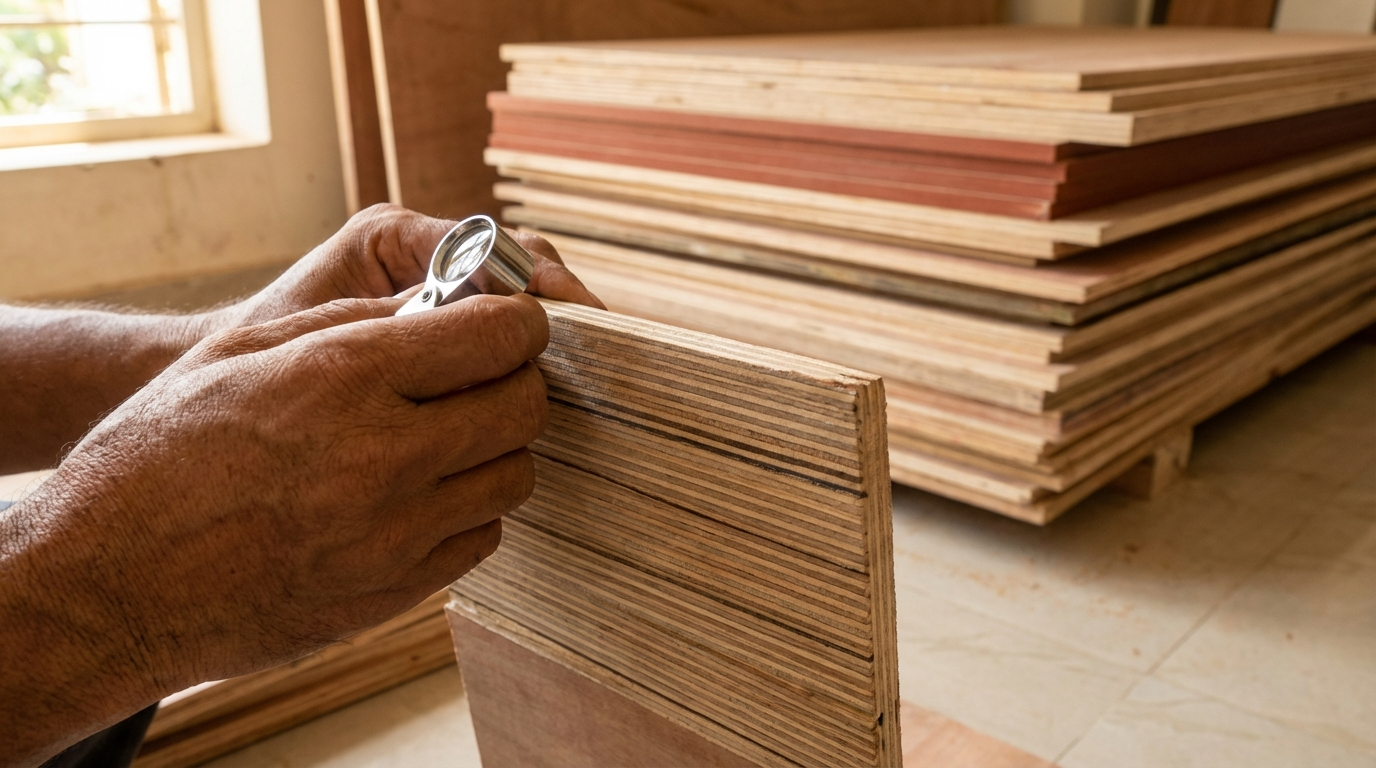
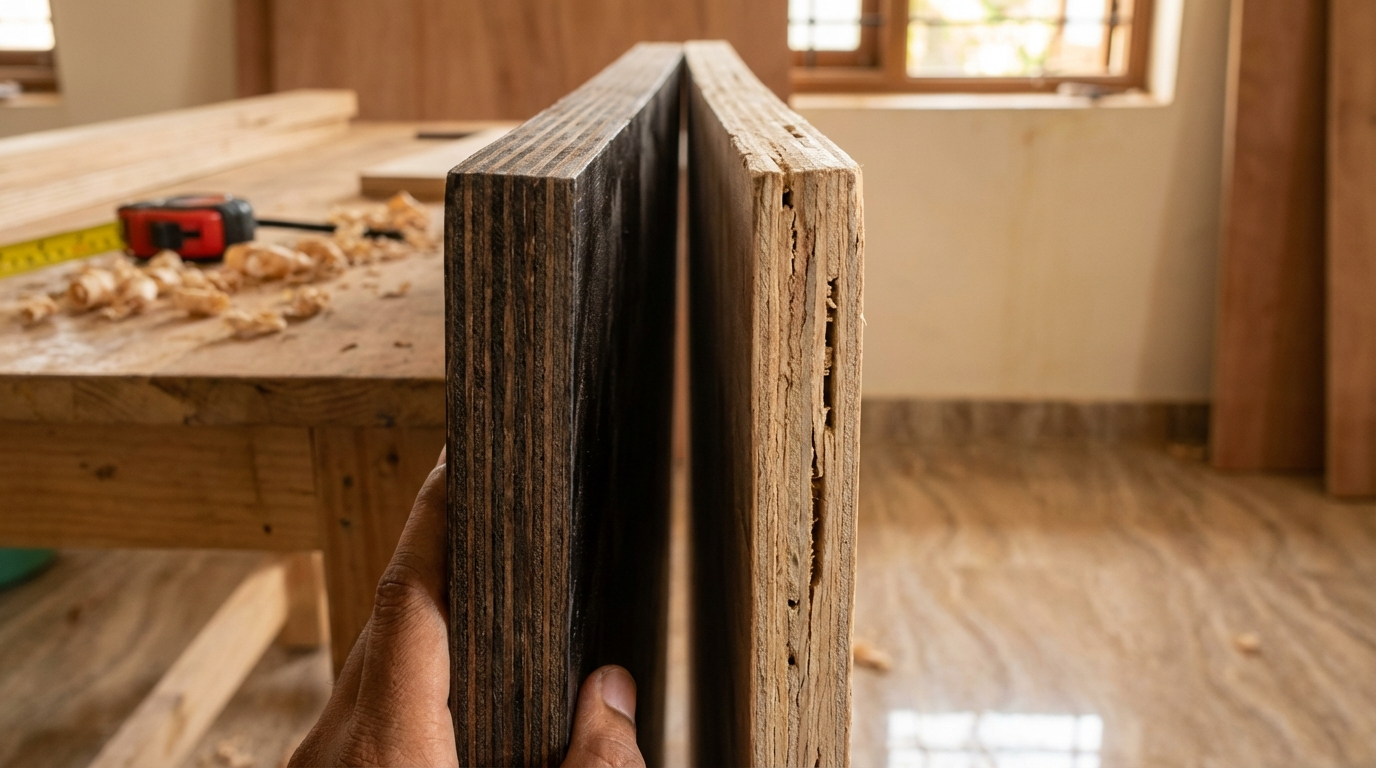
The core of marine plywood should be solid with no gaps or overlaps. Check the edges of the plywood for visible gaps or uneven layers. This takes 30 seconds per sheet. I've rejected entire lots based on edge inspection alone.
Step 5: Ask for documentation
Fake sellers avoid paperwork. A proper GST invoice includes manufacturer details, grade specification, and batch numbers. If they hesitate to provide one—walk away.
What thickness works best for kitchen cabinets in Chennai?
For kitchen cabinet carcasses—meaning the structural boxes—18mm or 19mm BWP is standard. Not 16mm, despite what some carpenters suggest to save cost. In Chennai humidity, the thinner material tends to sag over time, especially on spans wider than 60cm. Shelves inside cabinets can be 12mm if they're properly supported at intervals. Shutter panels (the doors) need 18mm minimum to prevent warping—which happens fast here during monsoon season. For drawer bases, 12mm works. For drawer fronts, match the shutter thickness at 18mm.
Direct Comparison: BWR vs BWP for Chennai Conditions
| Parameter | BWR Plywood | BWP Plywood | My Preference for Chennai |
|---|---|---|---|
| ISI Standard | IS 303 | IS 710 | BWP for wet, BWR acceptable elsewhere |
| Boiling water test | Up to 2 hours | 72 hours minimum | BWP—Chennai needs this buffer |
| Glue type | Phenolic (A grade) | 100% Phenol Formaldehyde | BWP—better long-term bonding |
| Price (18mm, per sq ft) | ₹65-90 | ₹90-140 | Depends on budget |
| Kitchen base cabinets | Risky choice | Recommended | BWP always |
| Kitchen upper cabinets | Usually okay | Better if budget allows | BWR is acceptable |
| Bathroom vanity | Avoid | Essential | BWP only |
| Wardrobes (dry bedrooms) | Good choice | Overkill | BWR or even MR is fine |
| Termite treatment | Usually included | Always included | Both acceptable |
Trade-off summary: With BWP, you gain peace of mind and 8-12 years extra lifespan in moisture-prone areas. You lose about ₹25-40 per sq ft. Over a standard 3BHK kitchen (roughly 100-120 sq ft of plywood), that's ₹2,500-4,800 extra. Compare that to one cabinet replacement costing ₹15,000-25,000. The math is simple.
Choose BWR when: Budget is genuinely tight, area has minimal water exposure, you're doing temporary installations (rented apartments), or upper kitchen cabinets where steam is the main concern.
Choose BWP when: Any surface near sinks, taps, or drains. Bathroom anything. Outdoor or balcony furniture. Long-term installations in owned property. Modular kitchen base units.
How to Choose a Plywood Dealer in Chennai
Okay, so here's my decision framework for evaluating dealers. It's not complicated, but most people skip these checks:
Step 1: Visit during working hours, not when they're closing
You want time to inspect. Rushed visits lead to bad decisions.
Step 2: Ask to see the stock, not just samples
Samples are always perfect. The stock in the godown tells the real story. Look at storage conditions—is it stacked properly? Is there humidity damage on edges?
Step 3: Request multiple sheets of the same specification pulled for inspection
Consistency matters. If three sheets of "18mm BWP" have visibly different edge quality, ask questions.
Step 4: Compare prices from at least 3 dealers
Not online prices—actual quoted prices after you've specified exactly what you need. Get everything in writing.
Step 5: Ask who their regular clients are
Good dealers work with architects, interior firms, and repeat carpenter networks. They have reputation at stake. Random shops selling to walk-in customers only have different incentives.
| Situation | Recommendation | Why |
|---|---|---|
| First-time buyer, small project | Go to established dealer in Choolai timber market area | Higher accountability, multiple options nearby for comparison |
| Working with interior designer | Verify their suggested dealer independently | Some designers get kickbacks for recommending specific shops |
| Large apartment project | Get quotes from 3-4 wholesalers directly | Bulk pricing can save 10-15% |
| Budget under ₹30,000 total | Focus on one reputed brand rather than mixing | Easier to verify authenticity |
| Premium modular kitchen | Insist on calibrated BWP from authorized dealers | Precision matters for expensive hardware |
Red flags to walk away from:
- Dealer can't explain the difference between BWR and BWP
- No proper invoicing offered—only "cash payment" discount
- Prices significantly below market (more than 20% cheaper)
- Stock stored in open areas exposed to rain or extreme humidity
- Refuses to let you inspect edges or core layers
- Brand names you've never heard of with no verifiable information
Common Mistakes People Make When Buying Plywood in Chennai
1. Trusting the carpenter's "regular dealer" without verification
This one really frustrates me. Your carpenter might be excellent at his craft but terrible at understanding plywood grades. Or—and I've seen this—he gets ₹50-100 per sheet kickback from specific dealers. Always verify independently.
2. Confusing BWR with BWP because the dealer said "same only"
They're not the same. BWR and BWP have set standards. For BWP plywood, it has to pass 72 hour boiling water test. The glue used, pressing technique and pressure used for BWP is different than for BWR plywood. If a dealer tells you they're interchangeable, find another dealer.
3. Not checking the ISI license number online
Takes five minutes. Saves potentially lakhs. In India, authentic plywood is stamped with the ISI mark, which is issued by the Bureau of Indian Standards (BIS). But several manufacturers use fake ISI stamps, so always check the license number that is printed below the ISI mark. If you have any doubts, then cross-verify it on the BIS website.
4. Buying based on price alone
Be cautious of significantly lower prices compared to market standards. Genuine BWP plywood involves higher manufacturing costs due to the quality of materials used. Unusually low prices could indicate substandard materials or counterfeit products.
5. Skipping edge inspection
It is crucial to get a closer look at the plywood's edge because it reveals a lot about the inner quality. The best quality plywood has gap-free layers of veneer and is tightly bonded with strong adhesive. I've seen homeowners pick sheets just by looking at the face veneer. Big mistake.
6. Ignoring storage conditions at the dealer
Plywood sitting in humid godowns for months already has moisture damage you can't see. Ask when the stock arrived. Avoid material that's been there more than 2-3 months during monsoon season.
7. Mixing grades within the same furniture piece
There was this client in Anna Nagar who used commercial ply for wardrobe carcass but BWP for the base only. Different expansion rates during humidity changes caused visible gaps within a year. Either upgrade everything or accept the risk uniformly.
8. Not accounting for wastage in quantity calculations
Standard wastage is 8-12% depending on your carpenter's skill. Order accordingly or you'll be making emergency runs to the dealer at retail rates.
9. Believing "marine grade" marketing without checking IS 710 certification
Any plywood can be labeled "marine" or "waterproof" in marketing. Only IS 710 certification actually means something. Both high-grade marine plywood and BWP plywood adhere to the IS:710 standard in India, certifying their boiling water-proof properties.
10. Forgetting about termite and borer treatment
Even BWP ply needs proper treatment. CrownPly offers a 25-year warranty against Borer and Termite attacks. Ask about treatment specifically—don't assume it's included.
Quality Checks You Can Do Yourself
Visual Checks (5-6 things to look for):
- Genuine marine plywood has a smooth surface with consistent veneer quality. Fake plywood may have visible defects like knots, gaps, or overlaps.
- There should not be visible cracks, fillers, or holes, and it should be even in thickness. Do not forget to take a look at the side of the sheet. If there is a consistent grain pattern, it's a green flag.
- Face veneer should be uniform in color and grain pattern
- No visible repairs, patches, or filler material on surface
- Edges should show clean, tight layers without separation
- Sheet should be flat, not warped or bowed
Questions to Ask the Dealer:
- "Can you show me the BIS license certificate for this brand?" (Not the ISI mark on the sheet—the actual license document)
- "What's the CM/L number? Can I verify it while I'm here?"
- "When did this batch arrive? How is it stored?"
- "Will you provide a proper GST invoice with brand, grade, and thickness mentioned?"
- "What's your replacement policy if sheets are defective?"
Simple Field Tests:
Tap test: Simply tap on the plywood's internal structure. You can check by knocking on different parts of the sheet using your knuckles or a tool. If it sounds solid and even, then its core layers are well bonded and are gap-free. The hollow or patchy sound indicates air pockets or delamination inside.
Weight check: Real furniture grade plywood has a weight and density unique to each grade and type. Counterfeit plywood may feel very light or very heavy, indicating it is fake. 18mm BWP should feel substantial—compare multiple sheets.
Flex test: Try bending the plywood; genuine marine plywood should flex without cracking. Fake plywood may crack or break under pressure, due to lower quality wood veneers.
Edge inspection: Look at the cross-section closely. Core layers should be uniform thickness, no gaps, no overlapping veneers, no filler material visible.
Water test (if dealer permits): Soak a small sample of plywood in water for 24-48 hours. Genuine marine plywood will show minimal swelling or delamination. Most dealers won't let you do this on their stock, but you can request a cutoff piece.
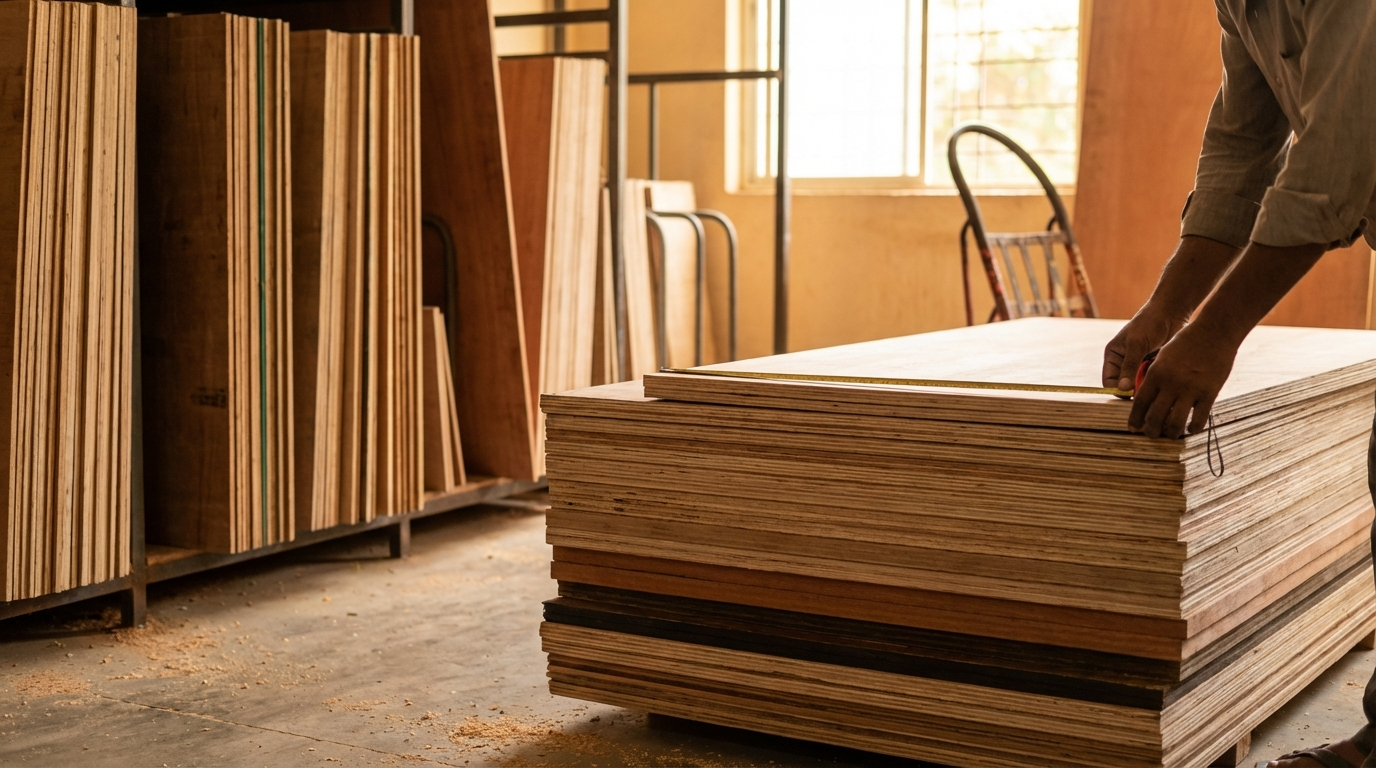
Here's a trick most dealers don't like: Bring a measuring tape. Check if the "18mm" ply actually measures 18mm. Cheap ply often measures 16-17mm but is sold as 18mm. A 2mm difference doesn't sound like much—until your carpenter's calculations go off and you're short on material.
Can you use commercial grade ply in bathrooms?
Absolutely not. Just... no. Indian kitchen conditions are such that you end up using lot of water for cleaning, cooking etc. Even though sink is away, water will regularly get in touch with shutters etc. Waterproof plywood is recommended for long lasting results. Bathrooms are even worse—constant steam, splashing, potential leaks. In Chennai's humidity, commercial ply in a bathroom will show damage within 6-8 months. I've seen complete bathroom vanities replaced in under a year because someone wanted to save ₹3,000 on material.
Workmanship & Installation: What to Tell Your Carpenter
Buying good ply is half the battle. Bad installation ruins even premium material. Here's your briefing checklist for the mistri:
Cutting requirements:
- All cuts should be with a sharp circular saw blade, not old worn blades that cause splintering
- Cut plywood face-up to minimize chipping on visible surfaces
- Allow 2-3mm tolerance in measurements—plywood expands in Chennai humidity
Edge sealing—this matters more than you think:
Every exposed edge should be sealed with either edge banding tape, PVC lipping, or at minimum, primer and sealer. Unsealed edges are where moisture enters first. In Chennai, you'll see laminate lifting at unsealed edges within the first monsoon. I've seen this happen in at least 30-40 kitchens. Infuriating to watch because it's completely preventable.
Fastener guidance:
- Use stainless steel or zinc-coated screws—regular iron screws will rust in Chennai humidity
- For 18mm ply, screws should be 25-32mm long
- Pre-drill pilot holes to prevent splitting, especially near edges
- Confirm screw (minimum size 4mm diameter for cabinet construction)
What to tell your carpenter—briefing checklist:
- "I want to see the ISI mark on every sheet before cutting starts"
- "All edges, including hidden internal edges, must be sealed"
- "Use waterproof wood adhesive, not standard fevicol, for joints in wet areas"
- "Leave 5mm gap between bottom of cabinets and floor—for air circulation and cleaning"
- "No plywood should directly touch the wall in bathroom areas—use spacers"
- "Keep all cutoff pieces until project is approved—for potential repairs later"
Storage and acclimatization:
Plywood should ideally sit in the room where it will be installed for 2-3 days before cutting. This allows it to adjust to local humidity levels. Stack sheets flat, not leaning—leaning causes warping. Keep away from direct sunlight and rain exposure.
Story time: I've seen carpenters skip edge banding on internal shelf edges because "nobody sees it." Three monsoons later, those shelves were swollen and the laminate was bubbling. The "hidden" edges absorbed moisture first. ₹45,000 repair job for a ₹500 edge banding tape that was skipped.
How Long Does Waterproof Plywood Actually Last?
Honest lifespan expectations:
- Commercial/MR grade in dry areas: 8-12 years if properly installed and maintained
- BWR grade in low-moisture areas: 10-15 years
- BWP grade in kitchen/bathroom: 12-20 years with proper edge sealing and ventilation
- BWP grade with poor installation: 5-8 years (same as commercial grade—what a waste)
What affects longevity:
- Edge sealing quality—maybe 40% of lifespan depends on this
- Ventilation around cabinets—closed, unventilated spaces trap moisture
- Plumbing leak detection—one hidden leak can destroy years of investment
- Regular inspection—catching early damage before it spreads
- Climate control—homes with AC usage have significantly less humidity cycling
Signs of wear to watch for:
- Laminate edges lifting—usually first sign of moisture intrusion
- Soft spots when pressing—indicates internal delamination
- Visible swelling at base of cabinets near floor
- Hinges becoming loose repeatedly—screws no longer gripping
- Musty smell from closed cabinets
When to consider replacement:
If structural integrity is compromised—meaning the plywood feels soft, spongy, or has visible delamination across more than 20-30% of a panel—repair isn't worth it. Replace the affected section. For small areas of damage (a corner, an edge), you can often repair rather than replace. Our plywood repair guide covers this in more detail.
Alternatives Worth Considering
HDHMR (High Density High Moisture Resistant boards):
MDF (Medium Density Fibreboard) and HDMR (High-Density Moisture Resistant board) are commonly used for wardrobe shutters and decorative panels. These boards provide a smooth surface that works well with laminate, acrylic, PU paint, and membrane finishes. HDMR performs better than standard MDF in humid conditions.
For shutter panels specifically, HDHMR gives a flatter surface than plywood—better for high-gloss finishes. But for carcasses and structural elements, stick with plywood. Our HDHMR vs plywood comparison guide covers when to use which.
Pre-laminated particle board (with caution):
If budget is genuinely tight and you're doing wardrobes in bedrooms only—not kitchens, not bathrooms—pre-laminated particle board from reputed brands can work. But particle board absorbs moisture easily, swells quickly, and loses structural integrity in humid conditions. In Chennai, I'd recommend this only for rental properties where you're not staying long-term.
WPC boards (Wood Plastic Composite):
For bathroom vanity tops and door frames in wet areas, WPC boards offer zero water absorption. More expensive than ply, but genuinely waterproof rather than water-resistant. Our WPC frame guide covers applications in detail.
Where to Find Dealers in Chennai
Let me give you the practical geography. The T.K. Mudali Street Choolai area of Chennai is the traditional timber market hub. You'll find dealers around Kannappar Thidal, Sydenhams Road area, near IOC Petrol Pump, Choolai and surrounding streets.
Other concentration areas include:
- Arcot Road (Kodambakkam, Virugambakkam)
- G.N. Chetty Road (near Sun Plaza area)
- Mylapore (Kutchery Road area)
- Velachery (scattered dealers)
- OMR stretch (newer dealers catering to IT corridor apartments)
Quick tip: The Choolai market has concentration of dealers which makes comparison shopping easy—you can visit 4-5 shops in an hour. The scattered dealers elsewhere might have better prices for specific brands but require more travel time.
FAQs: Plywood Dealers in Chennai
How do I verify if BWP plywood is genuine without cutting it?
Check the ISI mark for IS 710:2010 specification, note the CM/L license number, and verify it on the BIS website immediately—this takes 5 minutes on your phone. Beyond that, inspect the edge for gap-free layers, do the tap test for hollow sounds, and check weight consistency across sheets. Tap on the plywood's internal structure using your knuckles. If it sounds solid and even, the core layers are well bonded. Hollow or patchy sounds indicate air pockets or delamination. Also, ask the dealer to show their BIS license certificate—legitimate dealers will have this available.
Is it true that all plywood sold as "marine grade" is actually IS 710 certified?
Absolutely not—this is one of the biggest myths I encounter. "Marine" and "waterproof" are marketing terms anyone can use. The market for BWP plywood has seen instances of counterfeit products, which can compromise structural integrity and safety. Only IS 710:2010 certification with a valid CM/L number actually guarantees the 72-hour boiling water test standard. A few suppliers treat MR Grade Plywood surface with colour and dipping and sell it as stamped BWP or Waterproof Plywood. Always verify—never trust labels alone.
What if I live near the beach in areas like Besant Nagar or Thiruvanmiyur—do I need special ply?
Coastal areas of Chennai experience higher salt content in the air along with extreme humidity. BWP grade becomes essential even for wardrobes here, not just wet areas. Additionally, pay extra attention to metal hardware—use marine-grade stainless steel hinges and fittings, not regular zinc-coated ones. The salt air accelerates corrosion significantly. Some clients in ECR area have experienced hardware failure within 2 years despite using BWP ply—the culprit was cheap hinges rusting and damaging the screw holes.
Is it true that higher thickness always means better quality?
No, thickness indicates strength requirements, not quality. An 18mm commercial grade ply can be lower quality than a 12mm BWP marine grade. Several factors determine the final plywood cost per sq ft: Type of plywood (Marine and hardwood are costlier than commercial plywood) and Thickness (Thicker plywood costs more because it requires more raw material). Match thickness to application—don't overspend on 19mm for a shelf that needs only 12mm.
Can I negotiate plywood prices with dealers in Chennai?
Yes, and you should. Standard negotiation space is 8-15% below the first quoted price, especially for orders above ₹40,000. Tips: visit during weekdays (less crowded), get quotes from 3 dealers first so you have leverage, pay by cash if dealer prefers (some offer 2-3% additional discount), and buy complete requirements from one dealer rather than splitting. Bulk buying—15+ sheets—typically gets automatic wholesale rates without much negotiation.
What's the deal with "calibrated" BWP plywood? Is it worth the extra cost?
Calibrated plywood is machine-sanded to precise uniform thickness across the entire sheet. Regular ply can vary by 0.5-1mm across different areas of the same sheet. For modular kitchen installations with European hinges and hardware, calibrated ply makes installation smoother and alignment better. For regular carpenter-made furniture, the premium usually isn't justified. Price difference is typically ₹15-25 per sq ft extra.
How much plywood will I need for a standard 3BHK in Chennai?
Rough estimates: Kitchen (modular): 80-120 sq ft. Master bedroom wardrobe: 100-130 sq ft. Kids/guest wardrobe: 60-90 sq ft. TV unit: 25-40 sq ft. Shoe rack/utility: 15-25 sq ft. Total usually falls between 280-400 sq ft depending on design complexity. Always add 10-12% for wastage. For a mid-range 3BHK, budget ₹80,000-1,50,000 for plywood alone (excluding labor, laminate, hardware).
Is it true that branded plywood is better than local mill plywood?
Generally yes, but with caveats. Branded plywood offers consistency, accountability, and easier warranty claims. Reputable plywood manufacturers in Chennai will have certifications proving their adherence to industry standards. However, some local mills produce excellent quality at 20-30% lower prices—they just don't have marketing budgets. The key is: can you verify ISI certification? Is the dealer reputable with years of operation? Do they offer proper documentation? If yes to all three, local brands can be fine.
What should I do if I discover fake plywood after installation?
This is painful, but document everything first. Photograph the ISI marks, keep your invoices, and file a complaint with BIS if the certification was forged. For immediate resolution, approach the dealer with evidence—most will offer partial refund or replacement to avoid reputation damage. If the dealer refuses, consumer forum complaints are an option, though time-consuming. Prevention is better: verify before purchase, not after.
How do I store plywood at my site before installation?
Stack flat on level surface, not leaning against walls. Keep at least 4 inches above ground level using wooden battens. Cover with plastic sheet to prevent dust and moisture, but allow air circulation around edges. Don't store in direct sunlight—face veneer can develop cracks. In Chennai, avoid storing more than 7-10 days before use during monsoon months (October-December) as humidity absorption is highest then.
What's better for Chennai—Gurjan wood core or eucalyptus core plywood?
Gurjan hardwood is an imported wood species known for high quality. Gurjan core is denser, more stable, and considered premium. Eucalyptus is locally sourced, more affordable, and performs adequately for most applications. For wet areas in Chennai, Gurjan core BWP offers better long-term stability. For dry areas, eucalyptus core saves cost without significant compromise. Price difference is typically ₹20-35 per sq ft.
Is online plywood purchase safe? Can I buy from Chennai-based dealers online?
Possible, but proceed with caution. You can't inspect edges, check actual thickness, or verify stock condition online. If buying online, stick to known brands with official websites, ensure return policy exists for defective material, and verify on delivery before signing acceptance. Better approach: use online pricing for comparison, then visit physical dealer for actual purchase after inspection.
Final Thoughts
Look, finding a good plywood dealer in Chennai isn't rocket science—it just takes more effort than most people want to invest. But here's the reality: you're spending lakhs on interiors that should last 15-20 years. An extra 2-3 hours verifying material quality isn't optional; it's basic due diligence.
The Choolai market area remains your best starting point. Walk in, compare, inspect, verify. Don't rely on your contractor's recommendations alone. And whatever you do, don't skip BWP for kitchen base cabinets just to save ₹3,000-5,000. Chennai humidity doesn't forgive that shortcut.
Good luck with your project. And seriously—check those ISI license numbers before paying.
Disclaimer: This content is provided for general informational purposes based on industry practices and publicly available information. Product specifications, standards, prices, and availability may vary by manufacturer, region, and time. Readers should independently verify details with manufacturers, dealers, or qualified professionals before making purchase or construction decisions.
Want Plywood Suggestions?
Share a few details and a Sainik 710 specialist will suggest suitable brands and connect you to responsive dealers.